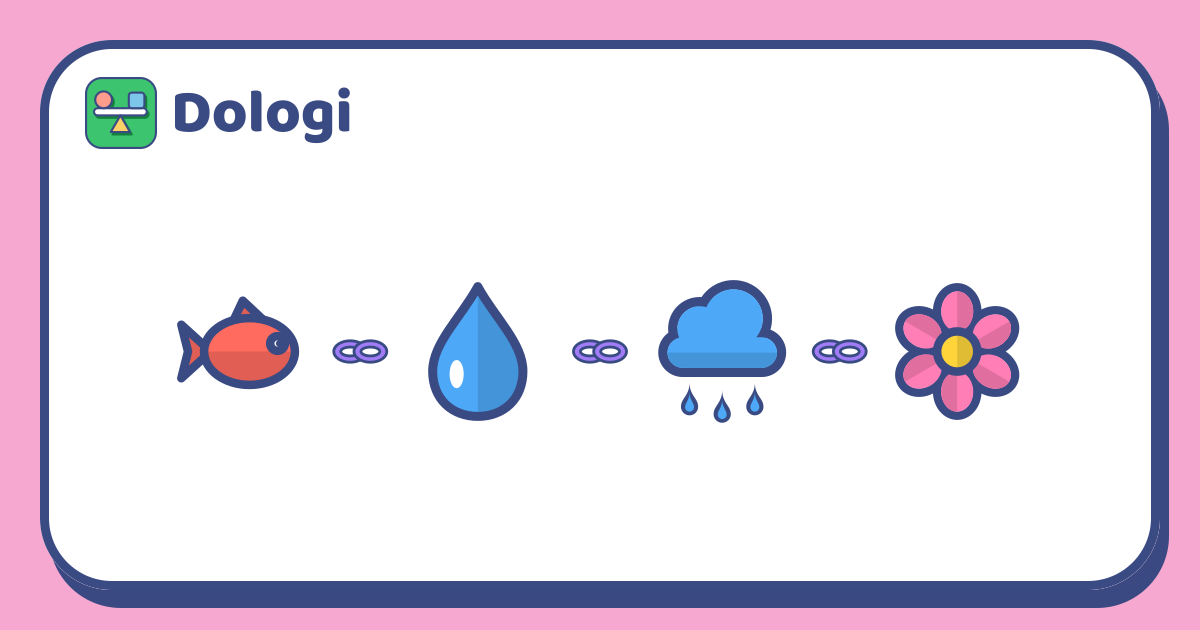
"Cat." "Fish!" "Water." "Rain!" "Umbrella..." The word association chain needs nothing but voices, which makes it perfect for car journeys, queues and walks. One person says a word, and the next person says the first word it makes them think of. Then the chain keeps going.
It sounds like a silly game, and it is fun, but it also gives children great practice in listening carefully, finding words and explaining how ideas connect. And because there's no single right answer, it's a relaxed way to think creatively together.
How to play
- Someone starts with any word: "Dog."
- The next player says a word it reminds them of: "Bone." "Walk." "Park." Any link counts.
- Keep going round, each person linking to the word just before theirs.
- If someone asks "Why?", the player explains the link: "Park, because we walk the dog in the park."
For children around 4 or 5, keep the chain short and help them find a word: "What does a dog like to eat?" Older children can go faster and keep the chain going for a long time.
Why explaining the link matters
The most valuable part of the game is the "Why?" Children often make surprising jumps: "Bread... duck!" At first it sounds random, but the explanation usually reveals clear thinking: "Because we take bread to feed the ducks."
- It shows how your child thinks, which is often more interesting than the words themselves.
- It builds reasoning: putting a connection into words is harder than just feeling it.
- It respects unusual ideas: a strange link with a good explanation is a creative link, not a wrong one.
Make it a rule that every link is allowed if it can be explained, and ask "Why?" with curiosity, not as a test.
Variations by age
| Variation | Good for | How it works |
|---|---|---|
| Rhyme chain | Ages 4–6 | Each word must rhyme with the last: cat, hat, bat... |
| Category chain | Ages 5–7 | Stay in one group: animals, foods, things in the kitchen |
| Same first sound | Ages 5–7 | Every word starts with a chosen sound, for example "b": ball, bread, boat... |
| Rewind | Ages 6+ | After a long chain, try to say it backwards: "How did we get from umbrella back to dog?" |
| From A to B | Ages 8+ | Choose a start and an end word, like "banana" to "moon", and reach the end in five links |
The rewind is a great memory and listening exercise. The "A to B" challenge turns the game into a little puzzle that needs planning.
What children practise
Without making it feel like a lesson, the game exercises:
- Careful listening: you have to hear the last word to link to it.
- Vocabulary: children search their memory for words and learn new ones from others.
- Flexible thinking: the same word can lead in many directions ("water" might bring "fish", "bath", "thirsty" or "blue").
- Turn-taking and patience: waiting while someone else thinks of a word.
Keep it light
- No wrong answers, only links that need explaining.
- Join in honestly with your own links, including funny ones.
- Stop while it's fun. Two minutes of play is plenty for young children.
- Write down a favourite chain sometimes, and read it back later. Children love seeing how far a chain travelled.
In Dologi, the Listening topic includes puzzles such as "Sound pairs", where children listen carefully and match cards that make the same sound: the same careful listening this game needs.
In short
- One person says a word; the next says a word it reminds them of; the chain keeps going.
- Asking "Why?" reveals how your child thinks, and every link that can be explained counts.
- Try rhyme chains for younger children, and rewinds or "A to B" challenges for older ones.
- The game builds listening, vocabulary and flexible thinking, with no materials at all.
Read more: Listening skills for children: sound games to play at home