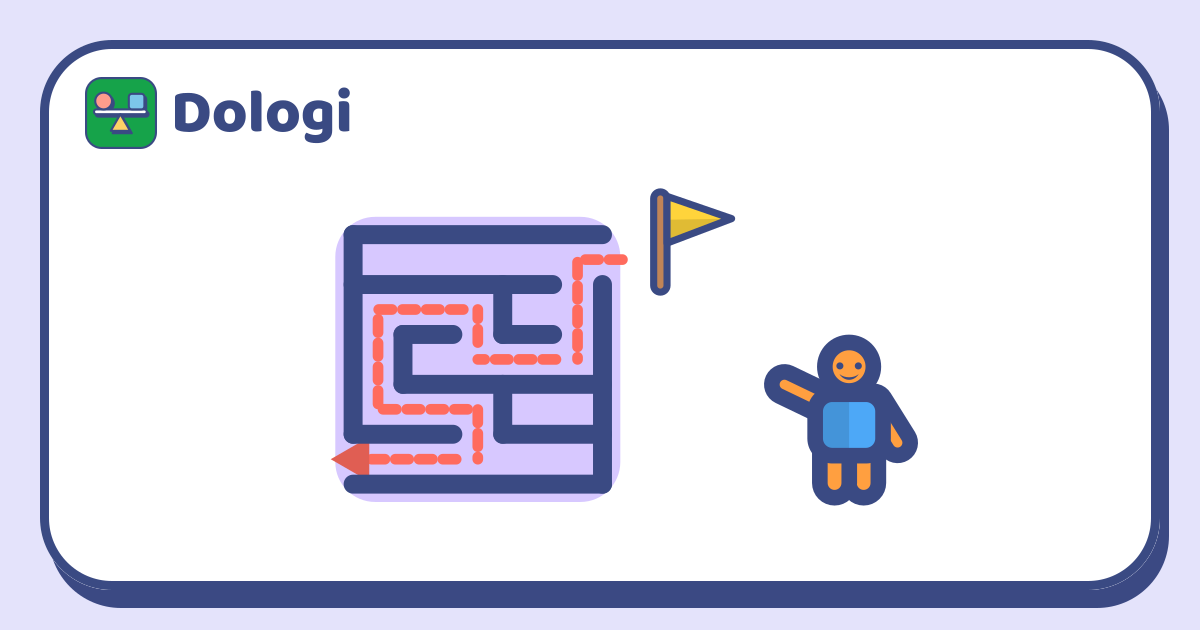
Have you ever solved a maze by starting at the exit? Many adults do it without thinking, because from the end there are often fewer dead ends. That trick has a name: working backwards. You start from where you want to be and ask, step by step, "What has to happen just before this?"
It's a powerful thinking strategy, and children can learn it with mazes, everyday routines and small number puzzles. This article explains the idea simply and suggests ways to practise it at home.
What is working backwards?
Most of the time we solve problems forwards: start at the beginning and keep going. Working backwards flips that around.
- Start with the goal. "We want to be at school at 8 o'clock." "We want to reach the exit."
- Ask what comes just before. "What has to happen right before we arrive?"
- Keep stepping back until you reach where you are now.
- Then go forwards along the path you found, to check it works.
The strategy helps most when the end is clear but the start has many possible directions.
Try it with a maze
Mazes are the easiest way to feel the difference.
- Find the exit first and put a finger or a small toy on it.
- Trace the path backwards towards the entrance. Look for the one way that leads out of the exit, then the next turn, and so on.
- Mark the path lightly as you go, with a pencil or a row of small objects.
- Compare: try another maze forwards, then backwards. "Which was easier? Why do you think that is?"
Some mazes are easier one way, some the other. Discovering that is part of the fun, and it teaches children that there's more than one way into a problem.
In Dologi, the Space topic includes maze puzzles. Before your child starts, you can look at the exit together and ask, "Which way would you go if you started from here?"
Planning backwards from a time
Working backwards is how many adults plan their mornings, often without saying it out loud. Doing it aloud with your child makes the thinking visible.
| Step (working backwards) | Time |
|---|---|
| Be at school | 8:00 |
| Leave home | 7:45 |
| Put shoes and coat on | 7:40 |
| Brush teeth | 7:35 |
| Finish breakfast | 7:30 |
| Wake up and get dressed | 7:10 |
You can draw this as a row of pictures with clock faces instead of numbers for younger children. Children who help build the plan are often more willing to follow it. The same trick works for getting ready for a party, a train or a bedtime story.
"Think backwards" number puzzles
Simple number riddles show the strategy clearly. Use objects such as buttons or grapes so your child can see what happens.
- "I had some apples. I got 2 more and now I have 5. How many did I have at the start?" Start from 5 and take back the 2.
- "I'm thinking of a number. I add 3 and get 7. What's my number?" Undo the "add 3" by taking 3 away.
- "A frog jumped forward 4 steps and landed on 6. Where did it start?" Draw a number line or step it out on the floor.
The key idea is undoing: if something was added, take it away; if a step was taken forwards, take it backwards. Many children around age 6 to 8 enjoy these riddles once they've seen one or two worked out with objects. Ages are only a rough guide; follow your child's pace.
Forwards or backwards?
Working backwards isn't always the best choice, and part of the skill is knowing when to use it.
- Go backwards when the goal is clear and the start has many options: mazes, time plans, "what was the starting number?"
- Go forwards when the start is clear and the goal isn't: following a recipe, building from instructions, exploring.
- Try both when you're stuck. Switching direction is a classic way to get unstuck.
Ask your child after a puzzle: "Did you start from the beginning or the end? Would the other way have been easier?"
In short
- Working backwards means starting at the goal and asking "what must happen just before?" until you reach the start.
- Mazes are a great way to try it: start at the exit and trace the path back.
- Plan mornings and outings backwards from the time you need to arrive.
- Use simple "undo" number riddles with objects, and talk about when forwards or backwards works better.
Read more: Planning before doing: teaching children to think three steps ahead