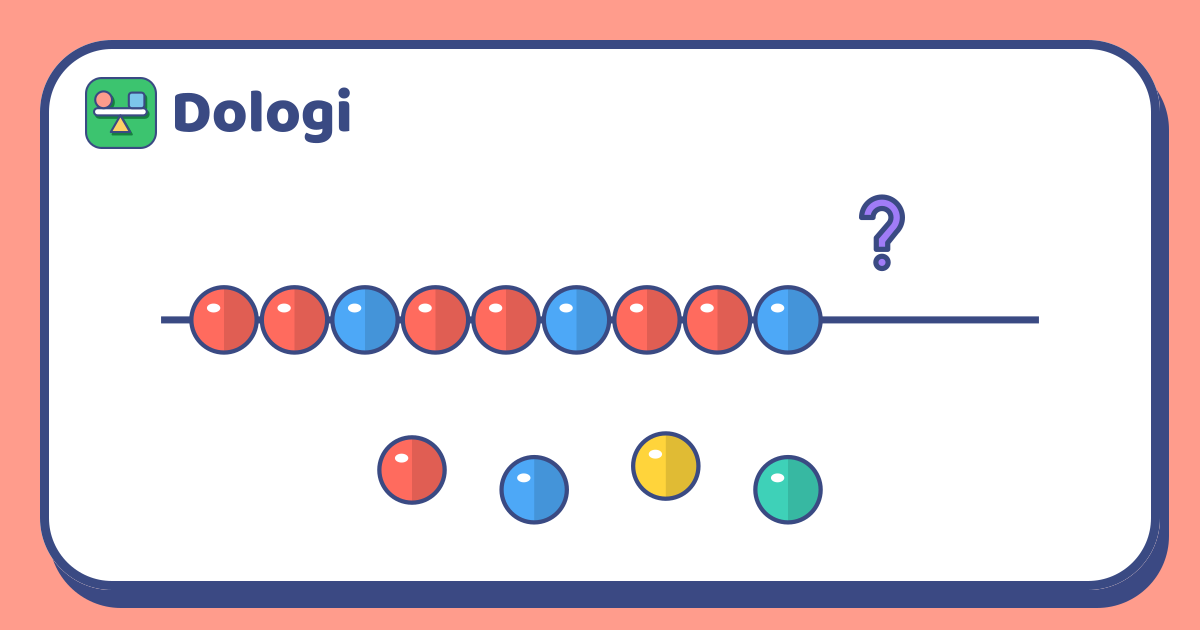
Threading beads keeps small fingers busy. Add one rule about the colours and it also becomes thinking: red, red, blue, red, red, blue. What comes next?
A pattern on a string is a pattern your child can hold. It can be felt, counted, taken apart and put right, which makes it a gentle first meeting with an idea that runs through all of maths.
What you need
- Beads in two or three colours, at least ten of each. Cut-up drinking straws, pasta tubes coloured with felt pens or buttons with large holes work too.
- Something to thread on. A shoelace has a stiff tip. A pipe cleaner is easiest for small hands. Wool needs a piece of tape wrapped round the end.
- A knot or a piece of tape at the far end, and a small bowl for each colour.
Beads are small. Choose large ones for young children, stay nearby, and keep the game for children who no longer put things in their mouths.
Reading the pattern aloud
Before your child threads anything, read your pattern together like a little chant: "red, red, blue, red, red, blue".
Then ask: "Where does it start again?" The piece that repeats is the heart of the pattern. Let your child put a finger between two repeats and say what one repeat is made of: "two reds and a blue". A child who can name that piece can continue any pattern.
Five levels
| Level | The repeating piece | Example |
|---|---|---|
| 1 | Two colours, one of each | red, blue, red, blue |
| 2 | Two colours, one of them doubled | red, red, blue, red, red, blue |
| 3 | Three colours | red, yellow, blue, red, yellow, blue |
| 4 | A longer piece | red, red, yellow, blue, red, red, yellow, blue |
| 5 | A growing pattern | one red, blue, two reds, blue, three reds, blue |
At every level, thread the repeating piece twice yourself, then hand the string over.
Four games with one string
Carry on. You start, your child continues to the end of the string.
Find the mistake. While your child looks away, thread a pattern with one wrong bead. They find it and explain: "This one should be blue, because after two reds comes a blue."
From card to string. Draw a pattern as a row of coloured dots on a card. Your child threads it. Then swap: they thread a pattern and draw the card for it.
What is under my hand? Cover part of the string with your hand. Which beads are hidden? Your child has to reason from both ends.
Then let your child invent a pattern for you to continue. Make a mistake on purpose now and then. Catching an adult's mistake is a great pleasure, and it shows that the rule has been understood.
The counting hidden in a pattern
- "Our string has four repeats of red, red, blue. How many reds? How many blues?" There are twice as many reds.
- "How many beads do we need for five repeats?"
- "What colour will the tenth bead be?" Predict first, then thread and check.
The last question is a hard one. Children who work it out without threading have stopped counting bead by bead and started using the rule.
| Rough age | What to try |
|---|---|
| 4–5 | Red, blue, red, blue with large beads on a pipe cleaner; chanting the pattern aloud |
| 6–7 | A doubled colour and three colours; find the mistake; from card to string |
| 8–9 | Longer repeating pieces; the hidden beads; predicting the tenth bead |
| 10 and up | Growing patterns; a bracelet that reads the same from both ends; working out how many beads of each colour a design needs |
Ages are only a rough guide, and every child is different.
In Dologi, "Repeating patterns" puzzles in the Patterns topic ask children to find the part that repeats and choose what comes next. The bead string is the same puzzle in the hands.
In short
- Beads and a string turn a colour rule into something a child can touch and fix.
- Reading the pattern aloud and naming the piece that repeats is the key step.
- Carrying on, finding a mistake, working from a card and guessing hidden beads are four games for one string.
- Counting the colours and predicting a later bead lead from patterns to numbers.
Read more: Patterns all around: why children love "what comes next?"