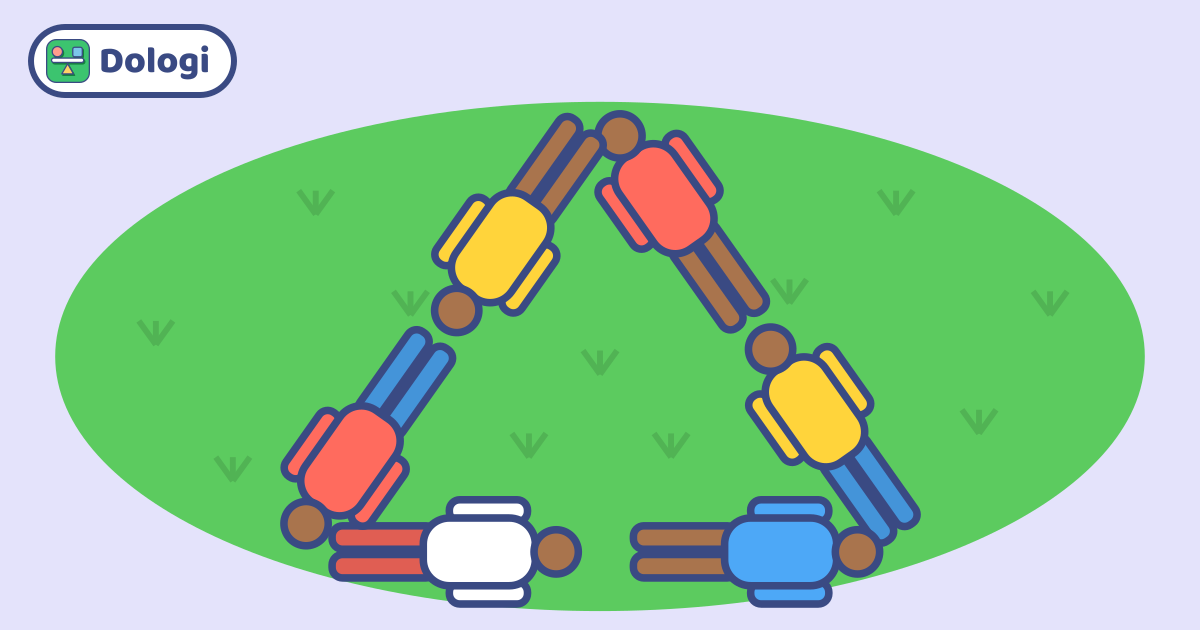
"Everybody make a triangle!" The kids look at each other, then one lies down on the grass, another lines up feet to head, and a third scrambles to close the corner. A grown-up standing somewhere high snaps a photo, and the whole group rushes over to look: does it actually look like a triangle?
This game suits groups of 3 to 10 kids aged roughly 5 to 12: cousins at a family gathering, friends at the park, a class outdoors. You need nothing but a few shape cards. Kids get moving, have to coordinate with each other, and learn a lot about shapes, angles, lengths and seeing things from above.
How to play
- Draw a few shape cards: a triangle, a square, an arrow, a star, a few letters.
- Pick a card and show the group.
- Everyone lies (or stands) to form that shape. Each child lying straight is one line.
- A grown-up standing somewhere high and stable takes a photo looking down.
- The group looks at the photo and compares it with the card: what matches, what's off? Fix it and take another photo.
The photo is the referee. From the ground, kids can hardly tell what their shape looks like. From above, they see right away that the triangle has a gap at one corner or the square is lopsided.
How many kids does each shape need?
Lying down, each child is one straight line. Count the lines in the shape and you know how many kids you need:
| Shape | Kids (one line each) |
|---|---|
| T, L, V | 2 |
| Triangle, arrow, A, H, N | 3 |
| Square, E, M, W | 4 |
| Five-pointed star (drawn in one continuous line) | 5 |
| House (a square with a pointed roof) | 6 |
| Circle | 5 or more, standing and holding hands |
With a bigger group, put two kids end to end on each line for a larger shape. A great opening question: "How many kids does a star need?" Lots of children guess ten, counting the ten edges around the outside. Draw a star in one continuous line on paper, count the strokes, then try it lying down: five kids are enough.
Lying or standing?
- Lying down works on grass, rugs or a clean floor: each child is a line segment, and the shape is clearest in a photo from above.
- Standing works on concrete or when kids are in good clothes: each child is a point at a corner, holding hands or stretching a scarf between them to make the sides.
- Indoors: use string, scarves or masking tape on the floor to "draw" the lines, with kids standing at the corners.
Staying safe
- Choose soft, clean ground that isn't hot: grass, rugs, mats. Never lie on asphalt or anywhere cars go.
- Keep heads from bunching up, so nobody bumps heads getting up.
- Only grown-ups go somewhere high for the photo: a step, a really sturdy chair, a balcony with a railing. Kids don't climb.
- If other people's children are in the photo, ask their parents before sharing it anywhere.
The no-talking version (ages 8 to 12)
Once the group has the hang of it, add one rule: nobody may speak. Only hand signals, eye contact and nods. Give them two minutes. Kids have to work out how to split the job: who lies down first, who fixes the corner, who becomes the "director."
After each round, give the group a few minutes to talk: "What did people do so everyone understood?" "What would we do differently next time?" Switch directors each round so everyone gets a turn.
What kids learn about space
- Looking down is different from looking across: standing inside the shape, you can't see it. That's why the photo matters, and it's a first lesson in maps and floor plans. Teaching left and right, up and down, in front and behind has more direction games.
- Length: three kids of the same height make an even triangle; if one is much taller, the triangle is lopsided. Ask: "What if the tallest kid is the bottom side?"
- Angles: a square needs four right angles. Use the edge of a rug or a floor tile to check the corners.
- Turning shapes: an upside-down triangle is still a triangle. Turn the card a quarter turn and rebuild, and see if the group notices.
Variations
- Guess the shape: team A builds a secret shape, team B stands on the steps and guesses.
- Fewest kids: "What's the smallest number of kids that can make an H?" Take kids away one at a time until the shape breaks.
- Spell a word: split a big group into small teams, one letter each, and spell a short word made only of straight-line letters, like "HAT."
- From a description: no card; a grown-up describes it: "Two kids lie side by side, and one lies across the middle joining them." The kids figure out it's an H and build it.
- Beat the clock: time each round from drawing the card to getting a correct photo, and try to be faster than last time.
The Space topic in Dologi has a puzzle called Seen from each side: "Which picture shows the stack seen from above?" Making shapes with your bodies is the outdoor version of that question: only from above can you see clearly the shape the group just made.
In short
- Draw a shape card, the group lies or stands to form it, and a grown-up checks with a photo from above.
- Lying down, each child is one line: a triangle takes 3 kids, a square 4, a five-pointed star 5.
- Pick soft ground, keep the high spot for grown-ups only, and ask before sharing photos of other people's children.
- Older kids play the no-talking version; everyone learns about seeing from above, length, angles and turning shapes.
Read more: Teaching left and right, Reading simple maps with kids