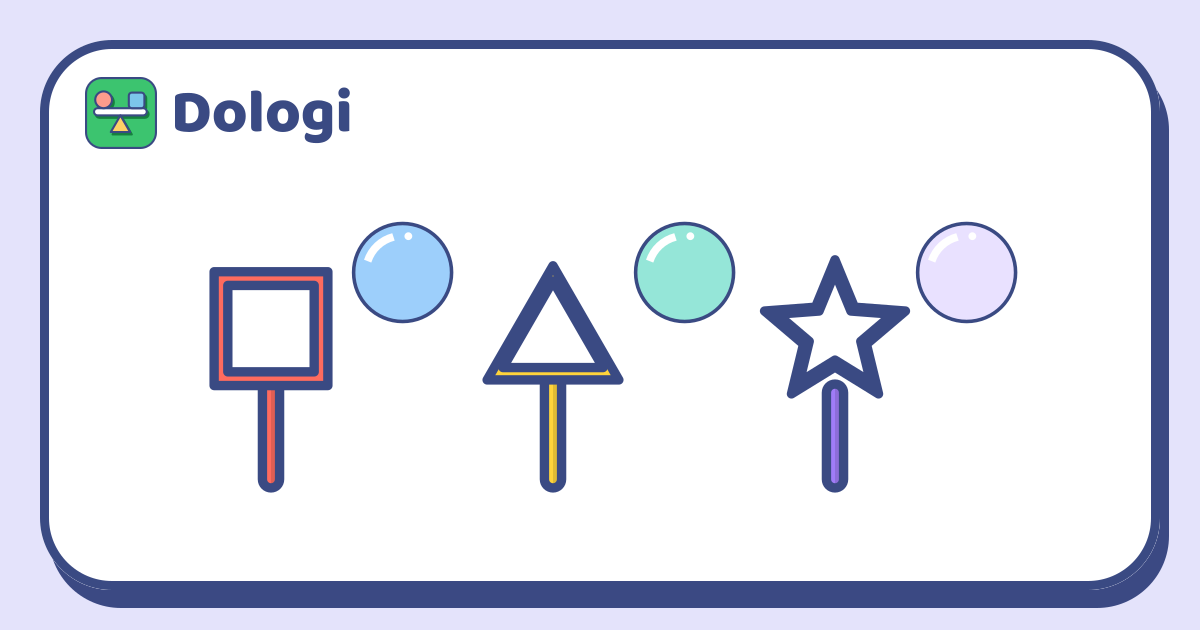
Ask a child "If the wand is square, what shape will the bubble be?" and many will answer "Square!" straight away. It sounds perfectly sensible. Then they blow, and the bubble that floats away is round. That small surprise is the start of a real experiment.
This activity suits children aged roughly 4 to 10. Younger children bend wands, guess and blow. Older children can build a cube frame from straws and look at the soap films that form inside it. Below you'll find the mix, the guessing game and an explanation that is simple and still true.
What you need
- Bubble solution: washing-up liquid and water. Start with about one part washing-up liquid to six parts water, stir gently so it doesn't froth, and if you can, let it stand for a while before using it. A spoonful of sugar or a little glycerine can help bubbles last longer. If the bubbles pop quickly, add a little more liquid.
- A wide, shallow tray or bowl, big enough to dip the whole wand.
- For the wands: plastic-coated garden wire or pipe cleaners.
- For the cube frame (older children): 12 straws of the same length and pipe cleaners or string to join the corners.
Bending and cutting wire is a grown-up's job. Snip the wire, then fold the cut ends over so nothing sharp sticks out, and leave a long handle on every wand. Your child decides the shapes and helps bend the loops.
A few safety points:
- Keep the solution away from eyes, and teach your child to blow away from other people's faces.
- The solution is for blowing, not drinking. Young children who blow through straws sometimes suck by mistake, so a wand is the easier choice for them.
- Soapy floors get very slippery. Play outside, or lay a towel under the tray.
- Stay close when small children are near a tray of water.
Guess first, then blow
Make four wands: a circle, a square, a triangle and a star. Before blowing, hold up each wand and ask: "What shape do you think the bubble from this one will be?" Write the guess down or let your child draw it.
Then blow, slowly and steadily, one wand at a time. Watch closely, because the shape changes as the bubble forms.
| Wand | My guess | While blowing | Once it flew |
|---|---|---|---|
| Circle | Round | ||
| Square | Square | ||
| Triangle | Triangle | ||
| Star | Star |
The table is only a starting point. Your child fills in the last two columns with words or quick drawings. Many children notice that while the bubble is still attached, it bulges out of the wand in a slightly wobbly shape. Once it breaks free, it wobbles for a moment and then becomes round.
Don't rush to give the answer. Ask: "Which result surprised you most?" A surprise is a good sign in science: there's something new to find out.
Why do bubbles turn round?
Keep the explanation simple:
- A bubble is a very thin skin of soapy water wrapped around some air.
- That skin keeps pulling itself tight, a bit like a stretched balloon trying to get smaller.
- Of all the shapes that can hold the same amount of air, a ball needs the least skin. So once the bubble floats free, the skin pulls itself into a ball.
The wand only shapes the film while the film is still touching it. Your child can see this: dip the square wand and hold it still without blowing. The film across the square is flat and square, because it is stretched between the four sides.
For a younger child, wrap a stretchy hair tie around a handful of pencils: it pulls in until it can't get any smaller. A soap film does the same in every direction.
A cube frame for older children
For children around 7 and up, this part often gets the biggest "wow".
- Join 12 straws into a cube frame, using pipe cleaners or string at the eight corners. Leave one corner with a long handle.
- Dip the whole frame into the tray, then lift it out slowly.
- Look inside.
Instead of six films on the six faces, your child will usually find flat films stretching inwards from the edges and meeting in the middle. Often there is a small, flat, almost square film right at the centre. Look closely at where the films join: they tend to meet three at a time along a line.
Ask: "Why didn't the soap just cover the outside of the box?" The answer is the same idea as before. The films are pulling themselves as small as they can, and this arrangement inside the frame uses less film than covering all six faces.
If the films keep popping, add a little more washing-up liquid and lift more slowly. Then try a triangular pyramid of six straws, guessing the films inside before dipping.
A few more tests
Each question below is a new small experiment. Change only one thing at a time.
- Big loop or small loop: two round wands of different sizes. Which makes bigger bubbles? Which bubbles last longer?
- Blowing fast or slowly: with the same wand, does a quick puff or a slow, steady breath work better?
- Two bubbles touching: catch two bubbles on a wet plate so they press against each other. What does the wall between them look like?
Picturing the films inside a frame is good practice for spatial thinking. In Dologi, "Fold a cube" puzzles in the Space topic ask children to choose which flat shape folds into a cube, another way of picturing a cube's faces.
In short
- Bend wands into a circle, square, triangle and star, ask your child to guess each bubble's shape, then blow and record what happens.
- While still attached, the film follows the wand. Once a bubble floats free, it turns round because the soapy skin pulls itself as small as it can, and a ball needs the least skin.
- Older children can dip a straw cube frame and find flat films meeting in the middle.
- Grown-ups cut the wire; keep soap away from eyes and floors dry.