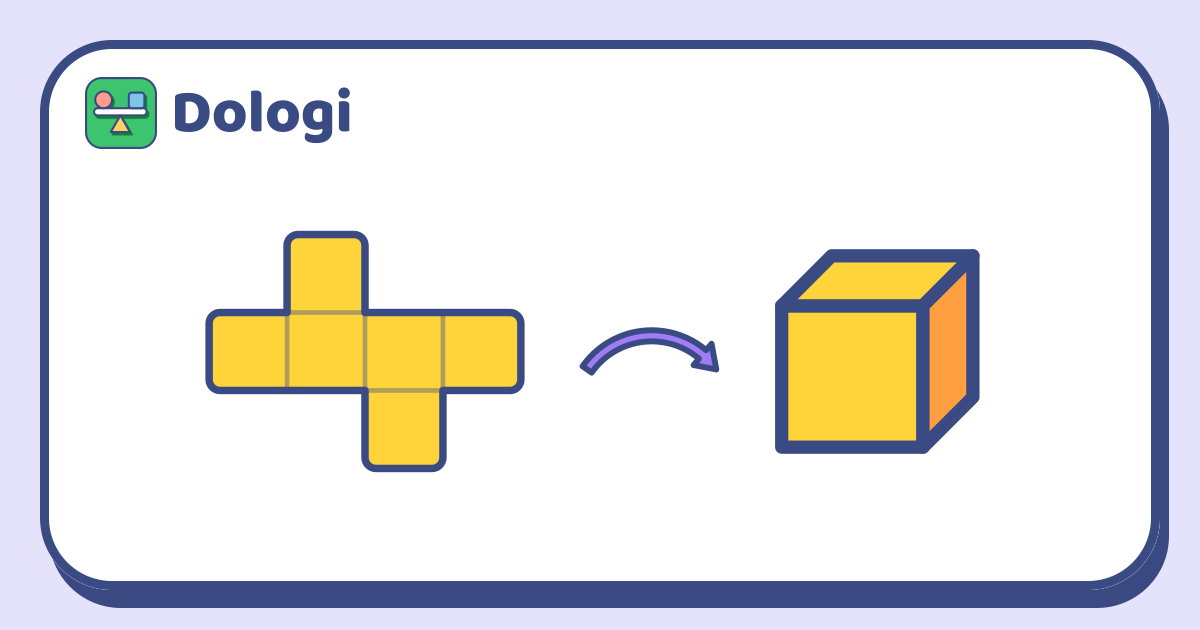
Before the next cereal box goes into the recycling, open it carefully along the glued edges and press it flat. The surprise is always the same: the whole box is one single flat shape. That flat shape is called a net.
Going back and forth in your head between a flat shape and a solid one is a fine workout for spatial thinking. And it costs nothing: all you need is scrap cardboard, scissors and sticky tape.
Open a box
- Choose a small box: tea, toothpaste, cereal.
- Predict first. "What will it look like when it's flat?" Let your child draw a guess.
- Open it along the glued seams and flatten it. Compare it with the drawing.
- Count the faces. There are six large rectangles (the small glue tabs don't count): bottom, top, front, back and two sides. Draw a different little picture on each one.
- Fold it back up. Which pictures end up on opposite sides? Look at the flat shape again: those two faces never touch.
Build a cube from six squares
Cut six equal squares from card, about as wide as your child's palm. Lay them out like the shape on the cover: four in a row, one above the second square and one below the third. Tape the touching edges, then fold.
The four squares in the row wrap around to make the walls. The two others close the top and the bottom. Your child has just built a cube from a flat shape.
Now the real game begins. Peel off one square, tape it somewhere else, and ask: "Will it still fold into a cube?" Guess first, then test.
Which shapes fold into a cube?
Six squares can be joined in many ways, and only some of them work.
| Shape made of six squares | Does it fold into a cube? | Why |
|---|---|---|
| Four in a row, one above and one below | Yes | The row makes the walls; the two others make the lid and the base |
| Four in a row, both extra squares on the same side | No | Both extras land on the same opening; the other side stays open |
| Six in a row | No | The row wraps round and covers itself; there is no lid and no base |
| A rectangle, two by three | No | Four squares meet at one point and can't be folded apart |
| A staircase: three pairs, each shifted along by one | Yes | A surprising one, well worth testing |
Two quick checks help older children: a net of a cube never has more than four squares in a straight line, and it never contains four squares that form a larger square.
There are exactly 11 different nets of a cube, if shapes that are only turned or flipped count as the same. Finding several of them is a lovely long project. There is no need to find them all.
A guessing game
- One player draws a shape of six joined squares on squared paper.
- The other predicts: cube or no cube? If it's a cube, which square will be the lid?
- Cut it out and fold it to check.
A harder version: put a dot on one square and ask which square will end up opposite the dot. A helpful discovery: in a straight row, the opposite face is always two squares along, never the neighbour.
What to try at each age
| Rough age | What to try |
|---|---|
| 4–5 | Open real boxes and fold them back up; count the faces; give each face its own colour |
| 6–7 | Tape six squares into the shape on the cover and fold it; move one square and test |
| 8–9 | Predict before folding; find several different nets; work out which faces are opposite |
| 10 and up | Hunt for all 11 nets; try nets of a long box or a pyramid |
Ages are only a rough guide, and every child is different. If predicting is too hard, simply fold more: hands teach the eyes.
In Dologi, "Fold a cube" puzzles in the Space topic ask children to choose which flat shape folds into a cube. At harder levels the squares carry little marks, and the question is which mark ends up opposite the star.
In short
- A net is the flat shape you get when you open out a box.
- Start by opening real boxes, then build a cube from six taped squares.
- Predict first, then fold: not every shape of six squares makes a cube.
- For older children: look for opposite faces and collect different nets.
Read more: Seen from above, seen from the side: top and side views for children