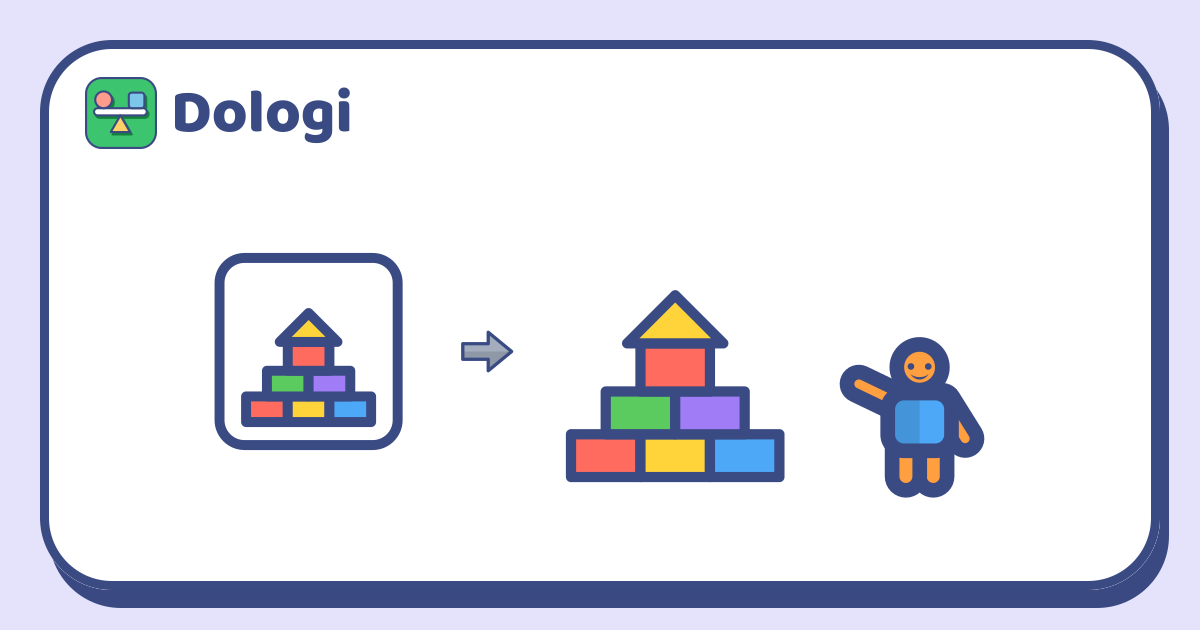
You build a small structure with blocks: three at the bottom, two on top, a roof. Your child looks carefully and builds the same thing next to it. It sounds simple, but copying a model is a rich thinking activity that children can enjoy from toddlerhood right up to their school years.
All you need is a set of blocks, ideally two of each colour and shape, so you can build a model and your child can build a copy.
Why copying a model is good practice
- Looking carefully. Which colour is on the left? Is that block lying down or standing up? Children learn to notice details.
- Thinking in space. Above, below, next to, on top of, behind: copying makes these words concrete.
- Checking their own work. Comparing the copy with the model, piece by piece, is a habit that helps everywhere.
- Planning. "I need to put the long block down first, or the others won't fit on top."
Step 1: copy a real model
Start with a model made of real blocks, right next to your child:
- Very small at first. Two or three blocks in a row, or one block on top of another.
- Same blocks available. Give your child exactly the blocks they need, then later a few extra ones they won't use.
- Compare together. "Let's check: bottom left, red. Yours? Red. Next one?"
- Grow slowly. Add height, then colours, then blocks that lie on their side or stick out.
Step 2: copy from a drawing
A drawing is harder than a real model: it's flat, and some blocks are hidden. Make simple drawings yourself, seen from the front, with each block coloured in. Take a photo of the model if you prefer, but drawings work well and encourage children to draw their own.
Later, show the model only for a short time, then cover it. Your child builds from memory, then you uncover it and compare.
Step 3: build from words
Sit back to back. One person builds and describes; the other listens and builds without looking:
- "Put a long blue block lying down."
- "Put a yellow cube on the right end of the blue block."
- "Stand a red block up on the left end."
At the end, turn around and compare. Differences are not mistakes but clues: which words were unclear? This is wonderful practice for precise language and careful listening.
Swap roles
Let your child make the model and you build the copy. Make a few deliberate mistakes and see if they notice ("Hmm, is my green block in the right place?"). Children love being the expert, and checking someone else's copy is excellent practice in itself.
Ideas by age
Ages are rough guides; follow your child.
- Around 4–5: copy real models of two to five blocks right next to them, mostly colour and position.
- Around 6–7: larger models, copying from simple front-view drawings, building from memory.
- Around 8 and up: back-to-back building with words, models with hidden blocks, drawing their own plans for others to build.
In Dologi, the Space topic has "Block builder" puzzles: children choose all the blocks that together make a given shape, with nothing left over. It's a calm extra to the building you do together.
In short
- Copying a block model trains careful looking, spatial words, checking and planning.
- Start with tiny real models right next to your child, then grow them slowly.
- Move on to drawings, memory and back-to-back building with words.
- Swap roles so your child builds the models and checks your copies.
Read more: Seen from above, seen from the side: top and side views for children