It might be a puppy, a kitten, a hamster, a goldfish or a turtle. Your child has asked for weeks, and the big promise comes: "I'll take care of it myself. Every day. I promise." Most parents know how this goes: by week four, you're the one filling the food bowl before work.
That doesn't mean the answer has to be no. A pet, or even a single houseplant, can teach responsibility in a very concrete, daily way, as long as the family plans ahead, splits the jobs by age and keeps a simple chart. Here's how to do each of those, and what to do on the days your child forgets.
Talk it through before you say yes
Sit down as a family and go through the real questions together:
- Who feeds the pet, and when?
- Who cleans the cage, the tank or the litter box?
- Who takes over when you go away for a weekend or a week?
- Does the pet fit your home and your schedule?
- Does anyone in the family have allergies? If you're not sure, ask your doctor rather than guessing.
- What will food, supplies and vet visits cost, and how long does this animal usually live?
Be honest with your child: a pet needs care every day, even when they're tired or busy playing. And a grown-up is still the one who makes sure the pet is fed and healthy.
You can do a trial run first: a plant for a month, a couple of small fish, or a few days helping a neighbor with their dog or cat. Ask the pet store, a longtime owner or a vet how that species should be cared for.
Pet jobs by age
Every child is different, so treat these ages as a rough guide. With younger kids, a grown-up stays close for every job.
| Age (roughly) | Jobs your child can do |
|---|---|
| 4–5 | Pour food you've measured out into the bowl, fill the water bowl with your help, water a plant with a small watering can, remind you when it's feeding time |
| 6–8 | Feed the right amount on their own, change the drinking water, brush the pet, help clean the bed or cage, check off the chart |
| 9–12 | Handle most of the daily care, walk the dog with an adult or by your family's rules, help clean the tank or cage, keep track of vet appointments you've booked, read up on the animal |
For more ideas, see chores for children by age.
A picture chart, the same every day
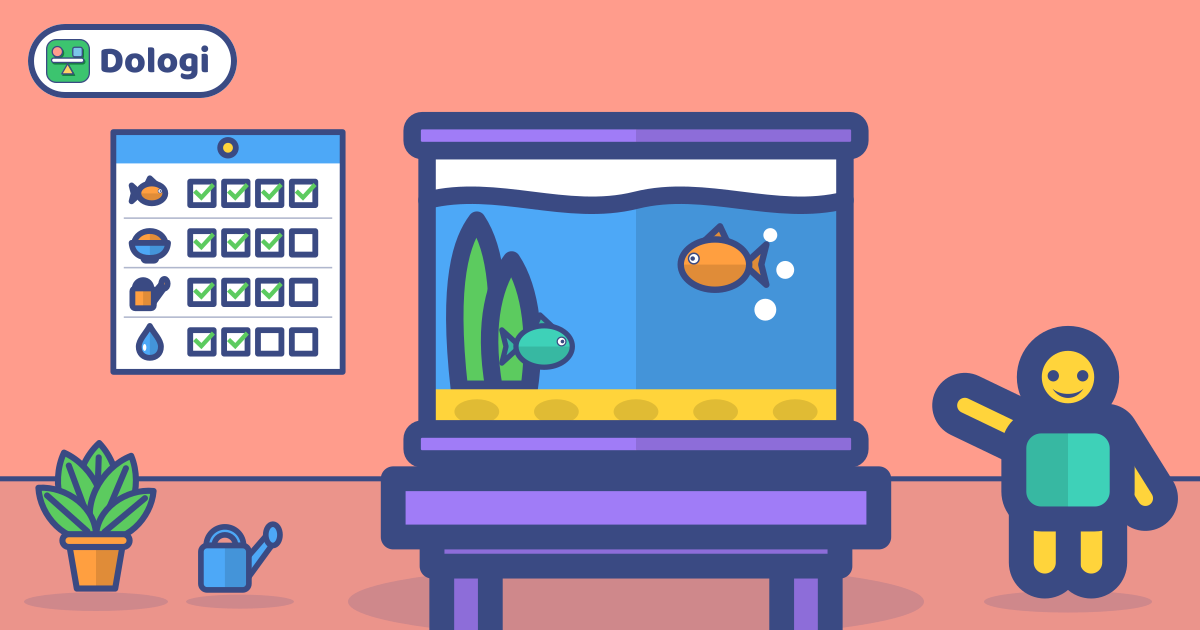
Make a chart for the fridge or the wall near the pet. Each row is a job, drawn as a small picture: a food bowl, a water drop, a brush, a watering can. Each column is a day of the week. When your child finishes a job, they check the box themselves. Children who can't read yet can use it just as well.
Tie each job to something that already happens every day: "Feed the fish right after breakfast," or "Water the plant when you get home from school." A job done at the same moment each day becomes a habit faster.
With more than one child, rotate the jobs weekly and draw the rotation on the chart.
When your child forgets or loses interest
Your child will almost certainly forget at some point. Try not to threaten to give the pet away, and don't quietly do the job yourself and say nothing. Instead:
- Remind with a question. "Are there any empty boxes on today's chart?"
- Start over together. Do the job side by side for a few days, then hand it back.
- Make it smaller. Cut the list to one or two jobs your child can keep up with.
- Point out how the pet responds. The fish swim up to eat, the cat rubs against their legs.
- Praise the effort, specifically. "You changed the water every day this week. The bowl has been clean the whole time." A big reward isn't needed.
One firm line: a pet should never go hungry to "teach a lesson." Whatever your child misses, a grown-up covers.
Start with a plant
Not ready for an animal? Give your child their own plant or a few bean seeds in a cup. They water it, turn it toward the sun and record its growth each week with a drawing or a mark on a craft stick.
Plants react more slowly than animals, so they teach patience. Forget to water and the leaves droop; water again and they perk back up. See growing a bean for the steps.
What a pet can teach
Daily care gives your child practice in:
- Thinking about another living thing's needs.
- Doing a job even when they don't feel like it.
- Seeing consequences, like a drooping plant.
- Telling a grown-up when something seems wrong. If the pet stops eating or seems tired, your child tells you, and you take it to the vet.
Daily pet care is a repeating pattern: food in the morning, fresh water in the afternoon, then morning again. In Dologi's Patterns topic, the Repeating patterns puzzle shows a group of shapes that repeats, and your child figures out what comes next. In the Logic topic, What happened first? asks them to put the steps of a flower growing in a pot in the right order.
In short
- Before you get a pet, agree as a family on who does what, trips, costs and allergies.
- Split jobs by age, with a grown-up nearby for younger kids and responsible for the pet in the end.
- Use a picture chart and tie each job to a fixed moment in the day.
- When your child forgets, remind with a question and praise effort; not ready for an animal? Start with a plant.
Read more: Chores for children by age, Growing a bean