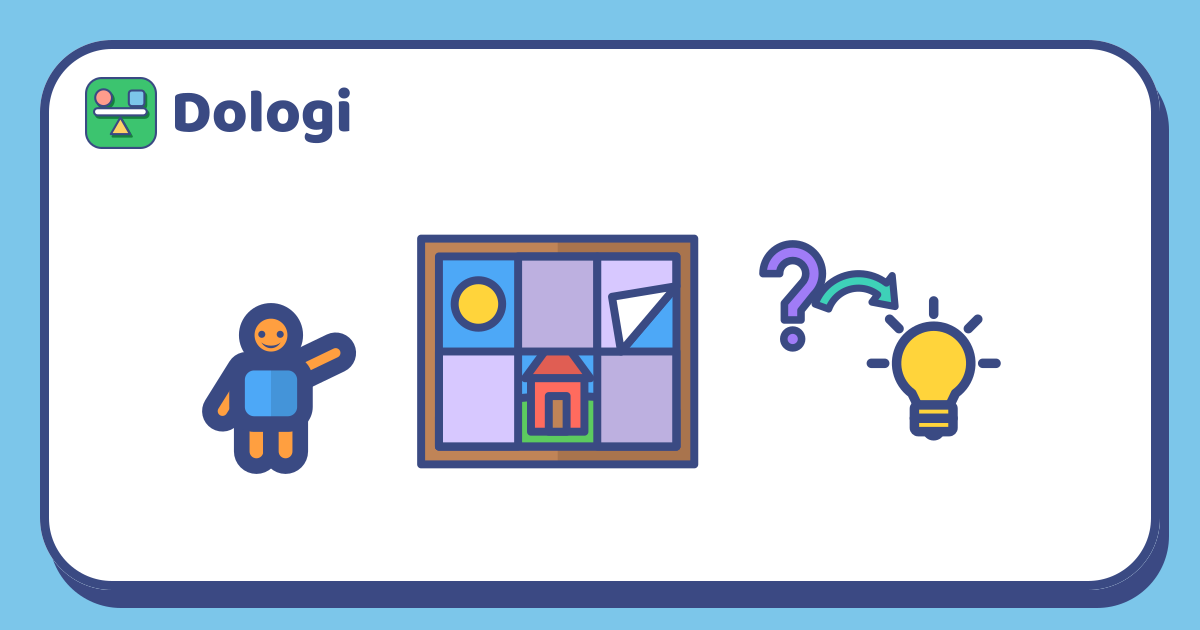
"It's a dog! I said dog first!" Many children hold on to their first guess even when new clues clearly point somewhere else. For them, changing your mind can feel like losing.
Yet the ability to say "I thought it was this, but then I noticed that, so I've changed my mind" sits at the heart of good reasoning: an idea is a guess to be tested, and what we see decides. This article looks at why children cling to first answers, how to model changing your mind out loud, a simple guessing game for home, what to praise, and how to tell changing your mind apart from giving in.
Why children hold on to their first guess
Every child is different, but a few reasons come up often:
- Being right feels good. Being wrong can feel like being told off, especially for a child who is often praised for quick, correct answers.
- Two ideas at once is hard. To change a guess, a child has to keep the old idea and the new clue in mind and compare them. This ability grows gradually through the primary years, at each child's own pace.
- Losing face. Admitting "I was wrong" in front of a sibling or a friend can feel embarrassing.
- They rarely see it done. If adults quietly switch plans without saying why, children never hear what changing your mind sounds like.
None of this is simple stubbornness. Changing your mind well is a skill, and skills can be practiced.
Change your mind out loud
Children learn a lot from what they see us do. Everyday life gives plenty of chances to think aloud:
- "I thought it would rain, so I packed umbrellas. But the clouds have gone, so I think we can leave them at home."
- "I was sure the keys were in my bag. They're not, and I remember putting something down by the door. So now I think they're on the shelf."
- "I said this road was quicker. But there are roadworks ahead, so I've changed my mind: let's go the other way."
The pattern has three parts: what I thought, what I noticed, what I think now. Say it calmly and without apologizing too much. The message is that changing your mind for a reason is normal and sensible.
| Instead of | Try |
|---|---|
| "Silly me, wrong again!" | "I thought..., but I saw..., so now I think..." |
| Changing plans without a word | Saying what made you change |
| "Fine, have it your way" to end an argument | "That's a good point. You've made me think again." |
A game: the covered picture
All you need is a picture (from a magazine, a postcard, or a drawing your child made earlier) and six to nine pieces of paper or sticky notes.
- Cover the whole picture with the pieces of paper. Your child should not see it beforehand.
- Lift one piece. Ask: "What do you think it is? What makes you think so?"
- Lift another piece. Ask: "Does this change your guess, or does it fit?"
- Keep going one piece at a time. Your child can keep their guess or change it. Both are fine, as long as they give a reason.
- At the end, look back together: "When did you change your mind? Which piece made you?"
To adjust it:
- Around 6 to 7: use simple pictures and fewer, larger pieces.
- Around 8 to 12: use more pieces and pictures with a surprise, where the first corner suggests one thing and the rest shows another. Let your child cover a picture for you, and think aloud as you guess, changing your mind when a new piece calls for it.
- Other versions: an object in a bag that your child feels before guessing, then gets clues about one at a time; or "who am I?" with clues read out one by one.
If you keep score, give points for good reasons, not for guessing first.
Praise the reason, not just the right answer
What you praise shows your child what matters. Try:
- "You changed your guess as soon as you saw the roof. Good noticing."
- "You kept your idea because the new piece fitted it. That's good thinking too."
- "You told me what made you change. That helps me follow your thinking."
Praising only speed ("You got it straight away, clever!") can teach that the first guess has to be right. And when your child ends up wrong but reasoned well, say so: "It wasn't a boat, but your reason made sense with what we could see."
Changing your mind is not giving in
Older children can learn an important difference: we change our minds because of new evidence, not because someone is louder, insists more or because everyone else says so.
- Ask: "What new thing did you find out?" If nothing new has appeared, there may be no reason to change.
- Separate clues from pressure: "Your friend says the answer is twelve. Did they show you why?"
- Make room for "I'm not sure yet" and "I need to check". Waiting for more clues is a reasonable choice.
In Dologi, the Guess the rule puzzles in the Logic topic show some things marked with a check and some marked with an X; the hint asks your child to test their idea on the X things and drop it if any of them fits. It is a small, regular chance to let go of an idea for a good reason.
In short
- Changing your mind for a reason is a thinking skill; a first guess is only a starting point.
- Model it out loud: "I thought..., I noticed..., so now I think...".
- Play the covered picture game: reveal one piece at a time and ask for a reason at each step.
- Praise noticing and good reasons, not just quick right answers, and change your mind because of evidence, not pressure.
Read more: Critical thinking for children: when your child asks "why?" all day long, When your child gives up on hard problems