Your child has the moves down: rooks go straight, bishops go diagonally, knights jump in an L. Then the real game starts. Move one is an edge pawn. Move two, the queen charges out to grab something. Ten moves later, the knights and bishops are still sitting at home, and your child loses without quite knowing why.
The start of a chess game, the opening, fills whole shelves of books, with hundreds of named move sequences. Beginners don't need any of that. Three principles are enough for a tidy start, and, more importantly, your child will understand why each move makes sense.
Why not just memorize an opening?
Memorizing a sequence of moves is like memorizing directions: as soon as the other player does something different, you're lost. Understanding principles is more like reading a map. Whatever the other side plays, your child can still find a sensible move.
The three principles are also easy to check. After each move, your child can ask: does this help me control the center, bring out a piece, or keep my king safe?
Principle 1: Control the center
The center is the four squares in the middle of the board. A piece near the middle can reach in every direction; a piece stuck in a corner can't do much. Here's an easy way to show it: put a knight in a corner and count the squares it can jump to (just 2). Move it to one of the middle squares and count again (8).
That's why, in the first move or two, the pawn in front of the king or the queen usually moves up one or two squares. It takes a center square and opens a path for the bishop and queen to come out later.
Principle 2: Develop your pieces, one move each
At the start, the knights and bishops are stuck on the back row, doing nothing. "Developing" means bringing them out to squares that point toward the middle. A few things to remember:
- Knights and bishops first, rooks and queen later. Rooks need open lines to be useful, and the queen is so valuable that bringing her out early just gets her chased.
- Knights toward the center, not the edge. A knight on the edge can reach only half as many squares as one in the middle.
- One move per piece in the first few moves, unless there's a clear reason (it's being attacked, or it can capture something). Moving one piece three times means the others are still waiting.
Principle 3: Get your king to safety
A king in the middle of the back row becomes a target once the board opens up. The way to tuck it away is castling: the king moves two squares to one side and the rook hops over to stand next to it, all in one move. To castle on the king's side, the squares between king and rook must be empty, which means the knight and bishop on that side have to come out first. So the three principles fit together.
Once the king has castled, the three pawns in front of it act as a wall. Encourage your child to leave them alone unless there's a good reason.
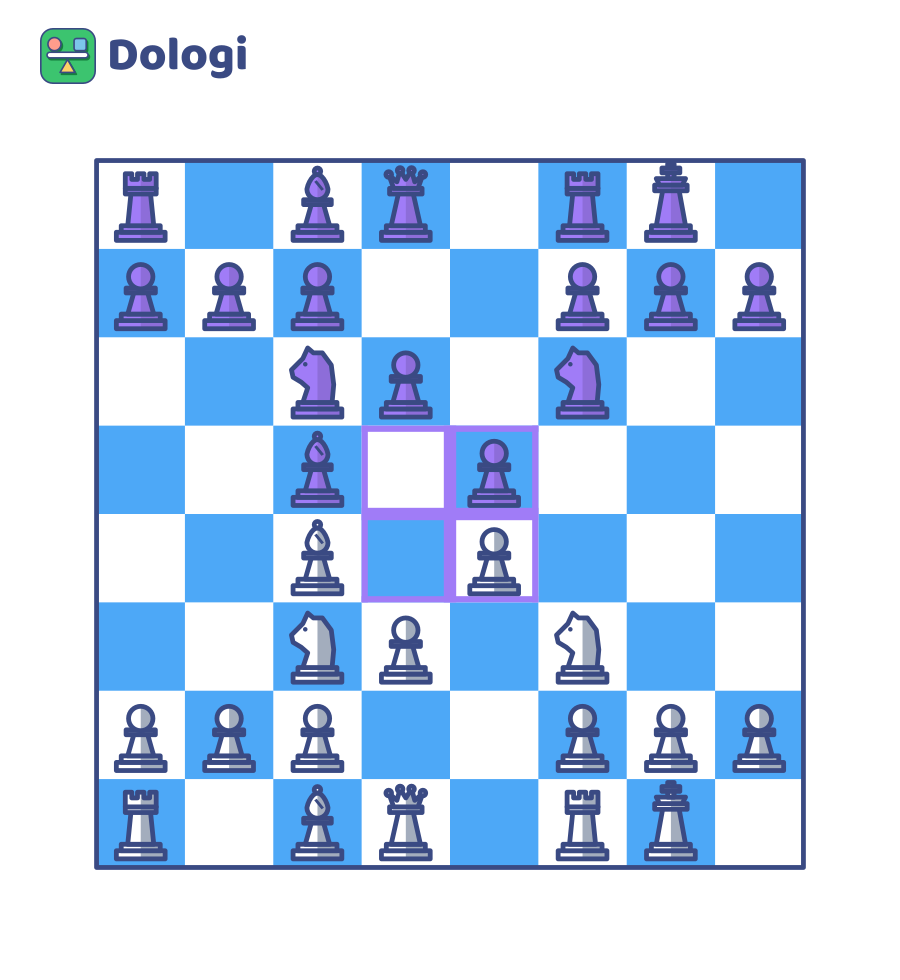
This is what a start can look like after six moves each. No need to memorize the moves. Just notice that both sides have a pawn in the center, knights and bishops out, and the king tucked in the corner.
Three common beginner mistakes
| Mistake | Why it doesn't help | What to say |
|---|---|---|
| Bringing the queen out too early | The other side chases her while developing; each chase brings out another of their pieces, and the queen keeps running | "Let the knights and bishops go first." |
| Moving the same piece again and again | One piece makes three moves while the other side brings out three pieces | "Which piece hasn't moved yet?" |
| Only moving pawns | The big pieces stay home, especially after edge pawn moves; pushing the pawns in front of the king leaves it open | "How does this pawn help your other pieces?" |
When your child makes one of these mistakes, try not to stop the game for a lesson. Afterward, pick one moment and ask about it gently.
A game to practice: the first ten moves
This works best once your child knows how all the pieces move, often around age 7, though every child is different. With a younger child, play with just one principle, such as "bring out a piece."
- Set up the board as usual and play slowly, only the first ten moves.
- Before each move, the player says out loud what the move is for: "center," "new piece," or "safe king." If it's none of those, give another reason ("to block the knight," "to take the pawn").
- You explain your moves too, and now and then make a strange move on purpose so your child can spot it.
- After ten moves, count together: how many pieces are out? Has the king castled? No points, no scores. Just look at the board, then keep playing or set it up again.
After a few rounds, your child may say "this one isn't out yet" before you get the chance. That's when the principles start to become a habit.
Guidelines, not rules
These three ideas are advice, not rules of chess. If the other player leaves a piece unprotected and your child can take it, go for it. If one of your child's pieces is under attack, saving it comes first. A good way to put it: "First check whether anything is in danger, then think about the three principles."
In the Chess room in Dologi's Creative corner, Learn chess has a lesson called How to start a game: your child watches a short animation about these three ideas, tries moves on the board, then practices with a few small exercises. When playing against the chess buddies, the Magnifier button shades the squares the other side is guarding, so if your child is about to put the queen or a knight on a square a pawn is aiming at, they can see it before they move.
In short
- Beginners don't need memorized openings: control the center, develop your pieces, and get your king to safety.
- Knights and bishops come out first, one move each, toward the middle; the queen can wait.
- The three most common mistakes: the queen out too early, the same piece moved over and over, and only pawn moves.
- The "first ten moves" game gets your child explaining each move, and the principles always come after checking what's under attack.
Read more: Chess for children: what age to start, and what they really learn, Reviewing a chess game with your child: learning from mistakes without criticism