Some puzzles get passed from one generation to the next because they have a lovely moment in them: at first they seem impossible, then one small idea makes everything fall into place. Children of around 10 to 12 are often ready for that kind of puzzle. They can hold several facts in mind, test an idea against each one, and explain why their answer must be right. As always, every child is different, so treat the ages as a rough guide.
Here are five classics, each told in our own words. For each one you will find the question, three hints from gentle to strong, a step-by-step solution and a way to act it out at home. A good routine for every puzzle: read the question twice, ask "What do I know for certain?", start from that certain point, and only then try ideas. Give hints one level at a time, and wait a few minutes before moving to the next one.
Three boxes with the wrong labels
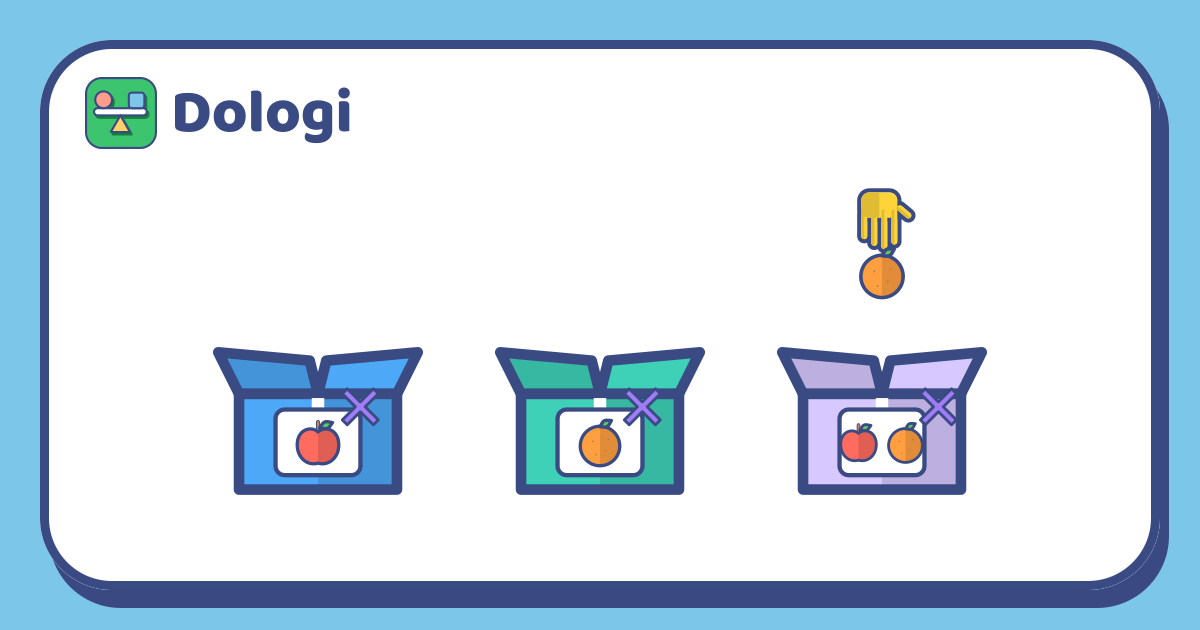
The puzzle. There are three closed boxes. One holds only apples, one holds only oranges, and one holds both. Each box has a label: "Apples", "Oranges", "Apples and oranges". But someone has made a mistake, and every label is wrong. You may take out one fruit from one box, without looking inside. How can you put all three labels right?
Hints:
- What do you know for sure about each box, just from the fact that its label is wrong?
- Look at the box labelled "Apples and oranges". What can't be inside it?
- That box holds only one kind of fruit. One fruit from it tells you which kind.
Solution. Take a fruit from the box labelled "Apples and oranges". Its label is wrong, so it holds only one kind of fruit. Say you pull out an orange: that box is the oranges. Now look at the box labelled "Apples". It isn't apples (its label is wrong) and it isn't oranges (we just found them), so it holds both. The last box, labelled "Oranges", must be the apples. If you had pulled out an apple, the same reasoning works the other way round.
Act it out. Use three bags or boxes, real fruit or balls of coloured paper, and sticky notes for labels. One person fills the boxes and sticks every label on the wrong box; the other solves it. Then swap roles.
Three switches and one bulb
The puzzle. Outside a closed room there are three switches. Only one of them turns on the bulb inside. You can flip the switches as much as you like, but you may open the door and go into the room only once. How do you find out which switch controls the bulb? (In this puzzle, the bulb is the old kind that gets warm when it has been on for a while.)
Hints:
- When you walk in, the bulb is on or off. That only tells two cases apart, but there are three switches.
- Is there anything else about a bulb that changes when it has been on?
- Use time: leave one switch on for a while before you go in.
Solution. Turn on switch 1 and wait ten minutes. Turn switch 1 off, turn switch 2 on, and go in straight away. If the bulb is on, it is switch 2. If it is off but warm, it is switch 1. If it is off and cold, it is switch 3. The key idea is to find a third piece of information besides "on" and "off".
Act it out. Don't test this by touching a real bulb. Play it as a role play instead: one person is the "bulb" behind a door and holds three cards, "on", "off and warm", "off and cold". The rule is that a switch left on for a count of 60 makes the bulb warm. Your child calls out which switches to flip, then opens the door only once.
Whose birthday is it?
The puzzle. A friend's birthday is one of these eight dates: 3 March, 6 March, 8 March, 2 April, 6 April, 3 May, 7 May, 8 May. Ana is told only the month. Ben is told only the day. Then they talk:
- Ben: "I don't know the birthday."
- Ana: "Now I know!"
- Ben: "Then I know too."
What is the birthday?
Hints:
- Write the dates in a table: one row for each month, one column for each day.
- Which days appear only once? If Ben had one of those days, what would he have said?
- Cross out those dates. Now Ana knows straight away: which month has only one date left?
Solution. Days 2 and 7 each appear only once. If Ben had been told 2 or 7, he would have known the date immediately. He says he doesn't know, so 2 April and 7 May are crossed out. What's left: 3, 6, 8 March; 6 April; 3, 8 May. Ana now knows, so her month must have only one date left. March has three and May has two, but April has just one. The birthday is 6 April. Ben, who was told 6, hears that Ana knows and works it out too.
Act it out. Write the eight dates on cards and lay them out in rows by month. One person whispers the month to one child and the day to another, then they have the conversation out loud. Afterwards, your child can make up their own list of dates and check that only one answer works.
Eight balls and two weighings
The puzzle. You have eight balls that look exactly the same. One is slightly heavier than the others. You have a balance scale with two pans, and you may use it only twice. How do you find the heavy ball?
Hints:
- One weighing has three possible results: left side down, right side down, or level.
- You don't have to put every ball on the scale. A ball left off is also giving you information.
- Split the balls into three groups: three, three and two.
Solution. Put three balls on each pan and leave two off. If the scale stays level, the heavy ball is one of the two left off: weigh those two against each other. If one side goes down, the heavy ball is among those three: put one on each pan and keep one off. The side that goes down has the heavy ball; if the scale stays level, it is the one you kept off.
Act it out. Use eight identical small containers with lids, and hide an extra coin in one of them. A homemade balance from a coat hanger works well (see the article in "Read more"). Afterwards, ask: "Would two weighings still be enough with nine balls?" (Yes: three groups of three.)
Coins in the dark
The puzzle. On the table there are 15 coins. Exactly 5 are heads up and the rest are tails up. Your eyes are covered, so you can't see or feel which side is up. You may move coins and flip any coin over. How do you split the coins into two piles with the same number of heads in each?
Hints:
- You can't see, but you can still count how many coins you move.
- Make one pile of exactly 5 coins, taken from anywhere.
- Now flip over every coin in that small pile.
Solution. Take any 5 coins to make a small pile, then flip all 5. Why does it work? Say your 5 coins happened to include 2 heads. Then the big pile keeps the other 3 heads. Your small pile has 2 heads and 3 tails; after flipping, it has 3 heads and 2 tails. Both piles now have 3 heads. Try other cases with your child (0 heads, 5 heads): the result is always the same.
Act it out. Play it for real with coins and a blindfold, then turn on the light and count. Children are often amazed that it works without them seeing anything, and they want to know why. That "why" is the most valuable part of the puzzle.
In Dologi, the "How many weighings?" puzzles in the Logic topic work on the same idea as puzzle 4: split the balls into three groups and reason from the way the scale tips.
In short
- Classic logic puzzles suit many children of 10 to 12: they are solved with reasoning, and the answer can be explained.
- Each time, start from "What do I know for certain?": every label is wrong, a bulb can be warm, a day that appears only once.
- Give hints one level at a time, from a question to a nudge, and let your child struggle a little before the next one.
- Act the puzzles out with real objects, then invite your child to invent their own version for the family.
Read more: Balance puzzles for children: reasoning about heavy and light