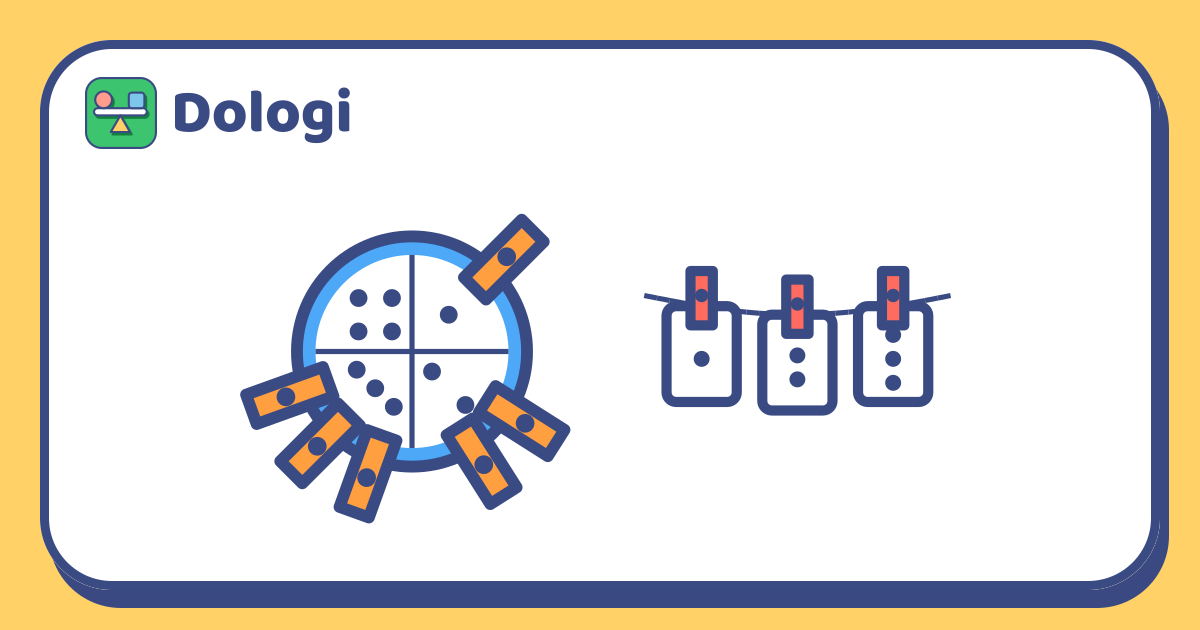
"Three dots… one peg, two pegs, three pegs. Done!"
Clothes pegs are cheap, sturdy and come in bright colours. Squeezing one open takes a firm pinch between thumb and fingers, a little like the grip used for holding a pencil, and young children find it surprisingly satisfying. Add some dots or numbers and the same pegs become a counting game.
What you need
- A bag of clothes pegs, wooden or plastic, in several colours if possible.
- Paper plates or circles of card.
- A piece of string and two chairs for a washing line.
- Card for number and dot cards.
Show your child how to hold the peg at the end, away from the opening, so it doesn't pinch their fingers. If squeezing is hard at first, look for looser pegs or start with the plastic ones.
Peg the plate
Divide a paper plate into four to six sections with a pen. Draw dots in each section: one dot, two dots, three dots… Your child counts the dots in a section and clips that many pegs onto the edge.
- For younger children, start with one to three dots.
- Later, write numbers next to the dots, then numbers alone.
- Check together: count the pegs on each section out loud.
Match the colours
Colour the sections of a plate red, yellow, blue and green, and ask your child to clip pegs of the matching colour onto each section. Then combine both ideas: "Three red pegs on the red section, two blue pegs on the blue section."
The number washing line
Tie a string between two chairs. Make cards with dots or numbers from one to ten.
- Peg the cards in order along the line, from smallest to largest.
- While your child closes their eyes, take one card away. Which number is missing?
- Swap two cards. Can your child spot the mistake and fix it?
- Hang only a few cards with gaps between them, like 2, 5 and 9. Where should 7 go?
The washing line is a number line you can touch, and children see that numbers have a fixed order and position.
Peg patterns and comparing
- Patterns. Clip pegs along the edge of a card or a ruler: red, blue, red, blue… Start a pattern and let your child continue it.
- More or fewer. Put pegs on two plates. Which has more? How many more? Line them up side by side to check.
- Adding pegs. "Three pegs on this side, two on that side. How many altogether?" Children can count all of them, then later count on from three.
| Rough age | What to try |
|---|---|
| 3–4 | Squeezing pegs open; clipping pegs onto a plate edge; matching colours |
| 5–6 | Pegging the right number of pegs onto dots; the washing line from one to ten |
| 7–8 | Numbers instead of dots; finding the missing card; peg patterns; adding two groups |
| 9 and up | Washing lines with gaps; numbers up to 100 in tens; making peg puzzles for younger siblings |
Ages are only a rough guide, and every child is different.
In Dologi, "Connect the dots" puzzles in the Math topic ask children to join numbers from the smallest to the largest, the same sense of order your child uses on the washing line.
In short
- Clothes pegs train the fingers and make counting something your child can do with their hands.
- Dotted plates turn counting into clipping the right number of pegs.
- A washing line with number cards is a number line to touch, reorder and fix.
- Patterns, comparing and adding all work with the same bag of pegs.