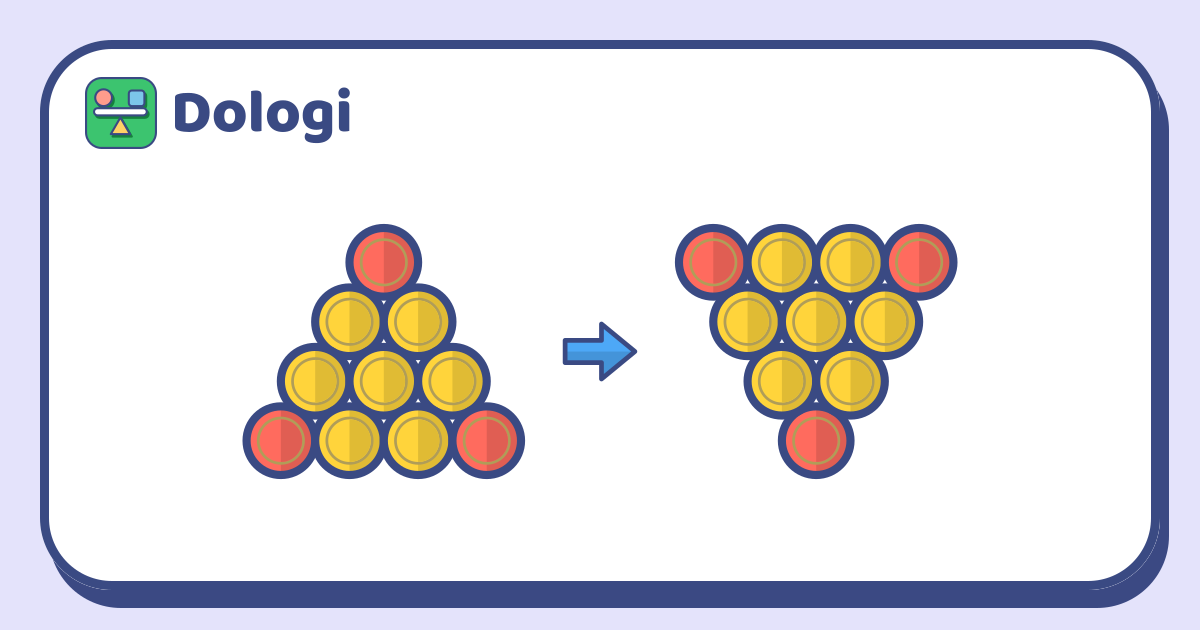
A handful of coins on the kitchen table can turn into a real thinking puzzle. Arrange them in a shape, name a new shape, and ask: "What is the smallest number of coins you need to move?" Getting to the new shape is easy. Doing it in the fewest moves takes planning.
Coin puzzles suit children aged about 6 to 12. They practice seeing shapes, imagining a coin in a new place before moving it, and checking whether a better solution exists. Below are four puzzles from easy to tricky, hints for each one, and the answers at the end.
What you need and the rules
- Ten coins of the same size. Buttons, counters or bottle caps work just as well.
- A flat table, and paper and a pencil to sketch the goal shape.
- The rules: one move means picking up one coin and putting it down somewhere else. You can't push other coins along. Coins in a shape touch their neighbors.
Coins are small, so play at the table with older children and put them away afterwards if there are toddlers in the house.
Before each puzzle, build the starting shape together and draw the goal shape on paper. Let your child try freely first, then ask: "Can you do it in fewer moves?"
Warm-up puzzles (around ages 6–8)
Puzzle 1: from a row to a square. Put four coins in a straight row, touching. Make a square of four coins: two in a row and two more just above them. What is the fewest number of moves?
Hint: a square has two coins in each row. How many coins of your long row could already be part of the square?
Puzzle 2: from a triangle to a ring. Make a triangle of six coins: three in the bottom row, two above them, one on top. Make a ring: six coins in a circle around an empty space, each touching the two next to it. Extra rule: every coin you put down must touch at least two other coins. What is the fewest number of moves?
Hint: a ring has a hole in the middle. Which coin of the triangle could be the "hole", and which coins already sit around it?
The upside-down triangle (around ages 8–12)
Puzzle 3. Make a triangle of ten coins pointing up: one coin on top, then rows of two, three and four. Turn it upside down so it points down, moving as few coins as possible.
Most children start by moving whole rows, and that takes many moves. The puzzle can be solved in just three.
Hint 1: draw the upside-down triangle on paper and lay it over the coins in your mind. Which coins are already in a place that belongs to the new triangle?
Hint 2: there are seven of them, a group in the middle. Only the coins left over need to move.
A puzzle with a twist (around ages 9–12)
Puzzle 4. Using only six coins, make two straight rows with four coins in each row.
At first it seems impossible. Two straight rows can share at most one coin, so 4 + 4 − 1 makes 7 coins, not 6. Let your child explain that before giving a hint, because noticing why something is impossible is an important step.
Hint: read the rules again. Do they say the coins must all lie flat side by side?
The habit that cracks every coin puzzle
All four puzzles reward the same way of thinking, and you can say it out loud:
- Look at the goal first. Draw the goal shape, or build it next to the starting shape with a second set of coins.
- Find what can stay. Put a finger on each coin that already fits into the goal shape. Those coins don't move.
- Count what is left. The leftover coins are the moves you need. If more than your target remains, try placing the goal shape somewhere else over the coins.
- Check the moves. Act them out, count aloud and compare with the first try.
When your child gets stuck, go one hint at a time and wait. A question such as "Which coins are already where they need to be?" helps more than showing the answer.
This "look at the target shape, then fit the pieces" habit is also at the heart of "Fill it up" puzzles in the Space topic in Dologi, where children turn blocks and place them until every empty square is covered.
Answers
- Two moves. Leave the two middle coins in place and move each end coin up to the row above, one just above each middle coin. One move isn't enough: a square has only two coins in a row, so at most two coins of the long row can stay.
- Two moves. The middle coin of the bottom row becomes the hole. First move the top coin down to sit below the bottom row, between the left coin and the middle coin: it touches both. Then move the middle coin of the bottom row to sit below, between the right coin and the coin you just moved. The six coins now form a ring around the empty space.
- Three moves. Move the top coin to sit below the middle of the bottom row. Move the left coin of the bottom row up to the left end of the second row, and the right coin of the bottom row up to the right end of the second row. The seven middle coins never move.
- Stack a coin. Make a corner shape: three coins in a row and three in a column sharing the corner coin, which is only five coins. Put the sixth coin on top of the corner coin. Each row now counts the two stacked coins plus two more: four coins.
In short
- Coin puzzles need only a table and ten coins, and suit children aged about 6 to 12.
- The challenge isn't reaching the new shape, it's reaching it in the fewest moves.
- Look at the goal first, find the coins that can stay, and count what's left.
- Give one hint at a time and ask your child to explain why fewer moves wouldn't work.
Read more: Stick puzzles for children: move a stick, make a new shape