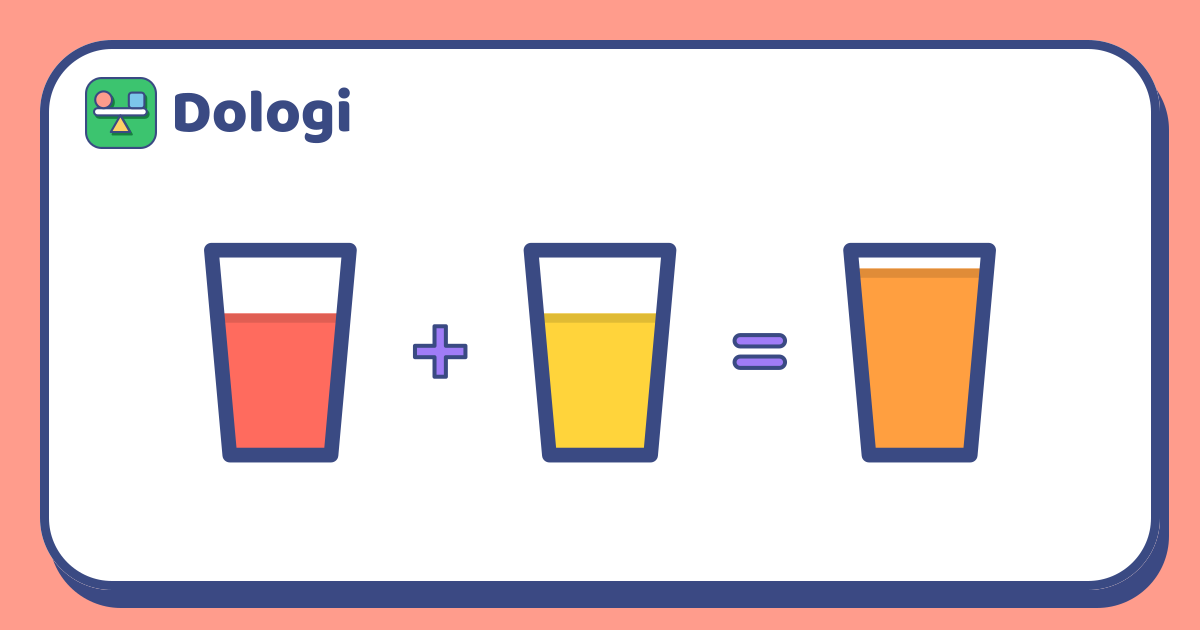
"What do red and yellow make?" Ask a five-year-old and you might hear "orange" straight away, or "pink", or "red-yellow". Every one of those answers is worth testing. With a few cups of water, your child will see the new colour appear right in front of them.
Colour mixing is one of the easiest experiments to set up at home, yet it still contains every step of science: guess first, try it, write it down, then think about why. This article shows how to set it up, how to keep a mixing chart together, and a few ways to take it further with older children.
What you need
- Four to six clear cups (clear plastic ones are easiest), each about half full of water.
- Food colouring in red, yellow and blue. If you don't have any, mix watercolour paint into the water instead.
- A small spoon or a dropper for adding colour, and a few sticks for stirring.
- A sheet of white paper behind the cups so the colours are easy to see, a tray and a cloth.
- An old T-shirt for your child: food colouring can stain hands and clothes.
Tell your child before you start that the coloured water is for looking and testing, not for drinking. With younger children, you pour the water and they add the drops and stir.
Step one: guess before you mix
Make three "starter" cups first: one red, one yellow, one blue. Before each mix, ask: "What colour do you think we'll get if we pour these two together?" Write the guess in the chart, then pour a little of each colour into an empty cup.
| First colour | Second colour | My guess | What happened |
|---|---|---|---|
| Red | Yellow | Pink | Orange |
| Yellow | Blue | Green | Green |
| Red | Blue | Black | Purple |
Children who can't write yet can colour a dot in each box instead. Older children can add a column: "Why do I think so?"
The real result depends on your colours: some reds and blues make a lovely purple, others make a dull, brownish one. That is a finding worth writing down too. What matters is that your child compares what they guessed with what they saw, not that they guess right the first time.
Step two: more or less changes the colour
Once your child knows that red and yellow make orange, ask a harder question: "What if we use lots of yellow and only a little red?"
Line up five cups of clear water. In the first, add one drop of red and five drops of yellow; in the next, two drops of red and four of yellow; and so on, until the last cup has five drops of red and one of yellow. The row of cups will shift gradually from yellowy orange to reddish orange.
This teaches more than colours:
- Counting and comparing: your child counts the drops and sees red going up while yellow goes down.
- Spotting a pattern: each cup changes a little in the same way, so your child can predict the next cup before mixing it.
- Keeping it fair: every cup has the same amount of water and only the drops change. If some cups were full and others half empty, you couldn't tell whether the colour changed because of the drops or the water.
Step three: what about white, or more water?
This part works best with paint on a plastic plate or thick paper, because white doesn't show up well in water.
- Add white: dab a little red, then mix in white bit by bit. Red turns pink, then paler pink. Ask: "Is pink its own colour, or is it red mixed with white?"
- Add water: pour clear water into a cup of coloured water. The colour gets lighter but stays the same colour. Compare with adding white: both make the colour lighter, but do they look the same?
- Mix everything: many children love tipping every colour into one cup. The result is usually a muddy brown. This is a great moment to ask: "Why does mixing more colours make it darker and duller?" Your child doesn't need the exact answer yet, just to notice that it happens every time.
Older children may enjoy one more surprise: a phone screen mixes colours with light rather than paint, and light follows different rules. Red light and green light together make yellow.
Games to take it further
- The secret colour maker: mix a colour where your child can't see, say a yellowy green. Your child looks at it, guesses which colours you used, then tries to mix a match. Swap roles so your child sets the challenge.
- A colour hunt at home: find something orange, something purple and something green, then ask, "Which two colours could make this?"
- Walking water: put a cup of red water and a cup of yellow water with an empty cup between them, and link the cups with strips of paper towel folded lengthwise. After a few hours, the water creeps along the paper into the middle cup and the two colours meet. Ask your child to predict the colour first.
- A personal mixing chart: a sheet of paper divided into boxes, one box per mix, with the number of drops of each colour. Next time your child wants a reddish orange, they can look up their own chart.
In Dologi, the Patterns topic has puzzles where children look at a row of colours and shapes and work out what comes next, the same kind of noticing how things change step by step as in the row of coloured cups.
In short
- Colour mixing needs only clear cups, water and red, yellow and blue, yet covers every step: guess, test, record, think.
- Always ask for a guess first, and record guesses and results in a simple mixing chart.
- Change the number of drops to watch the colour shift gradually, and keep the water the same so the test is fair.
- Adding white, adding water and mixing everything are all discoveries worth talking about together.
Read more: The sink-or-float experiment: guess first, then test