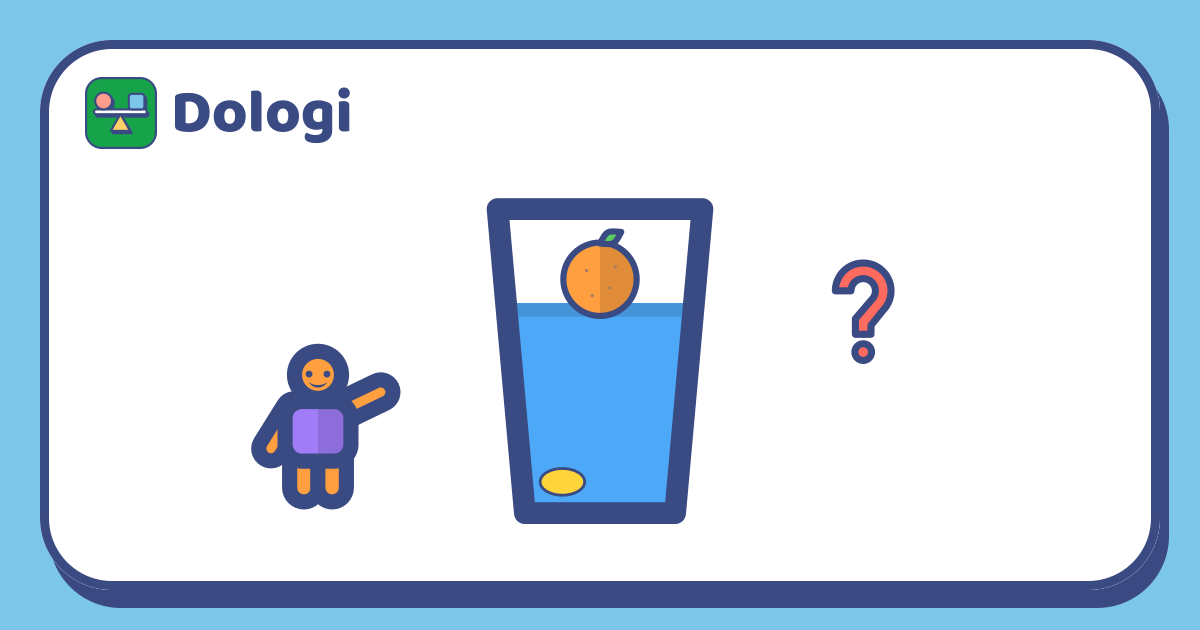
"Will it sink or float?" Hold up an apple and a coin, and most children will have an answer straight away. Now drop them in water. The coin sinks, as expected. The apple bobs up. And then you peel an orange, and something surprising happens.
A sink-or-float experiment needs only a bowl of water and a few things from the kitchen, yet it contains the whole heart of science: guess, test, look at what happened, and think about why. This article shows how to run it with your child.
Why guess first?
It's tempting to just drop things in and watch. But asking for a guess first makes a big difference:
- A guess makes your child think about what they already know.
- A wrong guess is the most interesting moment. "I thought it would sink, but it floated! Why?" That surprise is where new understanding starts.
- It builds a habit: predict, then check. The same habit helps in maths, reading and everyday problems.
Setting up
You will need:
- A large bowl, a washing-up bowl or a sink, half full of water, and a towel.
- About eight to ten objects: an apple, a grape, a coin, a cork, a metal spoon, a wooden spoon, an ice cube, a small toy, an orange.
- A simple table, drawn on paper.
| Object | My guess | What happened |
|---|---|---|
| Apple | Sinks | Floated |
| Coin | Sinks | Sank |
| Cork | Floats | Floated |
| Metal spoon | Floats | Sank |
For younger children, use pictures or ticks instead of words. For older ones, add a column: "Why do you think so?"
Always stay close when young children play with water, even a shallow bowl.
Surprises worth talking about
Some results nearly always lead to a good conversation:
- Big doesn't always mean sinks. A big apple floats, while a tiny coin sinks. So size alone isn't the answer.
- The orange trick. An orange with its peel on usually floats. Peel it, and it usually sinks. The peel holds lots of tiny pockets of air, a bit like a life jacket.
- Shape matters. Squash a piece of kitchen foil into a tight ball and it may sink. Shape the same foil into a little boat and it floats.
A child-friendly way to sum it up: whether something floats depends on how heavy it is for its size, and on its shape, not just on how heavy it is.
Asking "why?" without needing the right word
Your child doesn't need to know scientific words. What matters is having an idea and testing it.
- "Why do you think it floated?" "Because it has air inside." "Because it's flat."
- "How could we test that idea?" Try another flat thing. Try something with air inside, such as an empty bottle with its lid on.
- Accept ideas that turn out wrong. "Good idea; let's test it. Hmm, that flat coin still sank. What else could it be?"
Taking it further
- Sort the results into two groups, "floated" and "sank", and look for patterns: what do the floaters have in common?
- Make a sinker float: can your child shape modelling clay so that it floats?
- Salt water: a fresh egg usually sinks in tap water. Stir in lots of salt, and it may start to float. Why might that be?
In Dologi, "Balance scales" puzzles in the Logic topic ask children to work out which block is heavier from how the scales tip, another way to reason carefully about weight.
In short
- Sink-or-float needs only water and kitchen objects, and teaches the heart of science: guess, test, think.
- Always ask for a guess first and record guesses and results in a simple table.
- Talk about surprises: big things that float, the orange with and without peel, foil balls and foil boats.
- Welcome your child's ideas about why, then find a way to test them.
Read more: Teaching children to estimate: guess first, then count to check