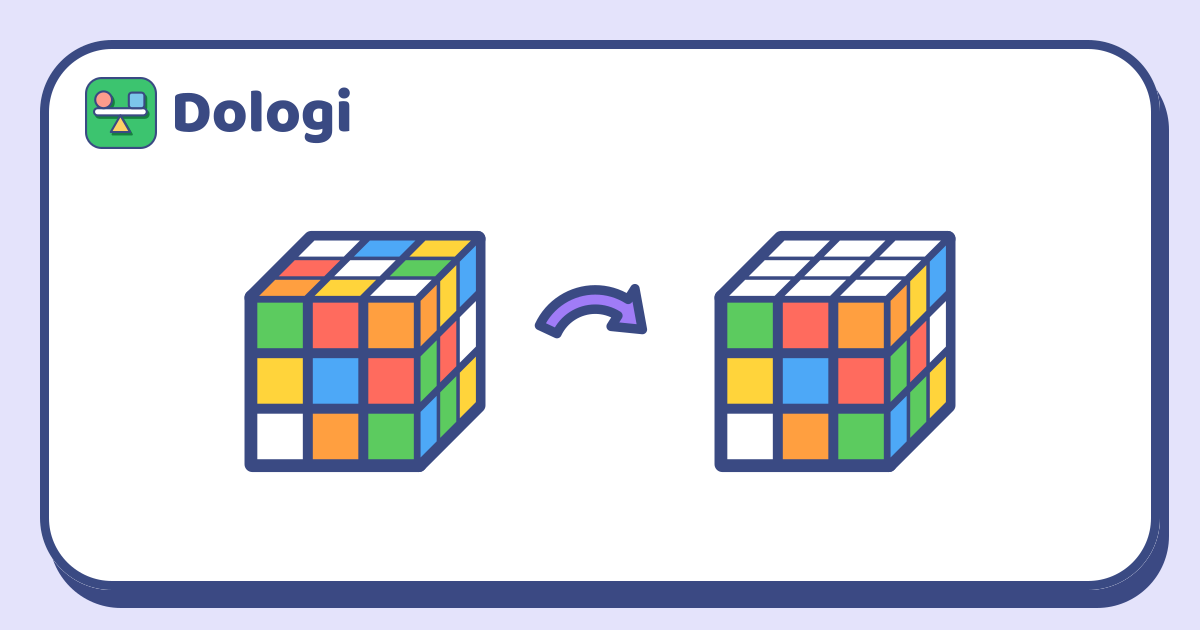
The cube with nine coloured squares on each face is one of the best-known puzzles in the world. Twist it a few times and the colours are mixed up; getting every face back to one colour looks impossible at first. Many children are fascinated by it, and many parents wonder whether it's too hard, too frustrating, or a great thinking toy.
The honest answer: it depends on the child and on how you approach it. Here's what the puzzle trains, how to start, and how to keep it fun.
What the twisting cube trains
- Spatial thinking. Each piece moves in three dimensions. Following where a corner goes after a turn means picturing the cube in your head.
- Patience and persistence. Progress comes slowly, and often you have to undo something you've just done to get further.
- Planning a few moves ahead. "If I turn this side, the white square will come up here."
- Following a sequence. Most people learn short move sequences that do one useful thing. Remembering and carrying out a sequence in the right order is a skill in itself.
- Living with frustration. Messing up a nearly finished face is part of the game. Learning to shrug, breathe and try again is valuable.
Is it right for my child?
Every child is different, so treat these as rough guides:
| Age, roughly | What often works |
|---|---|
| 4–6 | Twisting freely, matching colours, making simple patterns; a smaller cube with fewer pieces |
| 6–8 | Making one face a single colour, sometimes with help; learning one or two short sequences |
| 8 and up | Solving the whole cube step by step with a written or drawn guide, if they're interested |
Interest matters more than age. A child who loves it at six will learn a lot; a child who is pushed into it at ten may just feel stuck.
Start with one face
Solving the whole cube is a long road. Break it into small goals and celebrate each one:
- Find the centres. The middle square of each face never moves. It tells you which colour that face will be.
- Make a cross. Get four squares of one colour around their centre, like a plus sign.
- Fill the face. Add the corners so the whole face is one colour.
- Match the sides. Turn the cube and check that the row under the finished face matches each side's centre.
Many children are proud for weeks of being able to make one face. That is a real achievement, not "only" a face.
Figure it out, or learn a method?
Both are fine, and they train different things:
- Figuring out alone builds exploration and problem solving. It's slow, and most children get stuck after one face.
- Learning a step-by-step method (from a guide with pictures) builds memory and the ability to follow a sequence. It's how most people solve the whole cube.
A nice mix: let your child explore freely first, then offer a guide when they ask. Talk about why a sequence works, not just what to do.
Keep it fun
- Speed doesn't matter. Solving fast is a separate hobby. For thinking, slow and understood is better than fast and memorised.
- Short sessions. Ten minutes is plenty. Put the cube away before frustration builds up.
- Solve together. Learn alongside your child. Adults find it hard too, and it's good for children to see that.
- Play with patterns. Make stripes, a checkerboard or a single dot in the middle of each face. Patterns are fun and teach how moves affect the cube.
Easier versions for younger children
- A smaller cube with two squares per side has fewer pieces and is much easier to solve.
- Picture cubes made of separate blocks, where you put the picture back together, use the same idea of matching faces without twisting.
- Colouring a paper cube. Draw a cube net, colour the faces and fold it. It helps children understand which faces sit next to each other.
In Dologi, the Space topic has "Roll the die" puzzles: children follow a die as it rolls and work out which face ends up on top. It practises the same skill of keeping track of a cube's faces as it turns.
In short
- The twisting cube trains spatial thinking, patience, planning and handling frustration.
- Interest matters more than age; younger children can enjoy twisting and patterns.
- Start with the centres, a cross and one face, and celebrate small goals.
- Keep sessions short, ignore speed, and try smaller cubes or picture cubes first.
Read more: Turning shapes in your head: building children's spatial thinking