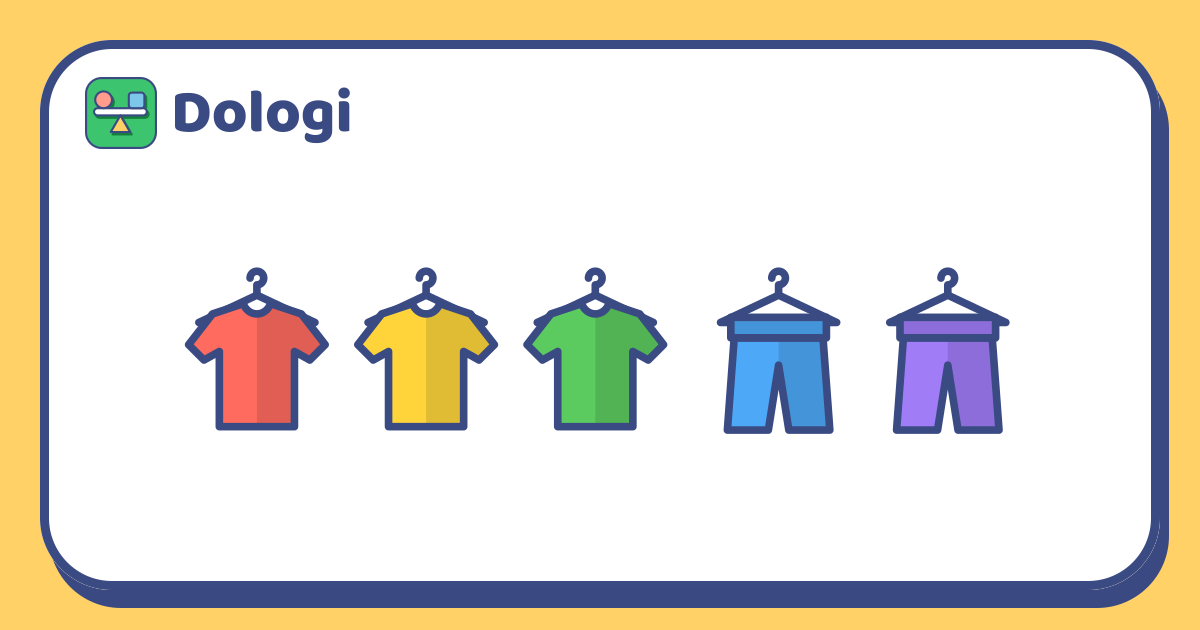
Three T-shirts and two pairs of trousers are lying on the bed. "How many different outfits can I make?" Most children start matching at random: red with blue, green with purple, red with blue again... and very soon nobody knows which ones have been done.
The question is small, but the idea behind it is big: counting in an organised way, so that nothing is missed and nothing is counted twice. This article shows how to play with real clothes, how to draw the answer, and how to make the game harder as your child grows.
Start with real clothes
- Lay out three tops and two bottoms in clearly different colours.
- Ask for a guess first. "How many outfits do you think there are?" Any number is fine. A guess gives your child something to check.
- Build each outfit on the bed or the floor, one at a time.
- Don't correct yet. When an outfit is repeated or forgotten, ask: "Have we had this one before? How can we be sure we have them all?"
No spare clothes to hand? Cut tops and bottoms out of coloured paper, or draw them with crayons.
The trick: keep one thing still
Random matching is where the muddle comes from. The way out is a simple rule: keep the top, change only the bottom.
Take the red T-shirt. Put it with the blue trousers, then with the purple ones. That's two outfits. Now the yellow T-shirt: two more. Then the green one: two more. Altogether 2 + 2 + 2 = 6.
A table shows the same thing at a glance:
| Blue trousers | Purple trousers | |
|---|---|---|
| Red T-shirt | red + blue | red + purple |
| Yellow T-shirt | yellow + blue | yellow + purple |
| Green T-shirt | green + blue | green + purple |
Every box is one outfit. Three rows, two columns, six boxes, and no box is empty.
Draw a tree diagram
A tree diagram is another picture of the same counting, and children enjoy drawing it.
- On the left of the page, draw the three T-shirts one under another (three coloured dots will do).
- From each T-shirt, draw two lines going right: one to a blue dot, one to a purple dot.
- Count the ends of the lines. There are six, one for each outfit.
The tree makes it easy to see why nothing is missing: every T-shirt has exactly two branches. If one has only a single branch, an outfit has been forgotten.
From counting to multiplying
Once six feels obvious, change one thing and ask again.
- One more pair of trousers. Each T-shirt gets one more branch: 3 + 3 + 3 = 9.
- One more T-shirt. Now there are four rows of three: 12.
- Add two hats. Each of the six outfits can be worn with either hat, so six becomes twelve.
Don't hurry to give the rule. After a few rounds many children say it themselves: "It's the number of tops times the number of bottoms!" A rule they have found is one they remember.
| Rough age | What to try |
|---|---|
| 4–5 | Two tops and two bottoms with real clothes; lay the finished outfits side by side |
| 6–7 | Three tops and two bottoms; keep one top still; draw a simple tree |
| 8–9 | Add a third kind of item such as hats; link it to multiplication |
| 10 and up | Add a condition: "the green T-shirt never goes with the purple trousers". How many now? |
Ages are only a rough guide. Every child gets there at their own pace.
The same idea in other places
- Breakfast: two kinds of bread and three fillings. How many different sandwiches?
- Ice cream: three flavours, in a cone or in a cup.
- Numbers: how many two-digit numbers can you write with the digits 1, 2 and 3? And if a digit can't be used twice?
- Drawing: a house with a red, blue or yellow roof and a green or brown door.
Each time, ask the same two questions: "What are we keeping still?" and "What are we changing?"
Common slips
- The answer "five". Many children add three and two. That's a sensible first idea: it counts the clothes, not the outfits. Build the outfits and count them together.
- The same outfit twice. Leave each finished outfit in a row, or tick it off on the table.
- Changing everything at once. Bring back the rule: keep the top, change only the bottom.
In Dologi, "Count and answer" puzzles in the Math topic ask children to count only the things the question asks about, for example only the stars. It's a small exercise in the same habit: go one by one, skip nothing, count nothing twice.
In short
- Ask the question with real clothes and let your child guess first.
- Keep one item still and change the other: organised counting misses nothing.
- A table or a tree diagram shows every outfit; count the boxes or the ends of the branches.
- Let your child discover the shortcut: tops times bottoms.
Read more: Probability for young children: certain, possible or impossible?