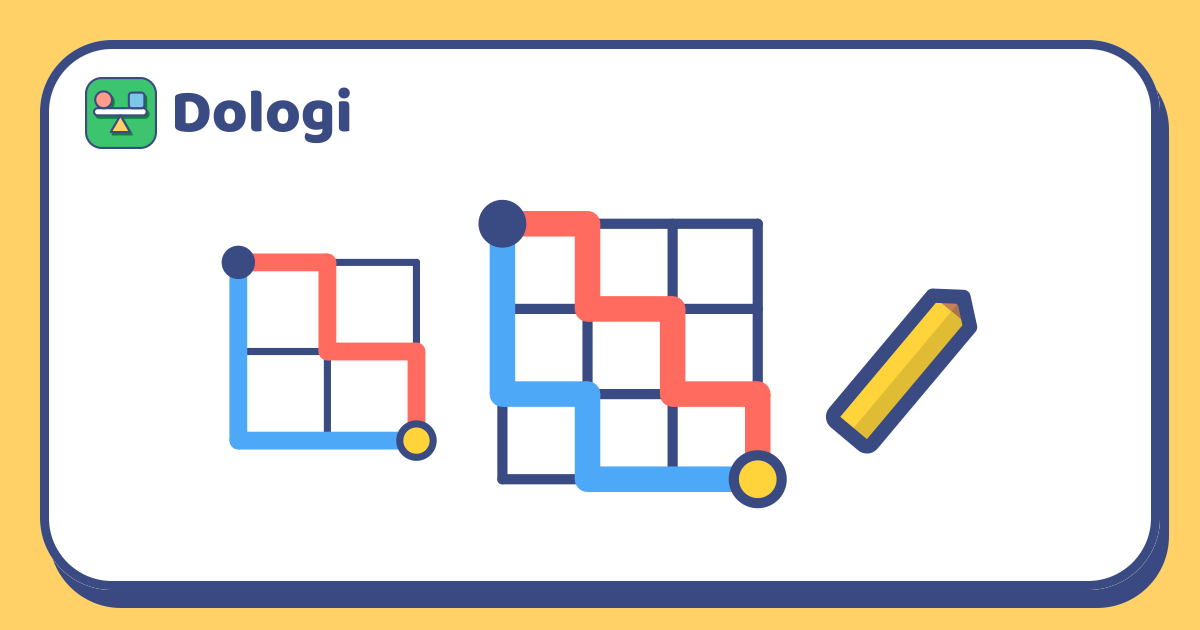
Draw a square grid on a sheet of paper. Put a dot in the top-left corner and another in the bottom-right corner. An ant wants to walk from one dot to the other along the lines, and it may only go right or down. How many different routes can it take?
It sounds like a small question. In fact it is a puzzle that grows with your child: two routes at first, then six, then twenty, with a neat pattern hiding underneath. All you need is squared paper and a few coloured pencils.
The rules
- Walk along the lines of the grid, from the top-left corner to the bottom-right corner.
- Only two moves are allowed: one step right or one step down. Never left, never up.
- Two routes are different if they differ in at least one step.
Why only right and down? Without that rule the ant could wander round and round, and there would be no end to the counting.
Start very small
- One square. There are two routes: right then down, or down then right. Trace each in a different colour.
- Two squares side by side. Let your child search. There are three routes. A helpful question: "At which corner does the ant go down?"
- Two by two. Ask for a guess first, then draw. There are six.
A practical tip: draw the same small grid several times and trace one route on each copy. Six routes on a single drawing quickly turn into a tangle.
Count without losing track
The usual trouble appears here too: one route is forgotten, another is counted twice. Two tools help.
Write each route with arrows. One arrow per step. On the two-by-two grid every route has two steps right and two steps down, so every route is a row of four arrows.
List them in order. First the routes that begin with a step right, then those that begin with a step down:
| Begins with → | Begins with ↓ |
|---|---|
| → → ↓ ↓ | ↓ → → ↓ |
| → ↓ → ↓ | ↓ → ↓ → |
| → ↓ ↓ → | ↓ ↓ → → |
Three and three: six routes, and it is easy to see that none is missing. Many children notice that the right-hand column is the left-hand one with the arrows swapped.
The number trick
For older children there is a way to count without drawing every route. At each crossing, write the number of ways the ant can get there.
- Every crossing along the top edge and the left edge gets a 1: the only way there is straight ahead.
- To reach any other crossing, the ant arrives either from above or from the left. So its number is the number above plus the number on the left.
- Fill in the grid row by row. The number in the bottom-right corner is the answer.
For the two-by-two grid, the nine crossings look like this:
| 1 | 1 | 1 |
|---|---|---|
| 1 | 2 | 3 |
| 1 | 3 | 6 |
The 6 matches the list of arrows. Two different methods, the same answer: that is how to be sure. Now let your child try the three-by-three grid. The last corner should say 20.
Make it harder
- A longer grid. Three squares wide and two tall gives 10 routes.
- Roadworks. Cross out one piece of line. On the two-by-two grid, close the very first step to the right: only the three routes that begin by going down are left.
- A stop on the way. The ant must pass through the middle crossing to pick up a crumb. There are two ways to the middle and two ways on from there, so 2 × 2 = 4 routes.
- Swap roles. Your child draws a grid with a closed road and you do the counting.
| Rough age | What to try |
|---|---|
| 6–7 | One square, then two side by side; trace each route in its own colour |
| 8–9 | Two by two; write routes with arrows and list them in order |
| 10 and up | The number trick; three by three; roadworks and stops on the way |
Ages are only a rough guide, and every child is different. A child who isn't interested today may enjoy it in a few months.
What your child is practising
- Counting in an organised way, so that nothing is missed and nothing is counted twice.
- Spotting a pattern and checking it, rather than trusting the first guess.
- Solving one problem in two ways and comparing the answers.
In Dologi, "Shortest way" puzzles in the Math topic show a small map of roads: children try several routes from the house to the tree, add up the steps of each one and compare. It is the same habit of looking at more than the first route that comes to mind.
In short
- The rule: walk along the lines, only right and down, from corner to corner.
- Start with one square (2 routes), then two squares (3), then two by two (6).
- Write routes with arrows and list them in order so that none is missed.
- For older children: at each crossing write how many ways lead there, the number above plus the number on the left.
Read more: How many outfits can you make? Counting combinations with children