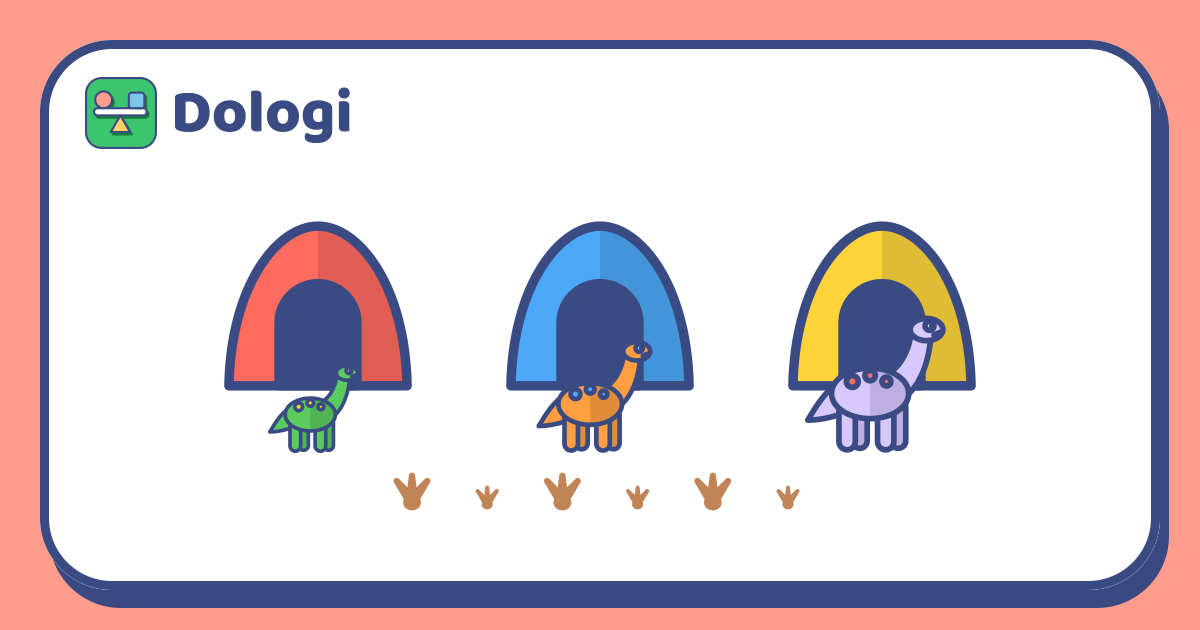
Some children go through a stage of talking about dinosaurs all day long: which one was biggest, which one had horns, which one walked on two legs. Instead of only adding more facts, you can turn that passion into puzzles. Your child still gets to play with the animals they love, but now they have to compare, spot patterns and rule things out to find the answer.
This article has four sets of original puzzles, from easier to harder. Each one has a suggested age, two levels of hints and the answer. All you need is paper, a pencil, scissors and a few toy dinosaurs if you have them.
Getting ready
- Make dinosaur cards. Draw five or six simple dinosaurs on old cardboard, each in a different color, or use toy dinosaurs.
- Pick puzzles to suit your child. The ages are rough guides; every child is different.
- Give hints in steps. Hint 1 points to where to look, hint 2 gets closer to the solution. Wait a while before offering hint 1.
- Ask "how do you know?" even when the answer is right. Explaining the thinking is where most of the learning happens.
Smallest to biggest
Warm-up (around 5–6). Set out five dinosaurs of different heights and ask your child to line them up from smallest to biggest. Then ask: "Which one is in the middle?" and "Which one is second biggest?"
Clue puzzle (around 6–8). Five dinosaurs are named after their colors: Green, Red, Yellow, Purple and Orange. Your child can't see them and only has these clues:
- Green is bigger than Red.
- Yellow is the smallest.
- Purple is bigger than Green but smaller than Orange.
Line up all five from smallest to biggest.
- Hint 1: Which clue tells you exactly where one dinosaur goes? Place that one first.
- Hint 2: Put clues 1 and 3 together: Red is smaller than Green, Green is smaller than Purple, Purple is smaller than Orange.
Answer: Yellow, Red, Green, Purple, Orange. Let your child place real cards clue by clue, then check every clue again.
Footprint patterns
Around 5–8. Draw three-toed footprints on paper, or press fingertips into play dough. Big prints belong to a big dinosaur, small ones to a small dinosaur. Ask your child whether the next print is big or small.
- Big, small, big, small, big, …
- Big, big, small, big, big, small, big, …
- Big, small, small, big, small, small, small, big, small, small, small, small, big, … How many small prints come after this big one?
- Hint 1: Read the whole trail aloud and clap along. Which part repeats?
- Hint 2 (puzzle 3): Count the small prints between two big ones. How does that number change?
Answers: 1 is small. 2 is big (the trail repeats "big, big, small"). 3 is five small prints: the small prints go up 2, 3, 4, then 5. Because this trail grows instead of repeating, it suits children around 7–8 better.
Swap roles: your child lays out a trail and you guess the next print. They have to choose a rule first and stick to it.
Sorting into two rings
Around 6–8. Lay two loops of string on the floor so they overlap. The left ring is "has horns", the right ring is "has spikes on its back". Draw six cards:
| Card | Dinosaur on the card |
|---|---|
| A | long neck, smooth back, no horns |
| B | three horns on its head, smooth back |
| C | row of spikes on its back, no horns |
| D | one horn on its nose, row of spikes on its back |
| E | two horns, a very spiky back |
| F | big head, short arms, no horns, smooth back |
Ask your child where each card goes.
- Hint 1: For each card, ask two questions: does it have horns? Does it have spikes?
- Hint 2: The part where the rings overlap is for dinosaurs with both. A dinosaur with neither goes outside both rings.
Answer: B goes in the "horns" ring only, C in the "spikes" ring only, D and E in the middle, and A and F outside both rings.
Harder version (around 8–9). Place the cards first but keep the ring labels secret, and let your child work out each ring's rule.
Who lives in which cave?
First puzzle (around 7–8). There are three caves: a red cave, a blue cave and a yellow cave. Each cave has exactly one dinosaur: the long-neck, the three-horn and the spiky-back.
- The long-neck does not live in the red cave.
- The spiky-back does not live in the blue cave or the red cave.
Draw a three-by-three grid. Put a cross in a box that must be wrong and a tick in a box that must be right.
- Hint 1: Start with the clue that rules out the most caves.
- Hint 2: The spiky-back has only one cave left. Tick it, then cross that cave out for the other two dinosaurs.
| Red cave | Blue cave | Yellow cave | |
|---|---|---|---|
| Long-neck | ✗ | ✓ | ✗ |
| Three-horn | ✓ | ✗ | ✗ |
| Spiky-back | ✗ | ✗ | ✓ |
Answer: the spiky-back is in the yellow cave, so the long-neck (not red) is in the blue cave and the three-horn is in the red cave.
Second puzzle (around 8–9). Now the three caves stand in a row: left, middle, right. Same three dinosaurs.
- The long-neck lives just to the left of the three-horn.
- The spiky-back does not live in the right cave.
- Hint 1: The long-neck and the three-horn are next to each other. How many ways can that pair be placed?
- Hint 2: There are only two ways: left and middle, or middle and right. Test each one against clue 2.
Answer: the spiky-back is on the left, the long-neck in the middle and the three-horn on the right. If the pair were on the left and in the middle, the spiky-back would have to go on the right, which breaks clue 2.
In Dologi, the Logic topic has "Two rings" puzzles, where your child sorts things into two overlapping rings, and "Who lives where?", which uses the same ruling-out as the cave puzzles.
In short
- A love of dinosaurs is a great way in to comparing, finding patterns, sorting and ruling out.
- Choose puzzles to suit your child, give hints in steps, and ask "how do you know?" even when they're right.
- A tick-and-cross grid and two loops of string make the thinking visible.
- Swap roles and let your child set puzzles: a footprint trail, cards in the rings, or clues for you to solve.
Read more: Logic grid puzzles for older children: who has which pet?