"Sign them up for chess. It'll make them smarter and better at solving problems." Parents hear this from relatives, from after-school programs, sometimes from teachers. It sounds great. But is it true?
The honest answer sits somewhere in the middle. Chess is an excellent place to practice problem-solving steps, because every game makes your child go through them again and again. But being good at finding chess moves doesn't mean a child will automatically use that same thinking on a word problem or when they're upset with a friend. That bridge usually needs a parent. This post covers what chess actually trains, what's uncertain, and how to connect the two.
Every position is a small problem
A problem, in the broad sense, has a goal, rules to follow, more than one possible approach, and a result. A chess position has all four:
- A goal: checkmate, win a piece, rescue a piece that's under attack.
- Rules: each piece can only move its own way.
- Lots of options: each side has 20 possible first moves, and usually more in the middle of the game.
- Instant feedback: a hasty move often loses a piece on the very next turn. The board doesn't play favorites, but it doesn't hold grudges either. Lose, and you just set up again.
What's nice is that one game strings together dozens of these little problems, and your child solves them while playing. It doesn't feel like studying.
Four steps practiced on every move
| Step | On the board | The question your child asks |
|---|---|---|
| 1. Look at all the options | Which pieces can move, where to, any checks or captures | "What are my choices?" |
| 2. Try it in your head | If I play this, how will the other side answer? | "What happens if I do that?" |
| 3. Choose | Compare the best few, pick one | "Which one works best?" |
| 4. Check again | Before letting go of the piece: is anything left unprotected, is my king safe? | "Did I miss anything?" |
Beginners often jump straight from spotting a move to playing it, skipping steps 1 and 4. Chess gives them endless chances to practice slowing down, just a little.
Try the four steps on a position
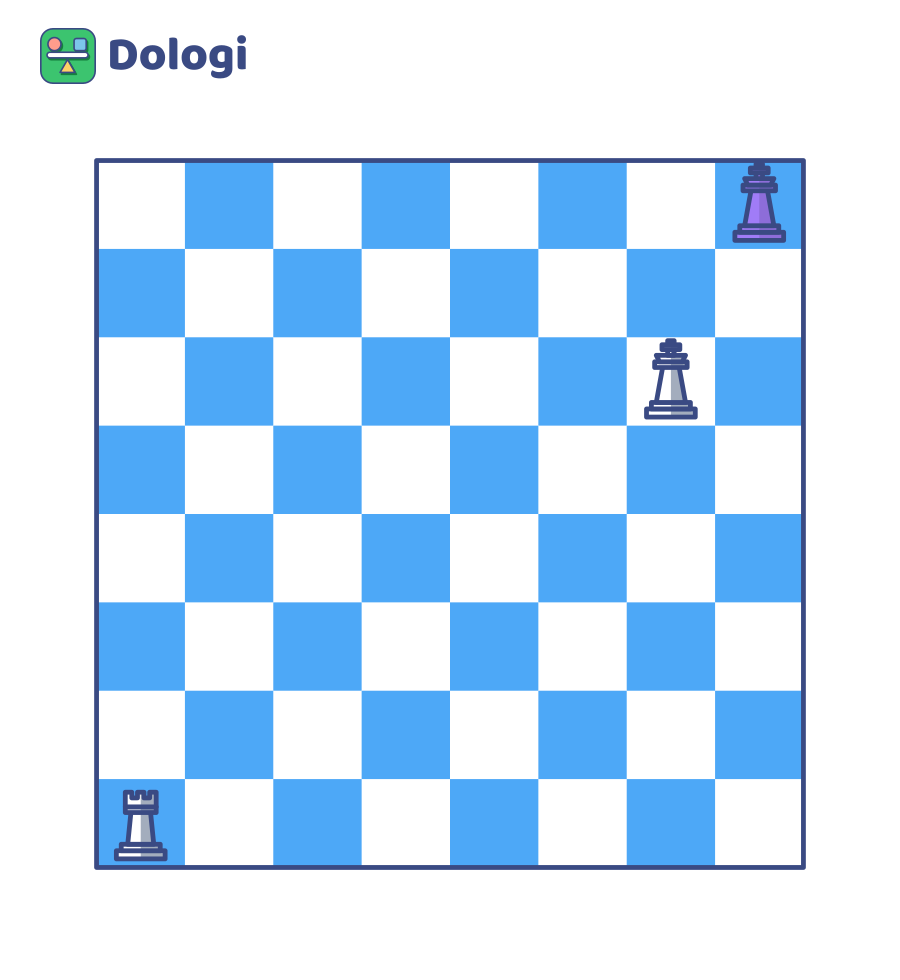
White to move and checkmate. Walk through the four steps with your child:
- Look at all the options. The rook can slide up its column or along its row, and the white king has a few squares. Are there any checks? Two: the rook to the top row, or the rook over to the black king's column.
- Try it in your head. Rook to the black king's column: the black king just steps to the square beside it on the top row and gets away. Rook to the top row: where can the black king go?
- Choose. The square beside it on the top row is covered by the rook, and the two squares below are covered by the white king. Nowhere to run: rook to the top row is checkmate.
- Check again. Can the black king capture the rook? It's too far away, so it doesn't matter that nothing protects it. Can anything block? Black has only the king.
It's an easy one, but here's the valuable part: your child sees that there are two checks and only one of them is checkmate. That's "try it in your head" and "check again" in action.
The uncertain part: skills don't move over on their own
A child can be very careful at the chessboard and still rush through math homework. That's normal. A way of thinking tends to stay attached to the place where it was practiced. At the board, your child knows "this is when I stop and think." Faced with a word problem, they may not recognize that this is the same kind of moment.
So don't expect chess to do all the work. Think of the board as the practice field. Your job is to point out that the same thinking works elsewhere too.
Building the bridge: same four questions, different places
Use the exact same four questions, in the same words your child already knows from chess, for everyday situations:
| Situation | Look at the options | Try it in your head | Choose | Check again |
|---|---|---|---|---|
| A math word problem | What do I know, what's being asked, how many ways could I solve it? | Try adding, try drawing a picture | Pick the clearest way | Plug the answer back into the problem: does it make sense? |
| Packing the backpack the night before | What's happening tomorrow, what do I need? | What if I forget my library book? | Pack the must-haves first | One last look at tomorrow's schedule |
| Two kids want the same toy | Take turns, play together, pick another game? | If I grab it, what will my friend do? | Pick one you can both live with | Later: is everyone still OK with it? |
A few things that make the bridge easier:
- Name the connection: "It's like when you look for checkmate. First, let's look at all the options."
- Ask, don't lecture: one well-timed "Did you check again?" beats a long talk.
- Praise the thinking, not the result: "You tried two ways before you picked one" rather than "You're so smart."
- Model it yourself: say the four steps out loud when you're choosing a route to the store or fixing a wobbly shelf.
When you play chess together
- Before your child moves, now and then ask "How many checks are there?" or "If you play that, what will I do?"
- When your child moves too fast, don't show them the right move. Let them take it back once and ask, "Did you check again?"
- Not every game needs this. A few times per session is plenty; the rest is just for fun.
In the Chess room in Dologi's Creative corner, Challenges has positions sorted By level: 12 levels from easy to hard, each position a small problem like the one above. The Hint button goes from general to specific: tap once and the app points to the piece to move, again for the move itself, once more to hear why. You can encourage your child to tap one hint at a time and then keep thinking on their own, which is exactly the four steps; using hints still earns the ✓.
In short
- Chess is a great place to practice four problem-solving steps: look at the options, try it in your head, choose, check again.
- Those steps don't necessarily carry over to homework or friendships on their own; the board is a practice field, not magic.
- You build the bridge by using the same four questions for homework, chores and disagreements, and by naming the connection out loud.
- Ask instead of pointing out the move, and praise the thinking rather than the win.
Read more: Planning before doing: teaching children to think three steps ahead, Teaching children to make decisions: what you gain and what you give up