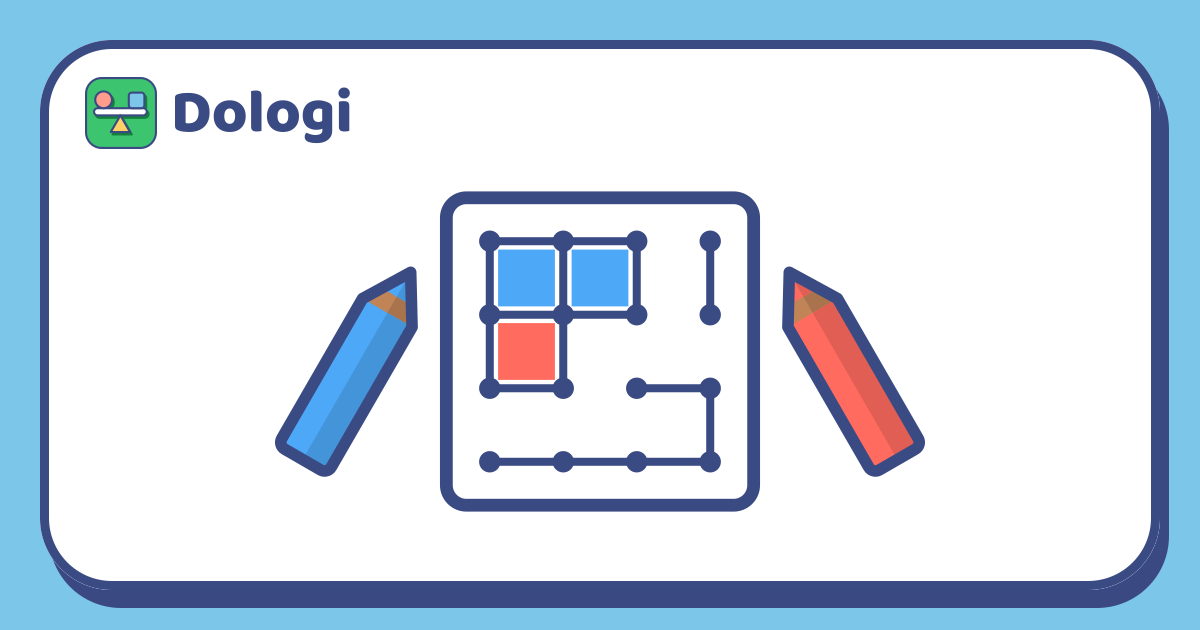
"If I draw this line, you'll close the box… so I'll draw over here instead."
Dots and boxes needs nothing but a sheet of paper and two pencils, and a game takes a few minutes. The rules fit in one sentence, yet the game quietly asks children to look one or two moves ahead. It works well from about six, at the table while dinner cooks, in a waiting room, or on the back of an envelope.
How to play
- Draw a grid of dots, for example four rows of four.
- Players take turns drawing one line between two dots that sit next to each other, across or down (never diagonally).
- If your line closes a box (its fourth side), colour it or write your initial inside, and draw another line straight away.
- When every box is closed, count. The player with the most boxes wins.
The extra line in step 3 is the part children forget most often, and it's also the most important rule: closing one box can lead straight into the next.
Two pencils of different colours help a lot. Each player colours their own boxes, so the score is visible at a glance.
Which grid to start with
A large grid makes a long game and a lot to keep track of. Start small and grow the grid when the games feel easy.
| Dots | Boxes | Good for |
|---|---|---|
| 3 × 3 | 4 | A first game, learning the rules |
| 4 × 4 | 9 | Most children from about six |
| 5 × 5 | 16 | Children who already play confidently |
| 6 × 6 | 25 | Older children and adults, longer games |
Grids with an odd number of boxes (9, 25) can't end in a tie, which saves some arguments.
The first big lesson: don't draw the third side
At first, most children draw lines anywhere. Soon they notice something: when they draw the third side of a box, the other player closes it on the next turn.
This is the moment to ask, not to explain: "What happened there? Why did I get that box?" Let your child find the rule in their own words. Then, before each line, they can ask themselves one question: "Does this line make a box with three sides?"
That question is a small version of planning ahead: picturing what the other player will do after your move. It's the same habit as blocking in noughts and crosses, and it grows with practice.
Later in the game: chains
As the grid fills up, there comes a point where every possible line draws a third side somewhere. Someone has to give boxes away. Now the question changes: "Which line gives away the fewest boxes?"
Boxes often join up into a chain, a row of boxes where closing one opens the next. Whoever takes the first box of a chain can usually take the whole chain. So when you have to give something away, give the shortest chain.
For children around nine and older, there's a surprising trick: when taking a long chain, an experienced player sometimes leaves the last two boxes for the other player. The other player takes those two, and then has to draw a line and open the next chain. Giving away two boxes to win four more is a real strategic idea, and children who discover it are usually very proud.
You don't need to teach any of this. Play often, lose a few boxes, and ask afterwards: "Where did it go wrong?"
Counting at the end
The game ends with a count, which is useful for younger players:
- Count each player's boxes, pointing at each one.
- Check that the two totals add up to the size of the grid: "You have 5, I have 4. Is that all 9?"
- Compare: "How many more did you get?"
| Rough age | What to try |
|---|---|
| 5–6 | A 3 × 3 grid of dots; learning the extra-line rule; colouring and counting boxes |
| 6–7 | A 4 × 4 grid; noticing the third side; asking "why did I get that box?" |
| 8–9 | A 5 × 5 grid; choosing which line gives away the fewest boxes |
| 10 and up | A 6 × 6 grid; chains, leaving the last two boxes; replaying a game to find the mistake |
Ages are only a rough guide, and every child is different.
In Dologi, the Space topic has puzzles such as "Shapes inside a figure", where children count all the squares or triangles hidden in a drawing made of lines. It trains the same eye for boxes formed by lines that this game needs.
In short
- Dots, two pencils, one line per turn; closing a box earns you another line straight away.
- Start with a small grid (4 or 9 boxes) and make it bigger as your child gets better.
- The first lesson is not to draw the third side; ask "why did I get that box?" rather than explaining.
- Older children can discover chains and when it pays to give boxes away.
Read more: Noughts and crosses for children: learning to think one move ahead