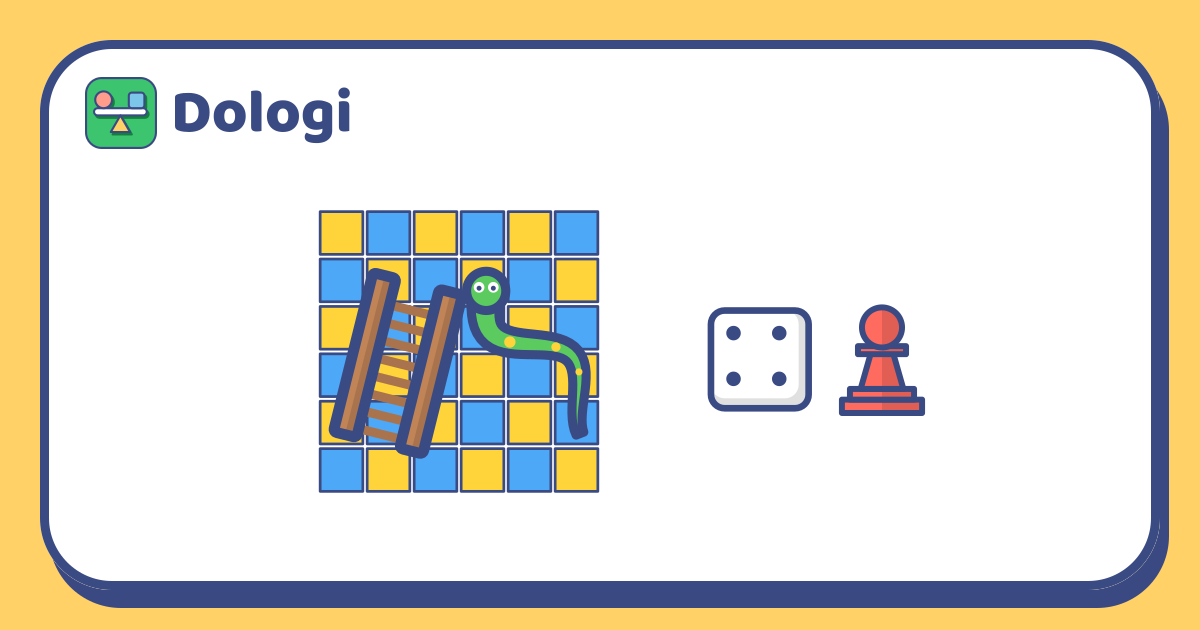
"A four! One, two, three, four… a ladder! Up I go!" Two turns later: "Oh no, the snake!"
Snakes and ladders is a very old game played in many countries: a grid of squares, ladders that take you up, snakes that slide you back down, and a die that decides everything. Drawing your own board turns it into a project. Your child decides how big it is and where every ladder and snake goes, and plays a game they designed.
Choosing the size
A full board of a hundred squares is long for young children; a game can last half an hour. Start smaller.
| Board | Squares | Good for |
|---|---|---|
| 5 × 5 | 25 | Four- and five-year-olds, games of a few minutes |
| 6 × 6 | 36 | Six- and seven-year-olds |
| 10 × 10 | 100 | Eight and up, and for practising numbers to 100 |
Draw the grid on a large sheet with a ruler, or fold the paper to get even lines. Square paper from a maths exercise book works well for small boards.
The zigzag path
On a snakes and ladders board, the path goes left to right along the bottom row, then right to left along the next row, then left to right again. This zigzag confuses almost everyone the first time.
- For children who can't read numbers yet, draw a small arrow at the end of each row showing which way to turn. A start picture in the bottom corner and a finish picture at the top help too.
- For older children, write the numbers in the squares together. On a 10 × 10 board, each row is a ten: the second row starts at 11, the third at 21. Writing them is useful practice in its own right.
Placing the ladders and snakes
Let your child decide where the ladders and snakes go. A few simple rules keep the game fair:
- A ladder starts low and ends higher up. A snake's head is high and its tail is lower.
- Use about as many snakes as ladders.
- On a small board, three ladders and three snakes are plenty.
- Keep a snake away from the square just before the finish if your child is sensitive to losing.
While drawing, ask: "How many squares does this ladder save you?" Your child can count from the bottom of the ladder to the top, square by square, along the path.
Playing, counting, and the sums inside
Players roll the die in turn and move along the path. Land at the bottom of a ladder and climb to the top. Land on a snake's head and slide down to its tail. The first to reach the last square wins.
Counting on from where you stand is the first skill. Count aloud and tap each square, and watch for counting your own square as "one", a very common early mistake.
On a numbered board, every ladder and snake hides a sum:
- "You were on 23 and the ladder took you to 42. How far did you jump?"
- "The snake sent you from 57 to 37. How many squares back is that?"
- On a 10 × 10 board, going straight up one row adds ten. Children often notice this themselves.
When the snake wins
Snakes and ladders is pure luck: nobody chooses where they land. That makes it a good game for talking about luck without blaming anyone. It can still be frustrating. Some ideas:
- Play a cooperative version: everyone keeps going until all pieces have reached the top.
- Give each player one "snake shield" to use once in a game.
- Say what is true: "That was bad luck. The die decided, not you."
| Rough age | What to try |
|---|---|
| 4–5 | A 5 × 5 board with arrows; counting aloud and tapping; two ladders and two snakes |
| 6–7 | A 6 × 6 board; placing the ladders and snakes; counting how many squares a ladder saves |
| 8–9 | A numbered 10 × 10 board; working out each jump and slide; the snake shield |
| 10 and up | Designing a fair board; two dice; changing the rules and testing them |
Ages are only a rough guide, and every child is different.
In Dologi, the Math topic has puzzles such as "Count and answer", where children count the objects in a picture and answer a question about the total. It's the same careful one-by-one counting your child uses on the board.
In short
- Start with a small board (25 or 36 squares) and move up to 100 when your child is ready.
- Arrows at the ends of the rows make the zigzag path clear; on a 10 × 10 board, each row is a ten.
- Let your child place the ladders and snakes, with about as many of each.
- Every climb and slide hides a small sum; luck, not skill, decides the rest.
Read more: Draw your own race track board game: counting squares and adding in your head