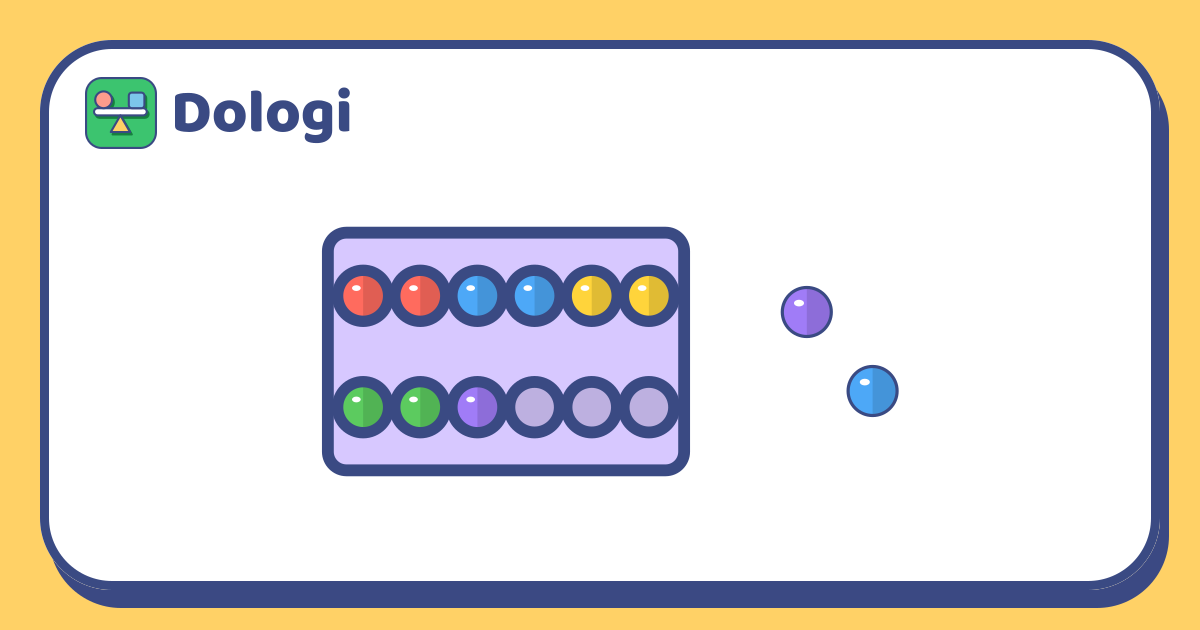
"Two red, two blue, two yellow, two green… and one purple on its own!"
Before an empty egg carton goes in the recycling, it can have a second life as a maths toy. Its cups are a sorting tray, a counting board and, with the lid closed, a shaker. Cardboard cartons with six, ten or twelve cups all work, and the games below need only a few small objects: buttons, pom-poms, beads, dried pasta or pebbles.
Choose objects to suit your child's age. Small items are a choking risk for babies and toddlers, so use bigger ones, such as pom-poms or pasta shapes, with younger children and stay close by.
Sorting treasures
Give your child a mixed handful of objects and an empty carton.
- One colour per cup: all the red buttons here, all the blue ones there.
- One kind per cup: buttons, pasta, beads.
- Let your child invent the rule, then guess each other's: "Why did you put these together?"
When the sorting is done, ask: "Which cup has the most? Which has the fewest?" and count to check.
The right number in each cup
Write a number or draw dots in the bottom of each cup: 1, 2, 3 and so on up to 10 or 12. Your child puts that many objects in each cup.
- Start with dots for younger children; numbers come later.
- Check together by tipping each cup out and counting.
- Mix it up: number the cups in a random order so the counting doesn't follow a pattern.
Shake and count
This works like a homemade die. Number the cups from 1 to 6 (or more), put one pom-pom inside, close the lid and shake. Open it: which cup did the pom-pom land in?
- Count out that many beads, or move that many steps on a board game.
- With two pom-poms, add the two numbers together.
- Keep a tally of results. After twenty shakes, which number came up most?
Pairs, odd and even
A twelve-cup carton has two rows of six, which makes it ideal for pairs.
- Put objects in two by two, one in each row, side by side.
- With 8 objects, every one has a partner. With 7, one is left alone.
- Numbers where everything pairs up are even; numbers with one left over are odd. Children can see it before they can define it.
- Fill both rows equally to see doubles: 3 and 3, 5 and 5, 6 and 6.
Making ten
A ten-cup carton works like a ten frame: two rows of five.
- Put in 7 objects. How many empty cups are left? That's how many more you need to make 10.
- Fill one row of five first, then the next. Children start to see 7 as "5 and 2".
| Rough age | What to try |
|---|---|
| 3–4 | Sorting big objects by colour; one object per cup; counting up to six (with an adult close by) |
| 5–6 | The right number of dots in each cup; shake and count with one pom-pom; making ten |
| 7–8 | Numbers instead of dots; shake and count with two pom-poms; pairs and odd and even |
| 9 and up | Tallying twenty shakes; doubles up to six and six; inventing new carton games |
Ages are only a rough guide, and every child is different.
In Dologi, the Math topic has puzzles such as "Count and answer", where children count the objects in a picture and answer a question about how many there are, the same careful counting as tipping out each cup.
In short
- An empty egg carton is a sorting tray, a counting board and a shaker in one.
- Sort by colour or kind, and put the right number of objects in each numbered cup.
- Shake and count works like a homemade die for counting and adding.
- Two rows of six show pairs, odd and even, and doubles; ten cups show how many more make ten.
Read more: Bean maths: sorting, counting in groups and sharing equally