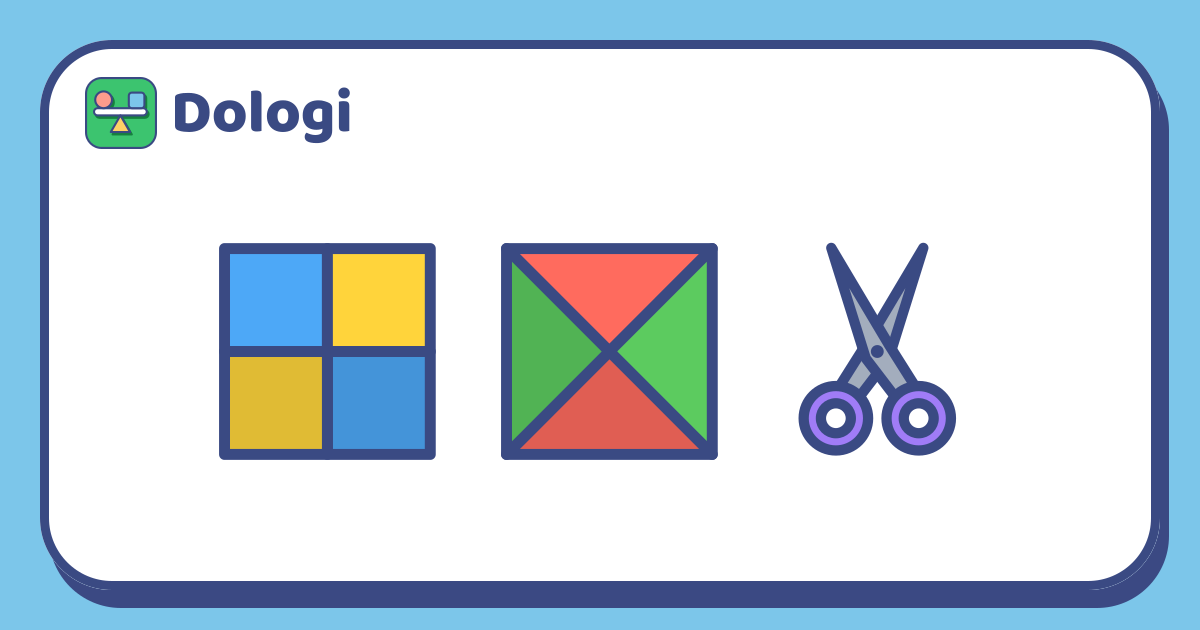
Four farmers share a square field. Each wants a piece exactly the same shape and size as the others. How should they divide it?
Most children quickly draw one line across and one line down. Then comes the question that turns a small task into a real puzzle: "Can you find another way?" Suddenly there isn't one answer but several, and each has to be checked. All you need is paper, a pencil and scissors.
What "equal" means here
In these puzzles, two parts are equal when one fits exactly on top of the other. You may turn a piece round or flip it over, but nothing may stick out.
That is why scissors matter. A drawing can look right and still be wrong. Cutting the pieces out and stacking them settles the question.
Start with a paper square
Cut several squares of paper, all the same size, so that each idea gets its own square.
Two equal parts. Fold edge to edge and you get two rectangles. Fold corner to corner and you get two triangles. Two ways already.
Four equal parts. Here are four ways. The first two are on the cover.
| How to cut | The four parts |
|---|---|
| One line across and one line down | Four small squares |
| Both diagonals | Four triangles |
| Three lines, evenly spaced | Four strips |
| In half, then each half from corner to corner | Four long triangles |
Let your child find the ways before you show any. Even one new way, found alone, is worth more than four ways copied.
Fold and stack to check
- Fold before cutting. A fold finds the middle without a ruler.
- Stack after cutting. If the edges match all the way round, the parts are equal.
- Look at what sticks out. When the pieces don't match, the bit that sticks out shows what to change.
A discovery for older children: on a rectangle, any straight cut through the centre gives two equal parts. Try a slanted one, then turn one piece half a turn and lay it on the other.
A harder field: the L-shape
On squared paper, draw an L made of three large squares: two side by side, and one on top of the left one. Make each large square four small squares wide, and cut out a few copies.
- Three equal parts. Easy: the three squares.
- Two equal parts. One straight cut from the outside corner of the L to the inside corner. The two pieces are mirror images, so one has to be flipped over before stacking.
- Four equal parts, all the same shape. This is a famous tricky one. Give it time.
A hint for the third puzzle: draw a cross in each of the three large squares. Now the field has twelve medium squares, so each of the four parts must have three. The answer is four small L-shapes: one sits in the bend of the big L, and the other three fit around it, one at each end and one in the outside corner.
Same amount, different shape
Here is a question for children of about ten and up. Cut a square down the middle. Cut the left half across, into two small squares. Cut the right half lengthwise, into two long strips.
Are the four parts equal? They don't stack: two are squares and two are strips. But cut one strip in half, lay the halves side by side, and they make the small square exactly.
So there are two meanings of "equal": the same shape and size, or the same amount of paper. Farmers sharing a field might be happy with the second. The puzzles above ask for the first.
What to try at each age
| Rough age | What to try |
|---|---|
| 4–5 | Fold a square in half in two ways; cut and stack |
| 6–7 | Four equal parts in two or three ways; "find another way" |
| 8–9 | The L-shape in two and in three; cuts through the centre of a rectangle |
| 10 and up | The L-shape in four; same amount but different shape |
Ages are only a rough guide, and every child is different.
In Dologi, "Fold and punch" puzzles in the Space topic show a sheet being folded step by step and then punched. Children choose what the sheet looks like when it is opened again, the same back-and-forth between folding and predicting.
In short
- Equal parts fit exactly on top of each other: cut them out and stack them to check.
- A square can be cut into four equal parts in several ways; ask "can you find another way?"
- The L-shape gives three puzzles, from easy to really tricky.
- For older children: the same amount of paper is not always the same shape.
Read more: Teaching fractions to children: start by sharing a cake