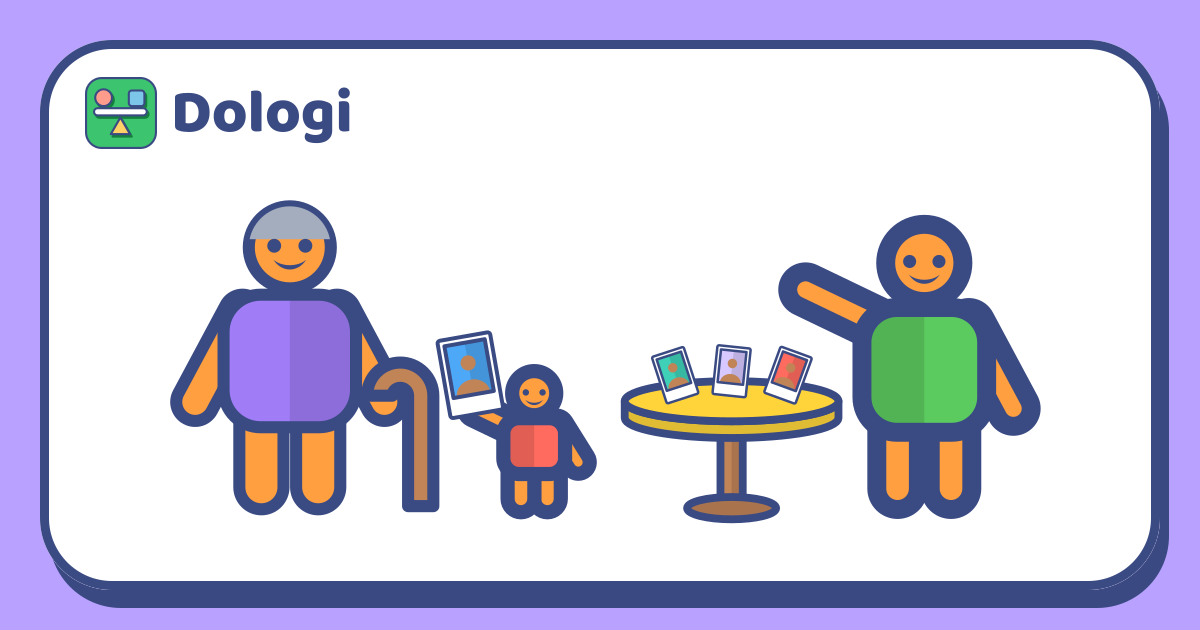
A family gathering brings together people who rarely sit at the same table: grandparents in their seventies, parents, teenagers, and a four-year-old who is already running between the chairs. The adults talk, the children get bored, and sooner or later someone hands out phones.
A few simple games can bring everyone into the same circle. The best ones for a mixed group have two things in common: they don't depend on speed or strength, and the oldest people at the table have something nobody else has, which is their memories. This post gathers games that work for every age, how to set them up with almost nothing, and how to make sure the youngest children can really play.
What makes a game work for every age
Before choosing, it helps to check a game against a short list:
- Short rounds. Five to ten minutes, so that people can join or leave without spoiling it.
- No running, no fast reactions. Grandparents and small children are then on equal terms.
- Something only the older generation knows. Old photos, old games, stories from the past. This turns grandparents from spectators into the people everyone needs.
- Pairs instead of single players. A child aged about 4–6 plays together with an adult, so nobody is left out.
Ages are only a rough guide. Some five-year-olds will want to play on their own, and some nine-year-olds will prefer a partner.
Who is in this photo?
Ask relatives to bring a few photos from when they were children, or find some in old albums beforehand. Lay them face down on the table.
- Turn over one photo at a time.
- Everyone guesses who the child in the picture is now.
- Before the answer, each guesser gives one clue they used: the ears, the way of standing, a house in the background, the year written on the back.
The last step is the useful one. Children learn that a guess can be based on details, not just luck, and they look much more closely at faces. Grandparents usually have a story ready for every photo, which is half the fun.
Put the photos in order
Choose five or six photos of the same person, or of the same house or street, taken in different years. Mix them up and ask a team to put them in order from oldest to newest.
Good clues to look for:
- how tall the person is, or how many children are in the picture,
- whether the photo is black and white or in color,
- trees that grow, cars and clothes that change.
Children aged about 7–12 can explain their order out loud. Younger children can sort just three photos, or put "baby, child, grown-up" in a row. Afterwards, the person in the photos tells the real order and what happened in between.
A game from the old days
Ask each grandparent to teach one game they played as a child: a clapping rhyme, a game with pebbles or seeds, a chalk game on the ground, a riddle passed down in the family. Many traditional games need nothing but hands, a few stones or a piece of string.
Let the grandparent be in charge: they explain the rules, show the moves and decide when someone is out. Children have to listen carefully and remember steps they have never seen before. Parents often discover they half remember the game too. If the rules are long, play a shorter version first.
What changed?
This is a good game for the end of a meal, when people are tired of sitting.
- One person stands in front of the group for about thirty seconds while everyone looks carefully.
- The group turns away or closes their eyes.
- The person changes one or two small things: takes off glasses, rolls up a sleeve, swaps a watch to the other wrist, unbuttons one button.
- Everyone turns back and tries to find what changed.
Start with one obvious change for younger players, then make it harder: two changes, or changes on the back. Grandparents are often excellent at this game, because they notice details.
Pairs so the youngest can play
Four-to-six-year-olds can join every game above when they play with a grown-up partner:
| Game | The child's job | The adult's job |
|---|---|---|
| Who is in this photo? | Turns the photo over, points to a clue | Says the guess, asks "what do you see?" |
| Put the photos in order | Finds the baby photo and the newest one | Places the photos in between |
| A game from the old days | Plays the moves | Remembers the rules |
| What changed? | Says what they spotted first | Checks the rest |
Choose partners across generations where possible: a grandmother with a grandson, an uncle with a niece. Keep score by team, not by person, and finish while people still want one more round.
If children want to keep practicing this kind of noticing and remembering at home, the Memory topic in Dologi has puzzles such as "Put it back", where your child looks at where things are placed and then puts them back in the same spots. It is a short exercise on a tablet, while the photo games belong to the family table.
In short
- Pick games that don't depend on speed and give the older generation a central role, such as old photos and old games.
- Photo guessing and putting photos in order train careful looking, and turn family history into a game.
- "What changed?" and games taught by grandparents work for every age with almost no equipment.
- Pair children aged about 4–6 with an adult, keep score by team and stop before people get tired.
Read more: Games for siblings of different ages: how to play together so both have fun