Kids love running and jumping, and they love numbers more than we think, as long as the numbers are about them: "How far did I jump?" "How many did I get in this time?" A mini sports day in the backyard or at the park combines the two: real movement, then measuring, recording and comparing like a little scientist.
The most important rule of this sports day: everyone competes with themselves. No ranking siblings, no comparing your child with friends. The record to beat is your child's own from last time. Here are five stations for kids roughly 5 to 12, how to measure and record results, and the math that fits each age.
Getting ready
- Where: a backyard, a driveway or a grassy spot at the park, flat and away from cars.
- What you need: sidewalk chalk or a piece of string for lines; a hoop (a hula hoop or a rope tied in a circle); three homemade beanbags (a handful of dried beans or rice in an old sock, tied tight); an hourglass, or just count out loud from 1 to 30; paper and pencils.
- Score sheets: one per person, with the station names down the side and three columns for "try 1, try 2, try 3."
- Warm up gently before you start, and take water breaks between stations.
Five stations
| Station | How to play | How to measure |
|---|---|---|
| Long jump | Stand behind a chalk line and jump forward with both feet | Count heel-to-toe foot lengths from the line to the back heel |
| Beanbag toss | Stand a few steps from the hoop and toss three beanbags | Count the beanbags that land inside |
| Hourglass hops | Hop in place or jump rope while the sand runs | One person counts, your child makes tally marks |
| Balance walk | Walk heel-to-toe along a straight chalk line | Count steps before a foot touches outside |
| Distance throw | Throw a beanbag as far as you can | Count steps from the line to where it lands |
Do three tries at each station. Kids 5 and 6 might do just three stations; older kids can do all five.
Recording with tally marks
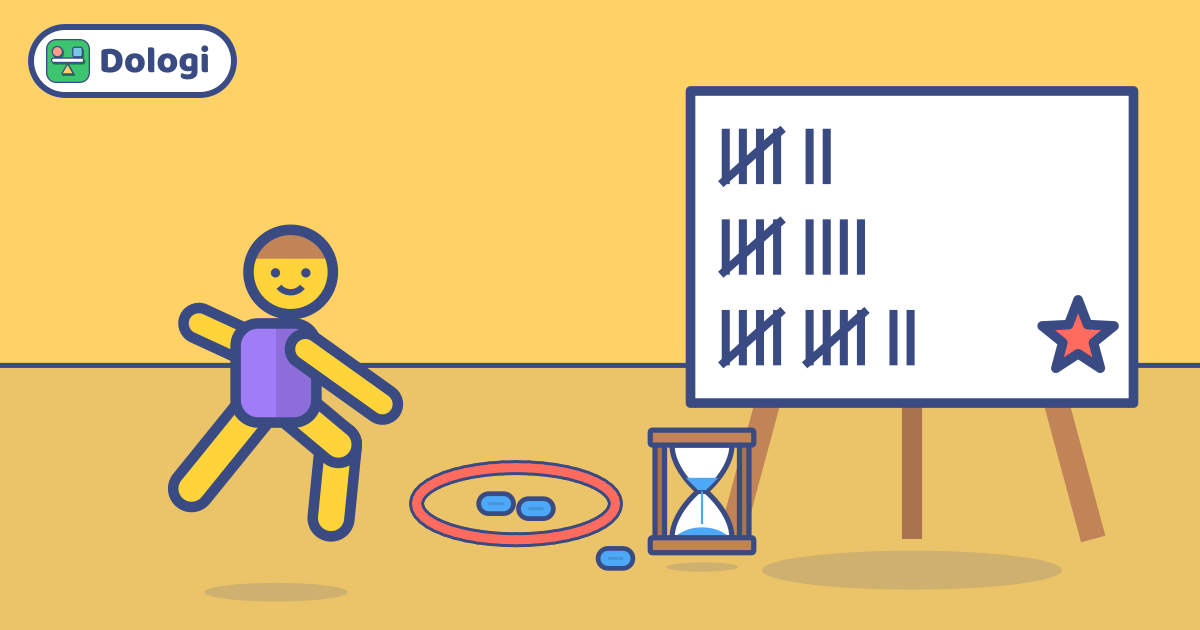
Tally marks are the easiest way for young kids to record numbers: one mark per point, and the fifth mark crosses the first four to make a bundle. Counting by bundles of five is faster than counting each mark.
- Kids 5 and 6 make the marks, and you help count them.
- Kids 7 and up make the marks, then write the number next to them.
- After three tries, your child circles their best try at each station. That's today's record.
Compete with yourself, not your siblings
- One score sheet per person. A 10-year-old and a 5-year-old don't share a scoreboard.
- The record belongs to your child. Next time, your child compares with last time's sheet: "Last time I jumped 5 feet long, today 6."
- Celebrate beating a record, even by a little. Draw a star next to any station where your child beat their own best.
- Not beating a record is fine, too. Ask, "What would you like to try differently next time?" instead of "What happened?"
For a child who gets upset about losing, competing with themselves is much gentler. When kids cry after losing has more on helping kids handle winning and losing.
The math of sports day, by age
- Ages 5 and 6: counting and comparing more, fewer and the same. "Which toss got the most in?"
- Ages 7 and 8: adding up three tosses, finding the best try, finding the difference: "How many feet longer than your record was that?"
- Ages 9 to 12: measuring in inches or centimeters with a tape measure, finding the average of three tries (add them up, divide by three), and drawing a bar graph of records over several weeks.
A great question for any age: if Dad measures your jump with his feet and you measure it with yours, do you get the same answer? No, because everyone's feet are a different length. It's the perfect moment to talk about why people need shared units like inches and centimeters. Measuring for kids goes into this in more detail.
For more practice comparing lengths, the Math topic in Dologi has a puzzle called Put in order, including "Put the pencils in order from shortest to longest." Just like lining up today's jumps from shortest to longest, your child has to look carefully before sorting.
In short
- Five simple stations: long jump, beanbag toss, hourglass hops, balance walk, distance throw; three tries each.
- Record with tally marks in bundles of five and circle the best try as today's record.
- Everyone competes with their own last score, never with siblings.
- The math grows with age: counting and comparing, adding and finding differences, measuring in units, averages and bar graphs.
Read more: Which ball bounces highest?, Measuring for kids