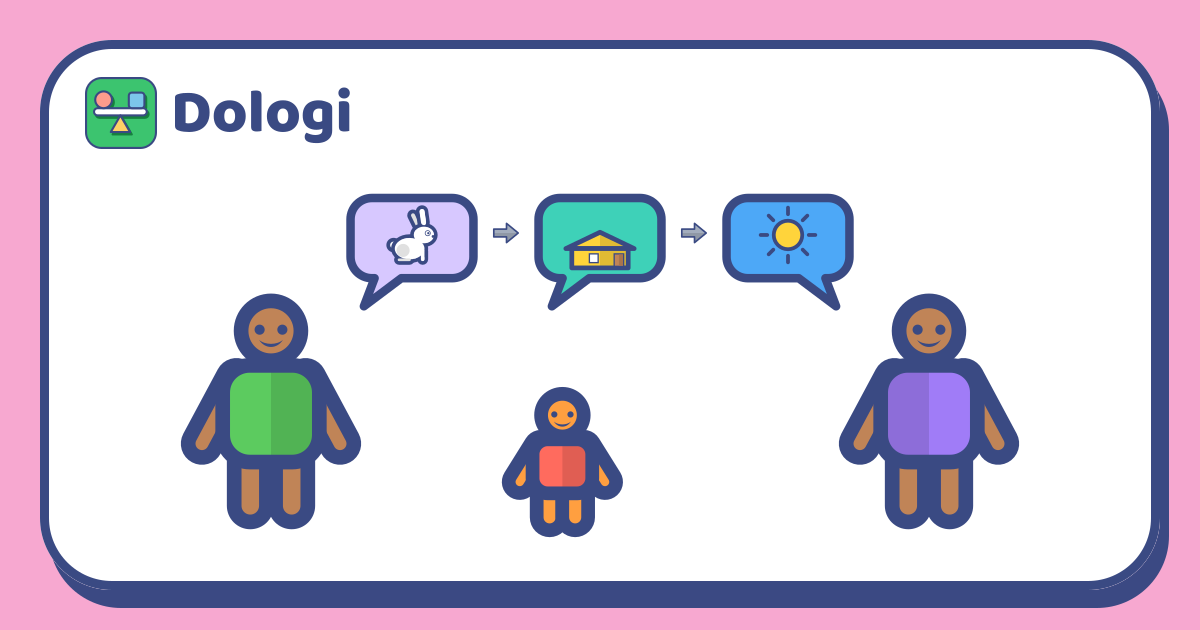
"Once upon a time there was a rabbit." "The rabbit lived in a house with a red door." "One morning the sun didn't come up…"
In a story chain, each person adds one sentence and then passes the story on. Nobody knows how it will end, which is half the fun. The game needs no cards, no paper and no screen, so it fits a meal, a car ride or the last ten minutes before bed. And because you can only add a sentence that fits what came before, everyone has to listen.
How to play
- Sit in a circle, or simply agree on an order: Dad, then the children, then Mum.
- The first person begins: "Once upon a time…"
- Each person adds one sentence that carries on from the one before.
- Go round two or three times. The last person in the last round ends the story.
Keep each turn short. One sentence is the rule, not a paragraph. Short turns keep the story moving and give young children a turn again quickly.
Start yourself, and make your first sentence simple and open: a character and a place are enough. "There was once a small bird who lived at the top of a tall tree" gives the next person plenty to work with.
Rules that make everyone listen
Once the basic game is going well, add one rule. A rule gives the story a little challenge, and it makes players listen more carefully to the sentence before theirs.
| Rule | How it works |
|---|---|
| An animal in every sentence | Each sentence must mention an animal, new or already in the story |
| Lucky, unlucky | Sentences take turns starting with "Luckily…" and "Unluckily…" |
| Take the last word | Your sentence must use the last important word of the sentence before |
| The secret object | Before you start, choose an object (an umbrella) that must appear before the end |
| No "and then" | Sentences must start in a different way each time: "Suddenly", "Meanwhile", "The next day" |
One rule at a time is plenty. Let your child choose the rule now and then.
The retelling round
When the story is finished, ask: "Who can tell the whole story from the beginning?"
Retelling the story is where most of the listening happens. Your child has to remember not just their own sentences but everyone else's, in the right order. Some ways to make it easier:
- Retell it together, each person saying their own sentence again in order.
- Let the youngest go first and help with "Who came next?" rather than giving the answer.
- Use fingers: one finger for each sentence, so your child can see how far through the story they are.
- After a good story, your child can draw it as a strip of three or four pictures.
Don't turn the retelling into a test. If a sentence is forgotten, the person who said it can give a hint.
When the story goes off the rails
Story chains don't always go smoothly. Some common moments:
- Everything becomes silly. A story full of flying sausages is still a story. If it gets too wild, the "lucky, unlucky" rule gives it a shape again.
- Your child's mind goes blank. Offer two choices: "Does the rabbit open the door, or hide under the bed?"
- One player takes over. Hold to one sentence per turn, for adults too.
- Someone ignores what came before. Ask: "How does that fit with the house with the red door?" Then let them try again.
- The story never ends. Agree on the number of rounds before you start.
| Rough age | What to try |
|---|---|
| 4–5 | Two rounds; you help with "And then what happened?"; retelling with fingers and help |
| 6–7 | Three rounds; one rule, such as an animal in every sentence; retelling the story in order together |
| 8–9 | "Lucky, unlucky" or the secret object; a planned ending; retelling alone |
| 10 and up | Two rules at once; a story in a fixed style (a fairy tale, a mystery); writing down the best story |
Ages are only a rough guide, and every child is different.
In Dologi, the Listening topic has short puzzles such as "Which note changed?", where your child hears a tune twice and finds the note that is different. Like a story chain, it asks them to listen to every part, not just the beginning.
In short
- Each person adds one sentence, and the story goes round two or three times.
- One rule at a time (an animal in every sentence, lucky and unlucky) makes everyone listen to the sentence before.
- The retelling round at the end is where most of the listening happens.
- Short turns, two choices and an agreed number of rounds keep the game going.
Read more: Storytelling with homemade picture dice: roll three, tell one story