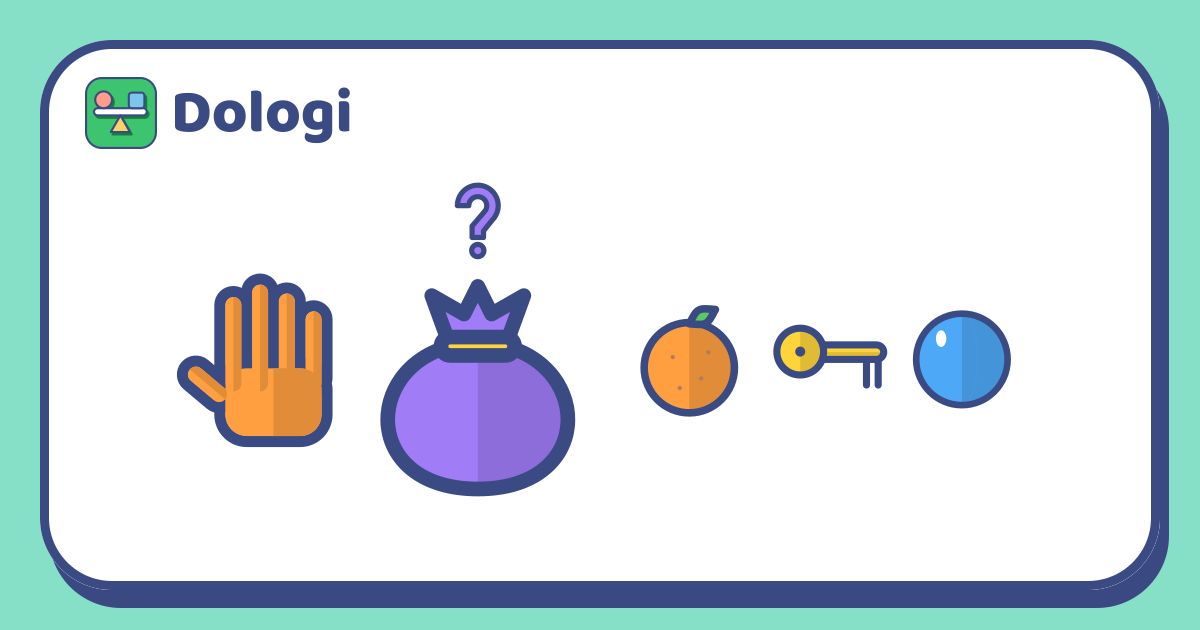
A hand goes into the bag. The eyes stay outside. "It's cold… and smooth… one end is round… it's a spoon!"
Without sight, your child has to collect clues with their fingertips, put them into words and reason their way to an answer. It is a quiet, concentrated game: for a minute or two, all attention goes to one hand. This article explains how to play and how to make the game grow with your child.
What you need
- A bag you can't see through: a cloth bag, a pillowcase, or a long sock for small things. A box with a hand-sized hole works too.
- Eight to ten familiar objects: a spoon, a key, a pencil, a ball, an orange, a toy car, a clothes peg, a comb, a sponge, a button.
Choose only safe things: nothing sharp, nothing breakable, nothing hot or sticky.
How to play
- Hide one object in the bag while your child looks away.
- One hand goes in. No peeking.
- Describe before you guess. Your child says three things about what they feel: "hard, long, cold". Only then do they name it.
- Take it out and check.
The third step is the heart of the game. Without it, children blurt out the first idea. With it, they slow down, gather evidence and find words for it. And if the guess is wrong, the description shows why: "You said it was round. Feel again: is it round all over?"
Words for what hands feel
Children often feel more than they can say. Offer the words as you play.
| What to notice | Useful words |
|---|---|
| The surface | smooth, rough, bumpy, fluffy |
| How hard it is | hard, soft, squashy, bendy |
| How warm it is | cold, cool, warm |
| The shape | round, flat, long, pointed, with a hole, with corners |
| Size and weight | heavy, light, fits in my hand, longer than my hand |
A good question to ask: "What else can you tell me about it?"
Five levels
| Level | How it works |
|---|---|
| 1. Name it | One object in the bag; describe it, then say what it is |
| 2. Find it | Several objects in the bag; "find the key" without looking |
| 3. Find the twin | One object on the table, its twin in the bag among others |
| 4. Nearly the same | Similar things together: a coin and a button, a pencil and a crayon, an orange and a ball |
| 5. Describe for others | One player feels and describes; the others guess from the words alone |
Level 4 is where careful fingers really matter. A coin and a button are both small, round and flat. The difference is in the details: the holes, the edge, the weight.
Level 5 turns the game round. Now the describer has to choose the most telling clues, and the listeners have to build a picture from words.
Tips
- Take your turn too, and think aloud: "It's light and it bends a little. Not metal, then."
- Don't rush a wrong guess. Ask what made your child think so, and let them feel again.
- Some children dislike putting a hand where they can't see. Let them fill the bag for you first, or use an open box covered with a cloth.
| Rough age | What to try |
|---|---|
| 4–5 | Very different, familiar objects, one at a time; you supply the words |
| 6–7 | Three things to say before guessing; "find it" with several objects |
| 8–9 | Nearly-the-same objects; describing for others to guess |
| 10 and up | Drawing the object from touch alone before taking it out |
Ages are only a rough guide, and every child is different.
In Dologi, "Find the shadow" puzzles in the Focus topic work with a similar idea: children recognise an object from its outline alone, without colour or detail, by paying attention to the few clues they do have.
In short
- One hand in the bag, eyes outside: clues come from touch alone.
- Describe three things first, then guess, then check.
- Offer words for surface, hardness, warmth, shape, size and weight.
- Move on to finding twins, telling similar things apart and describing for others.
Read more: Whose shadow is that? Reasoning from shadows with a torch and everyday objects