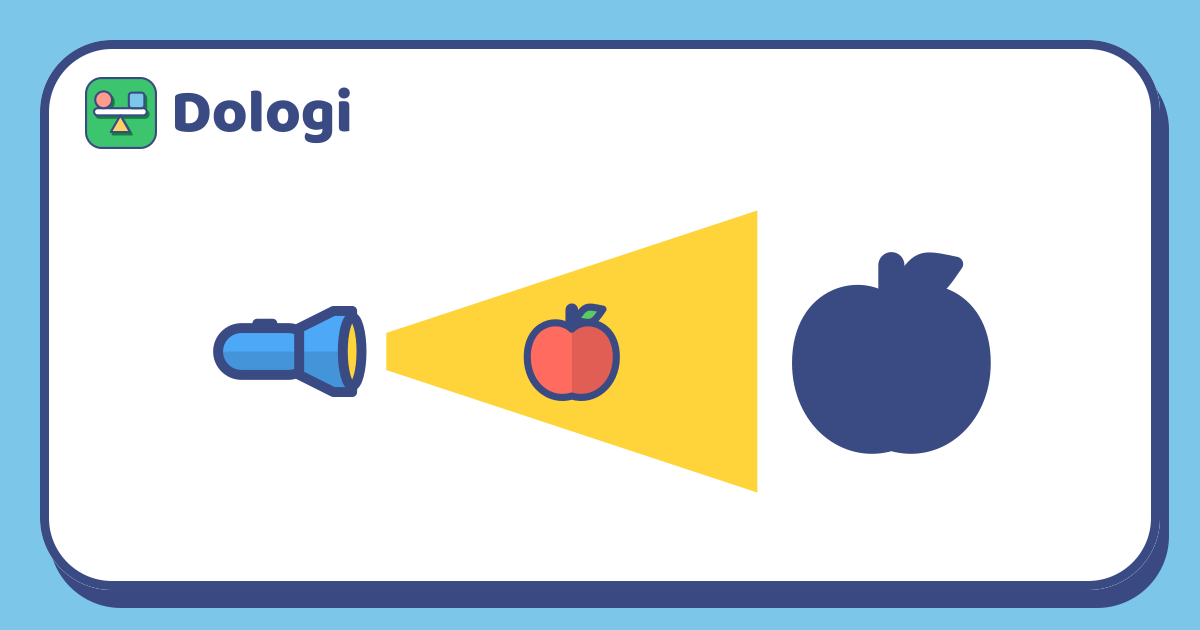
The room is dim. A torch shines on the wall. You hold something in the light and your child sees only its shadow. "What is it?"
A shadow keeps the outline of a thing and throws away everything else: colour, pattern, what it is made of. Guessing an object from its shadow means reasoning from incomplete information. What do I know for sure? What could it be? What would help me decide? Those are useful questions well beyond shadow games.
Setting up
- A light: a torch (flashlight), or the light on a phone.
- A screen: a pale wall, or a sheet hung over a doorway.
- A tray of six to eight objects with clear outlines: a fork, a spoon, a cup, a key, a toothbrush, a toy animal, a leaf, a ball, an apple.
- A darkened room. It doesn't have to be completely dark.
Your child sits facing the wall with their back to you, so that they see the shadow but not the object. Two safety rules: never shine the torch into anyone's eyes, and use a torch, not a candle.
Three rounds to play
Round 1: name the object. Hold one thing in the light. Your child names it and says which clue gave it away: "It has four prongs, so it's a fork." The clue matters as much as the answer.
Round 2: turn it. Use the same object but turn it slowly. A cup seen from the side shows its handle. Seen from below, it is only a circle. A coin makes a circle when it faces the light and a thin line when it is edge-on. One object can have several shadows.
Round 3: the mystery circle. Start with the least helpful view. A round shadow could be a ball, a plate, an orange or the bottom of a cup. Let your child list everything it could be, then turn the object little by little until they are sure.
Two questions keep the thinking going: "What can you tell for sure?" and "What can't you tell from a shadow?" A shadow shows the outline. It can't show colour, material or the picture printed on a cup.
Why do shadows grow and shrink?
Now your child holds the object. Before each change, ask for a prediction.
| Try this | What happens |
|---|---|
| Move the object closer to the torch | The shadow gets bigger |
| Move the object closer to the wall | The shadow gets smaller and sharper |
| Move the torch to one side | The shadow slides to the other side and stretches |
Let your child put the rule into their own words, something like "nearer the light, bigger shadow". The cover shows it: a small apple close to the torch, a large shadow far away.
A simple way to explain: light travels in straight lines. The object blocks some of them. The closer it is to the torch, the more of the beam it blocks.
Outside on a sunny day, shadows follow the same idea. Draw round your child's shadow with chalk in the morning and again at midday, standing on the same spot. The shadow is long when the sun is low and short when the sun is high. Remind children never to look straight at the sun.
Make shadow cards
Tape a sheet of paper to the wall, hold an object in the light and let your child trace round its shadow. A few of these make a set of shadow cards.
- Match them. The next day, lay out the objects and the cards. Which shadow belongs to which thing?
- Trick cards. Trace the same object from two directions. Can anyone tell that both cards are the same cup?
- Swap roles. Your child makes mystery shadows for you, perhaps with two objects held together to make a new shape.
| Rough age | What to try |
|---|---|
| 4–5 | Guessing familiar objects; matching objects to traced shadows |
| 6–7 | Turning objects: one object, several shadows; saying the clue aloud |
| 8–9 | The bigger-and-smaller experiments, with a prediction first |
| 10 and up | Different objects with the same shadow: list the possibilities, then test them; sun shadows at different times of day |
Ages are only a rough guide, and every child is different.
In Dologi, "Find the shadow" puzzles in the Focus topic show a coloured object and several shadows. Children choose the shadow that really belongs to it, looking closely at details such as how many petals or arms it has.
In short
- A shadow keeps the outline and drops everything else, so guessing from it is reasoning from clues.
- Play three rounds: name the object, turn it, then start from the least helpful view.
- Experiment with distance: nearer the light means a bigger shadow. Predict first, then try.
- Trace shadows to make cards, and let your child set mysteries for you.