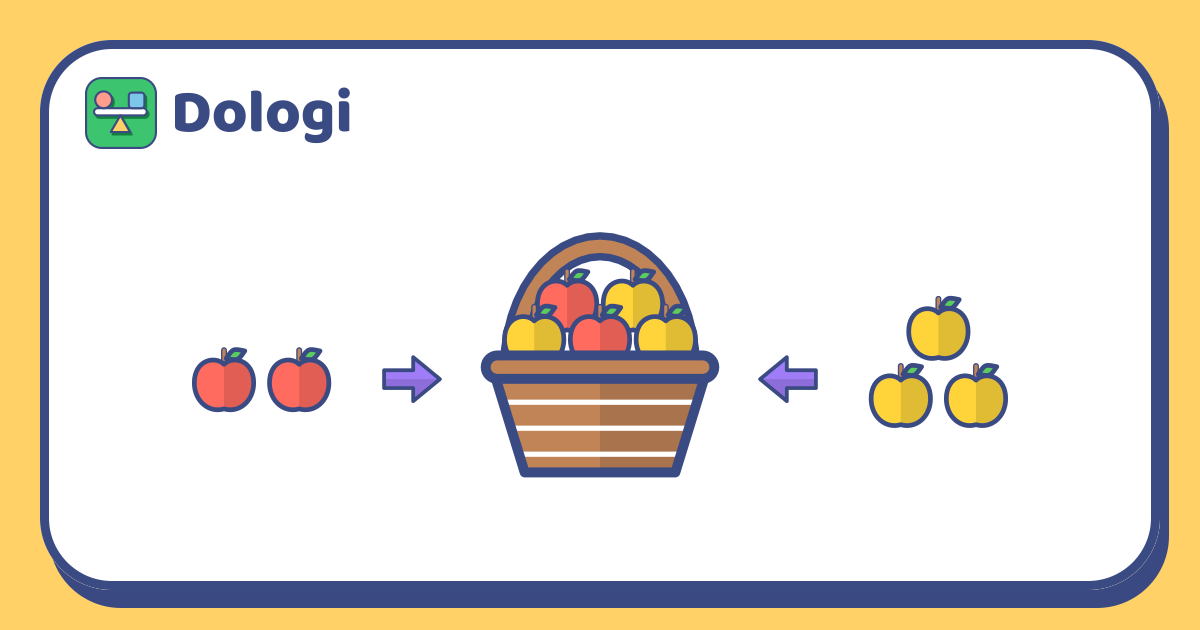
Your child has two apples, and you hand over three more. Ask "how many apples do you have now?" and watch what happens. Some children count everything again from the start, some say "five" straight away, and some get stuck because they don't know where to begin. All three are normal steps on the way to understanding addition.
For children aged about 4 to 6, the easiest way in is to put two groups of real things together, then count. Sums on paper come later.
Addition starts with putting things together
For young children, addition is something that happens to objects, not to numbers. There are two everyday situations:
- Adding more: your child has two toy cars and a friend gives them one more. The first group gets bigger.
- Putting together: two apples on this plate, three on that one, all tipped into a basket. Two groups become one.
Both lead to the same question: "How many are there altogether now?" When you play, mix both kinds and talk through each step slowly: "Here are two apples. Here are three. Let's put them all in the basket. How many are in the basket?"
Before combining groups, your child needs to count a small group reliably: one number for each object, and the last number tells how many. If they still skip objects, play counting games a little longer first.
Three ways children count when combining
Children usually move through three ways of counting, each faster than the last. There is no need to rush them.
| Way of counting | What your child does (2 apples and 3 apples) | What you can say |
|---|---|---|
| Counting all | Tips everything into the basket and counts from the start: "1, 2, 3, 4, 5" | Let them count freely and praise careful pointing |
| Counting on | Remembers the first group is 2 and keeps going: "3, 4, 5" | "This group already has 2. Let's carry on counting from there" |
| Counting on from the bigger number | Starts from the group of 3 and counts 2 more: "4, 5" | "Which group has more? Start there and you have less to count" |
Counting on is a big leap: your child has to trust that the first group is still 2 without counting it again. One way to help is to hide the first group under a bowl, say "there are 2 under the bowl", then count on with the ones still outside.
Counting on from the bigger number comes later, once your child understands that 2 + 3 and 3 + 2 give the same answer. Set out two groups, count them in one order and then the other, and let your child see that the number in the basket stays the same.
Combining games with everyday things
Each game takes a few minutes, for example while setting the table.
- Two plates, one basket. Put small things on two plates (apples, chestnuts, bottle caps). Your child counts each plate, guesses how many there will be together, then tips them into a basket and counts to check.
- Secret hands. Hide a few beans in each of your hands. Open your left hand for your child to count, close it, then open your right. "How many beans in both hands?" This practises exactly what counting on needs: remembering the first group.
- Toy bus. A box becomes a bus. Three soft toys get on at the first stop and two more at the next. "How many passengers are on the bus?"
- Two dice. Roll two dice and count the dots on both. Once that feels easy, start from the die with more dots and count on the dots of the other one.
- One number, many ways. Give your child five clothes pegs and two cups. How many ways can they share the pegs between the cups? Four and one, three and two… Five can be made from several pairs.
Keep the numbers small, with totals up to 10, until your child finds it comfortable.
From real objects to sums on paper
The sum 2 + 3 = 5 is a short way of writing down a little story. It makes more sense when children climb up step by step:
- Real objects. Your child holds them, moves them, counts them.
- Say it as a sentence. "Two red apples and three yellow apples make five apples." Let your child say it, and only prompt when they get stuck.
- Draw dots. Draw two dots and circle them, three dots and circle them, then draw a big circle around all five.
- Write the numbers. Write a number under each group of dots, then add the plus and equals signs: plus means "put together with", equals means "makes the same as".
Sometimes go the other way: you write 1 + 4 and your child sets out real objects to match. That keeps the numbers linked to a picture in their head.
Where children often get stuck
- Counting the starting number again. When counting on from 3 to add 2, a child says "3, 4" and ends up with 4. Ask them to touch each added object: the first one is "4", the second is "5".
- Counting an object twice when the basket gets full. Suggest taking each object out of the basket as they count it.
- Writing sums too early. If your child writes the right answer but can't tell the story behind it, go back to real objects for a while.
- Using fingers. Counting on fingers at this stage is normal and useful: fingers are objects children always have with them.
Every child moves through these steps at their own pace, and the ages here are only a rough guide.
When your child is comfortable counting on, the "Number line hops" puzzles in Dologi's Math topic show a rabbit jumping along arrows, and your child works out which number it lands on. Each hop is another way of counting on, with places on a number line instead of apples.
In short
- A child's first addition is putting two groups of real things together and counting how many there are altogether.
- Children usually move from counting all, to counting on, to counting on from the bigger number, and each step takes time.
- Play short games with everyday things, keep totals up to 10, and say it as a sentence before writing it down.
- Go from real objects to drawn dots before written sums, and sometimes work the other way round.
Read more: Mental maths to 20: simple strategies for adding and subtracting in your head