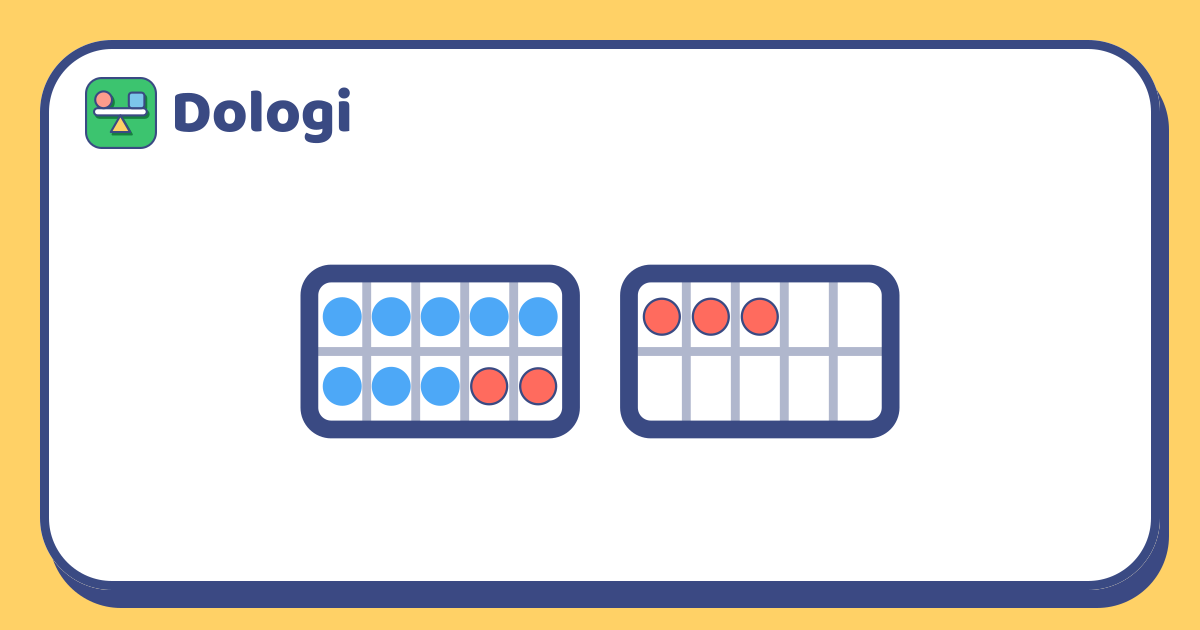
When children first add, they count everything: 8 + 5 means counting eight, then five more, often on fingers. That is a normal and useful start. But by around 6 or 7, many children are ready for something faster. Adding and subtracting within 20 in their head is the base for almost everything that comes later: bigger numbers, columns, times tables, money.
The goal is not to memorise a hundred separate facts by drilling. It is to learn a few key facts well, and a few clever ways to use them. This article shows which facts to start with, the main strategies, and short games to practise at home.
The facts that unlock the rest
A small set of facts does most of the work. If your child knows these well, they can work out almost everything else within 20.
- Pairs that make 10. 1 + 9, 2 + 8, 3 + 7, 4 + 6, 5 + 5. These are the most useful facts of all.
- Doubles. 2 + 2, 3 + 3, up to 10 + 10. Children often remember them easily because they come in pairs: two hands, two feet.
- One more, one less. Adding or taking away 1 is just the next or previous number.
- Ten and some more. 10 + 3 is 13, 10 + 7 is 17. This is where children see that numbers in the teens are "ten and some ones".
Practise these first, with objects and pictures, until your child can answer without counting.
Strategies for adding
| Strategy | Example | How your child might say it |
|---|---|---|
| Count on from the bigger number | 3 + 8 | "Start at 8, then 9, 10, 11." |
| Make ten | 8 + 5 | "8 needs 2 to make 10. 5 is 2 and 3. So 10 and 3, that's 13." |
| Near doubles | 6 + 7 | "6 + 6 is 12, and one more is 13." |
| Adding 9 | 9 + 6 | "Add 10, that's 16, then one less: 15." |
Making ten is the strategy that pays off most, because it works the same way later with 28 + 5 or 38 + 7. A ten frame makes it easy to see: a box of two rows of five, with dots or buttons. Put 8 buttons in, then add 5: two fill the frame, and three are left over. Ten and three.
Strategies for subtracting
Subtraction often feels harder, so give it its own time.
- Think of it as adding. 13 − 8: "8 and what make 13?" Children who know their adding facts can use them backwards.
- Back through ten. 14 − 6: "Take 4 to get to 10, then 2 more: 8."
- Count up the difference. 12 − 9: "From 9 to 10 is 1, from 10 to 12 is 2. That's 3." This works well when the two numbers are close.
- Use doubles. 14 − 7 is 7, because 7 + 7 is 14.
Ask your child which way they used. There is often more than one good way, and explaining it helps them choose quickly next time.
A few minutes a day
Short, regular practice works better than long sessions. Five minutes in the car, at the table or on the way to school is enough.
- Partner to ten. You say a number, your child says the number that makes 10 with it. "Three!" "Seven!" Then swap roles.
- Make-ten card game. Take the cards from 1 to 9 from a deck of cards. Lay them face up, and take turns finding two cards that make 10.
- Double dice. Roll one die and double it. Later, roll two dice and add them, saying the strategy out loud.
- Egg box frame. Cut an egg box to ten cups. Fill it with dried beans to show numbers, and use it to try "make ten" with real objects.
- Number line hops. Draw a line from 0 to 20 in chalk outside. Your child jumps to show 8 + 5: first to 10, then 3 more.
Avoid timing your child at the start. Speed comes naturally once the facts feel easy. If your child still counts everything on fingers after a lot of practice, that is fine for now: keep going with objects and pictures, and talk to the teacher if you are unsure.
Mental maths in Dologi
In Dologi's Math topic, the "Number line hops" puzzles show a rabbit jumping along arrows on a number line, and your child works out where it lands. It is a gentle way to see adding as jumps, which is the same picture as counting on and making ten.
In short
- Start with the key facts: pairs that make 10, doubles, one more or less, and ten and some more.
- Teach strategies, not just answers: count on, make ten, near doubles, adding 9.
- For subtraction, think of adding, go back through ten, or count up the difference.
- Practise for a few minutes a day with games, and leave speed for later.
Read more: Is it OK for children to count on their fingers? Helping them move from counting to understanding numbers.