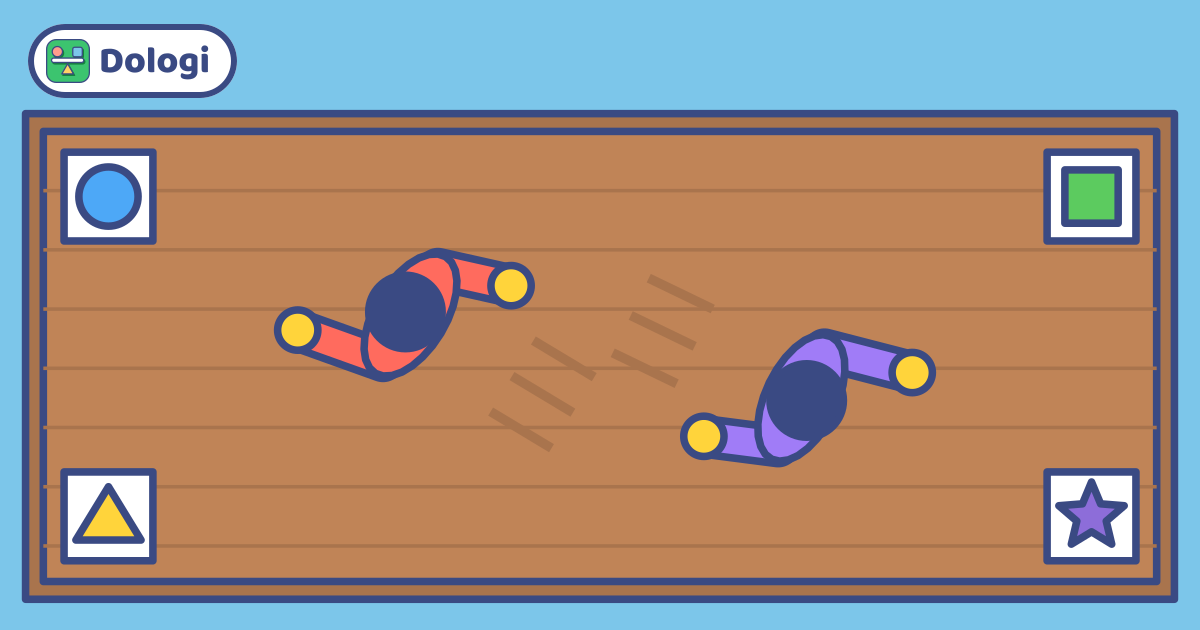
Some kids can sit at a table answering riddles for about two minutes before the wriggling starts. This game gets them on their feet: every answer is a run to a corner of the room. You read the question, your child picks a corner, then explains from that corner why they chose it. It works for children aged 5 to 10, whether you have one child or a few siblings.
Getting ready
- Four large sheets of paper, each with a shape in a different color: a blue circle, a green square, a yellow triangle, a purple star. Tape them in the four corners at your child's eye level.
- Clear a path: push chairs aside and pick toys up off the floor. On slippery floors, go barefoot rather than in socks.
- Small room? Change the rule: "walk fast, no running," or hop or tiptoe to the corner.
- A list of questions written in advance, each with four answers linked to the four shapes.
How to play
- Everyone stands in the middle of the room. Read the question and the four answers: "Which animal lays eggs? Circle: a cat. Square: a chicken. Triangle: a dog. Star: a cow."
- Count "one, two, three, go!" Everyone runs to the corner they choose.
- Before you reveal the answer, each corner gives its reason in one sentence: "I picked square because I saw a hen sitting on eggs at Grandma's."
- Reveal the answer, then everyone comes back to the middle for the next question.
Nobody is out, and nobody keeps score. A wrong pick still plays the next question. The best part is hearing the reasons, including the ones from the wrong corner.
Kinds of questions
| Type | Example for ages 5–6 | Example for ages 8–10 |
|---|---|---|
| Riddle | "What has legs but can't walk?" (a table, an ant, a pair of shoes, a ball) | "What gets bigger the more you take away?" (a hole, a balloon, a sheet of paper, a cup) |
| Sum | 3 + 4 = ? (6, 7, 8, 9) | 6 × 7 = ? (36, 42, 48, 54) |
| True or false | Use only two corners: circle is true, square is false. "Fish live in water." | "A whale is a fish." |
| Odd one out | A spoon, a bowl, a fork, a shoe | See the next section |
| About our family | "What did we have for dinner last night?" | "What year was Grandma born?" |
For true-or-false questions, use two opposite corners so your child has the longest run.
Questions with more than one right answer: let the corners argue
Now and then, ask a question where every corner can be right if they can explain it. For example:
"Which one doesn't belong? Circle: a banana. Square: an orange. Triangle: a ball. Star: a watermelon."
- Banana corner: "The other three are round; only the banana is long."
- Ball corner: "You can eat the other three, but not a ball."
- Orange corner: "Only the orange has the same name as a color."
- Watermelon corner: "The watermelon is the biggest; you can't carry it alone."
Instead of announcing "the right answer," ask each corner, then ask the others: "Does the reason from that corner hold up?" Your child learns that one question can have several answers, as long as the reason stands.
Next round: your child asks, you run
After a few questions, swap roles. Your child thinks of three questions, decides which answer goes with which shape, and has to know the right one. You do the running. Kids love watching their parents dash around the room, and to write a four-answer question they have to invent three wrong answers that still sound plausible, which is much harder than answering.
Tips for parents
- Mix easy and hard questions so your child gets plenty of right runs.
- Several siblings: let the youngest give their reason first so they don't just repeat the older ones.
- Child just follows the others? Have everyone close their eyes and point to a corner first, then open their eyes and run.
- Ten questions make a round. Stop while your child still wants more.
The Logic topic in Dologi has a puzzle called Two rings: "Drag each thing into the ring whose label fits it, or the middle if both do." Like the odd-one-out question, your child has to work out what each thing fits, and sometimes a thing fits both.
In short
- Four shapes in different colors in the four corners are the four answers; every answer is a run.
- From their corner, each player gives a reason before the answer is revealed; nobody is out.
- Mix riddles, sums, true or false and odd one out; sometimes ask a question with several right answers to argue about.
- In the next round your child asks the questions and you run.
Read more: Asking "Why do you think that?" even when your child is right, "My child argues about everything": turning arguments into a debate game