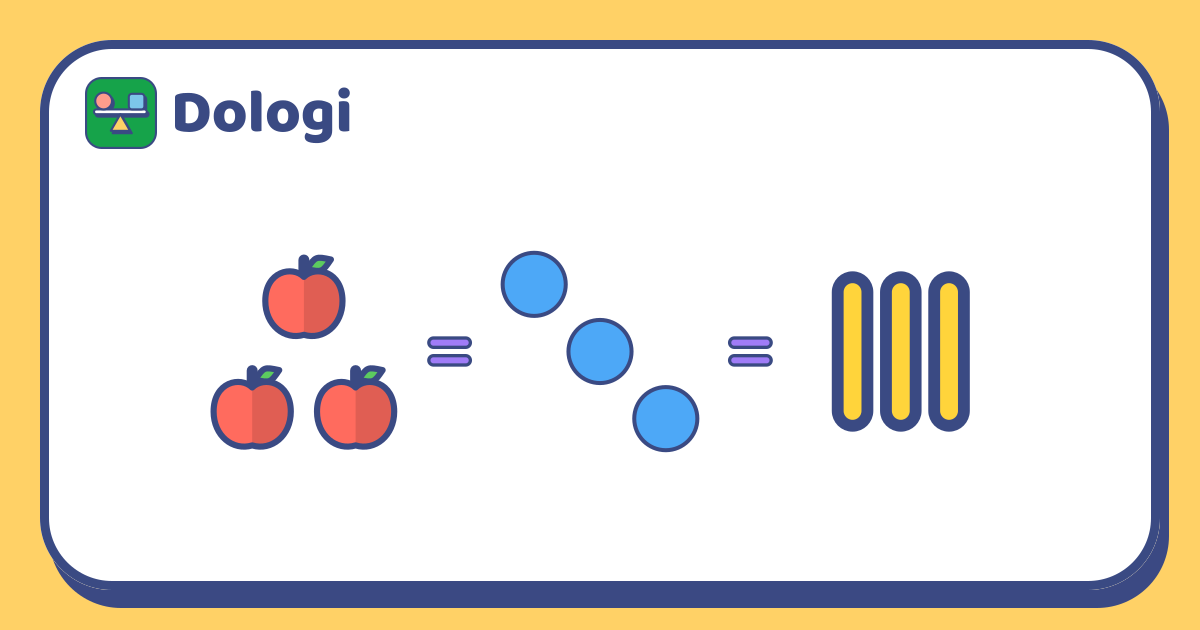
A child counts three apples on the table: "One, two, three." You ask, "So how many apples are there?" and they start counting again: "One, two, three…" It's a common moment, and a revealing one. Saying the numbers in order is not quite the same as understanding what "three" means.
Understanding numbers grows in stages. Children slowly discover that a number is an idea that can be shown in many ways: three apples, three dots, three claps, three fingers or the written numeral 3. This article looks at those stages, with games to try at home. Ages are only rough guides; every child is different.
One number, many faces
The same amount can appear in very different forms:
| Form | Example of "three" |
|---|---|
| Real objects | Three apples on a plate |
| Pictures | A drawing of three cars |
| Dots | Three dots, like on a die |
| Tally marks | Three short lines |
| Fingers | Three fingers held up |
| Sounds and actions | Three claps, three jumps |
| Words and numerals | "Three", the digit 3 |
Adults switch between these without thinking. For children, each link is something to discover. A child who can match three apples with three dots and the digit 3 is building a strong sense of number.
The big idea: the last number tells "how many"
When children count, the last number they say tells the total. This sounds obvious, but it's a real step.
- A quick check: after your child counts a small group, ask, "So how many are there?" If they say the last number straight away, they've got the idea. If they count again, they're still on the way.
- When it often clicks: many children grasp this somewhere around 4 to 5, though the timing varies a lot.
- How to help: model it yourself. "One, two, three, four. There are four spoons." Emphasise the last number and the word "four" as a total.
Counting things in everyday life, such as stairs, grapes and shoes, and always finishing with "so there are…", gives plenty of practice.
Seeing small amounts at a glance
Most people can see up to about four or five things and know how many there are without counting. This is sometimes called "instant recognition". Children develop it with practice.
- Flash a dot card: draw dots on cards, show one for a second, and ask how many. Start with one to three.
- Use dice patterns: the dot patterns on a die become familiar quickly. "Was that four or five?"
- Spot amounts around you: three birds on a wire, two cups on the table.
- Try different arrangements: three dots in a row, in a triangle, scattered. Which is easiest to see?
Instant recognition helps children move away from counting one by one, which makes later adding and subtracting much easier.
Does it change if we move them?
Put five buttons in a short row and five in a long, spread-out row. Ask, "Which row has more?" Many young children point to the longer row, even though both have five. Around 6 or 7, many begin to understand that moving things doesn't change how many there are.
- Play it as a game: "Let's count. Now I'll spread them out. Are there more now?"
- Let your child check: count again together and talk about what you find.
- Don't correct too fast: the surprise of finding "still five!" is where the learning happens.
Matching games across forms
These games link the different faces of a number:
- Number memory: make pairs of cards: one with objects (three apples), one with dots (three dots), or later, one with the numeral 3. Play a matching game face down.
- Show me three: call out a number and your child shows it in as many ways as possible: fingers, claps, jumps, blocks, a drawing.
- Tally the day: make a tally mark each time you see a dog on a walk, then count the marks at home.
- Number hunt: pick a number and find it around the house: four chair legs, two windows, five fingers.
In Dologi, several Math puzzles show amounts in ten frames, dice patterns and dominoes, so children get used to seeing quantities at a glance and linking them to numbers.
In short
- A number can take many forms: objects, pictures, dots, tally marks, fingers, sounds and numerals.
- A key step is understanding that the last number counted tells "how many".
- Help children see small amounts at a glance with dot cards and dice patterns.
- Explore whether moving things changes the amount, and play matching games that link different forms of the same number.