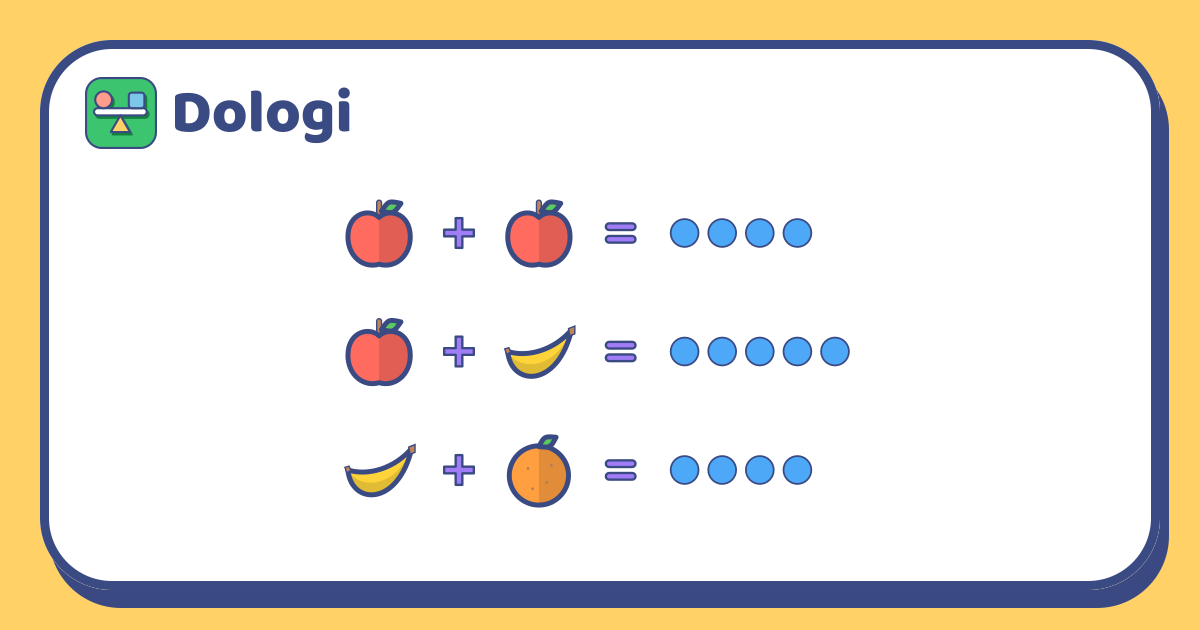
A fruit math puzzle looks like a sum, except the numbers have been replaced with pictures: an apple, a banana, a bunch of grapes. Many children look at it, see three or four unknowns at once, and guess a number at random.
In fact this kind of puzzle has a neat method: find the easiest row, put the number you found into the next row, then check. This post walks through it step by step, with five original puzzles from easy to hard, hints and answers, and a way to set puzzles with real fruit on the kitchen table.
The rules in three lines
Before solving, go over the rules with your child:
- Each kind of fruit is a number. An apple is the same number in every row.
- Each row is a sum. The number at the end of the row is the answer.
- Find the number for each fruit, then work out the row with the question mark.
For children around 7, start with puzzles that use only addition and numbers below 20. Older children can try subtraction and rows with three fruits. Ages are only a rough guide; every child is different.
Step by step: find, substitute, check
Take this puzzle as an example:
| Row | Sum |
|---|---|
| 1 | apple + apple = 10 |
| 2 | apple + banana = 9 |
| 3 | banana + orange = 7 |
| ? | apple + banana + orange = ? |
Step 1: find the row with only one kind of fruit. Row 1 has only apples. Two identical apples make 10, so each apple is 5. If your child is stuck, let them try: "Suppose the apple is 4. What's 4 plus 4?"
Step 2: substitute into the next row. Row 2 has an apple, and the apple is 5. So the row becomes 5 + banana = 9, and the banana is 4. Row 3 becomes 4 + orange = 7, so the orange is 3. Each time a fruit is solved, have your child write the number small under the picture so it isn't forgotten.
Step 3: check every row. Put all three numbers back into the puzzle: 5 + 5 = 10, 5 + 4 = 9, 4 + 3 = 7. Only when every row works do you work out the question mark: 5 + 4 + 3 = 12.
Checking is the step children skip most often, and the one most worth practising. One wrong number in step 1 makes every later row wrong too, and only putting the numbers back shows it.
When your child gets stuck, give hints in small steps rather than the answer:
- "Which row has only one kind of fruit?"
- "Two of the same fruit make 10. So what is one?"
- "The apple is 5. Five plus what makes 9?"
Five puzzles from easy to hard
We wrote these puzzles ourselves and put them in order of difficulty. You can draw the fruit on paper or read them aloud.
| Puzzle | Rows | Hint |
|---|---|---|
| 1 | apple + apple = 8; apple + banana = 7; banana = ? | Two apples make 8 |
| 2 | orange + orange + orange = 9; orange + pear = 5; pear + pear = ? | Three identical oranges |
| 3 | banana + banana = 12; banana + apple = 10; apple + grapes = 7; grapes = ? | Work down from the top |
| 4 | strawberry + strawberry = 10; strawberry − apple = 2; apple + apple + strawberry = ? | Row 2 is a subtraction |
| 5 | apple + banana = 9; apple + apple + banana = 14; banana + banana = ? | No single-fruit row: compare two rows and see what's extra |
Puzzle 5 is a real step up because no row has only one kind of fruit. The trick is to put the two rows side by side: the second row is exactly the first plus one more apple. So the difference between the totals is the apple.
Answers and solutions
- Puzzle 1: apple + apple = 8, so the apple is 4. 4 + banana = 7, so the banana is 3.
- Puzzle 2: three oranges make 9, so the orange is 3. 3 + pear = 5, so the pear is 2. pear + pear = 4.
- Puzzle 3: the banana is 6. 6 + apple = 10, so the apple is 4. 4 + grapes = 7, so the grapes are 3.
- Puzzle 4: the strawberry is 5. 5 − apple = 2, so the apple is 3. 3 + 3 + 5 = 11.
- Puzzle 5: row 2 has one more apple than row 1 and is 14 − 9 = 5 more, so the apple is 5. 5 + banana = 9, so the banana is 4. banana + banana = 8.
After each puzzle, remind your child to put the numbers back into every row once more before settling on an answer.
Set puzzles with real fruit on the table
Younger children pick up the rules faster when the fruit is right in front of them. Try this:
- Lay out two or three rows of real fruit on the table, for example two apples in one row and an apple and a banana in the next.
- Write the total for each row on a slip of paper and put it at the end of the row.
- Hide a slip with each fruit's number under one fruit of that kind. When your child has solved it, they lift the fruit to check.
Once your child is comfortable, swap roles: they set a puzzle for you. That's harder than solving, because they have to choose the numbers first and then work out each row's total. Check together that the puzzle can be solved: there has to be at least one row that gives away the first fruit, and each fruit must come out as exactly one number.
In Dologi, the Math topic has a "Fruit numbers" puzzle: each row has a few fruits with the total at the end, and your child finds the number for the question mark. The first hint is to start with the row where all the fruits are the same, just like step 1 above.
In short
- Each kind of fruit is a number, and each row is a sum.
- Solve in three steps: find the row with only one kind of fruit, substitute into the next row, check every row.
- When there's no single-fruit row, put two rows side by side and see what's extra.
- Practise with real fruit on the table, then let your child set puzzles for you.
Read more: Balance puzzles for children: reasoning about heavy and light