"Is a dog an animal?" "No! It's a dog!" Young children often feel that a thing can only have one name. Understanding that a dog is a dog and an animal and a living thing, all at the same time, is a real step forward in reasoning.
Once children see that small groups sit inside bigger groups, they can start to draw conclusions: "All animals need food. A dog is an animal. So a dog needs food." This article suggests a few simple games with things you already have at home.
Big groups and small groups
Think of boxes inside boxes. A sparrow goes in the box of birds. The box of birds goes inside the box of animals. The box of animals goes inside the box of living things.
Two questions let your child travel up and down:
- "What kind of thing is it?" takes you up to a bigger group. A spoon is a piece of cutlery. Cutlery belongs with kitchen things.
- "What kinds are there?" takes you down to smaller groups. Food: fruit, vegetables, bread. Fruit: apples, bananas, pears.
Try it with whatever is in front of you at breakfast or in the toy box.
Draw a sorting tree
- Collect about eight things or pictures: a fish, a bird, a cat, an apple, a banana, some bread, a spoon, a cup.
- Sort them into big groups and let your child name each one: animals, food, things we use.
- Draw a dot at the top of a large sheet. That dot means "everything on the table". Draw one branch for each big group.
- Split each branch again. Animals: those that fly, those that swim, those that walk. Food: fruit and not fruit.
- Put each thing at the end of its branch.
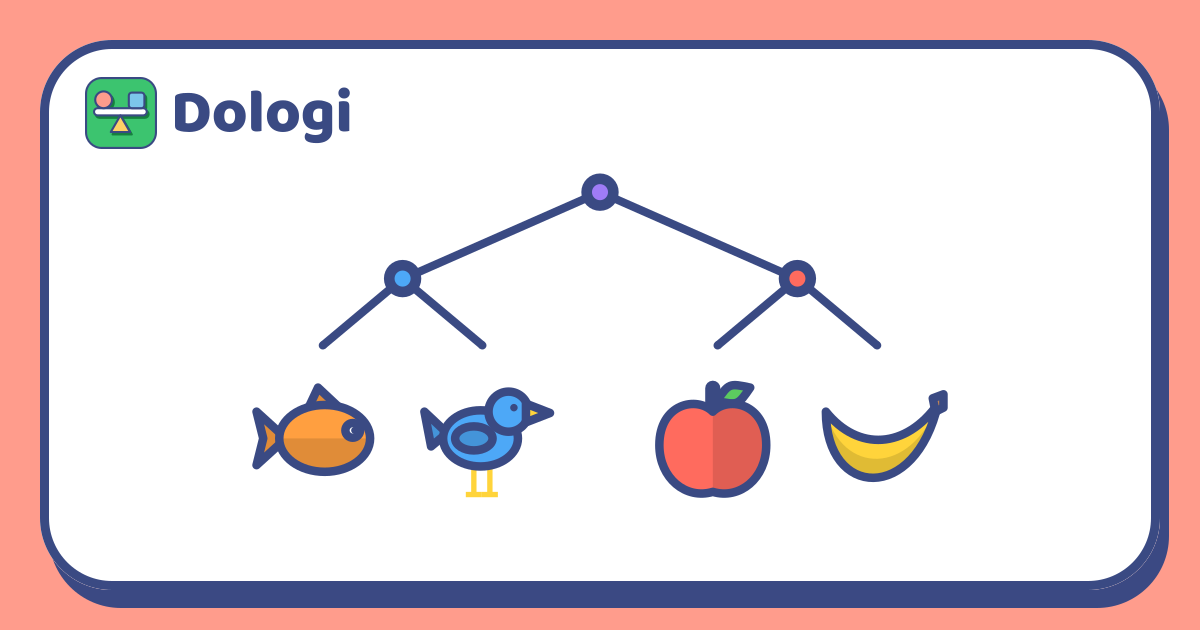
The tree on the cover is the simplest one possible: one dot, two branches, two things on each.
Then comes the game. Bring one new thing: "Where does it go? Does it need a new branch?" A toy car may need a whole new big group.
The "all or some" game
Say a sentence and let your child decide whether it is true. With the tree on the table, they can check by looking.
| Sentence | True? |
|---|---|
| All apples are fruit. | Yes |
| All fruit are apples. | No: a banana is fruit too |
| All birds are animals. | Yes |
| All animals are birds. | No: a fish is an animal |
| Some animals can fly. | Yes |
When a sentence is false, ask for one example that shows it: "Show me a fruit that isn't an apple." One example is enough.
Turning a sentence round is hard for young children. The tree helps: the small group is inside the big one, never the other way round.
When something belongs to two groups
Sooner or later something refuses to stay in one place. In many families a fish is an animal and also food. A toy duck is a toy shaped like an animal. A wooden spoon is a kitchen thing, and it is also made of wood, like the building blocks.
That isn't a mistake. It shows that the groups depend on the question being asked: "What is it?", "What is it for?" or "What is it made of?" Ask a different question and the same things sort differently.
For these cases, draw two overlapping circles and put the object in the middle. And accept any grouping your child can give a reason for. The reason matters more than the answer.
What to try at each age
| Rough age | What to try |
|---|---|
| 4–5 | Sort real things into two or three big groups and name the groups |
| 6–7 | Split a big group into smaller ones; draw a simple tree; play "all or some" with the things in front of you |
| 8–9 | Trees with three levels; hunt for things that fit two groups; overlapping circles |
| 10 and up | Make a tree for a collection of their own (stickers, books, leaves); sort the same things by a different question |
Ages are only a rough guide, and every child is different.
In Dologi, "Two rings" puzzles in the Logic topic show two overlapping rings, each with its own label. Things that fit both labels go in the shared part, and things that fit neither stay outside.
In short
- One thing can have several names: small groups sit inside bigger groups.
- Draw a sorting tree with real objects, then add new things and see where they go.
- Play "all or some", and ask for one example when a sentence is false.
- Things that fit two groups are not mistakes: it depends on the question you sort by.
Read more: Sorting by two features at once: colour and shape