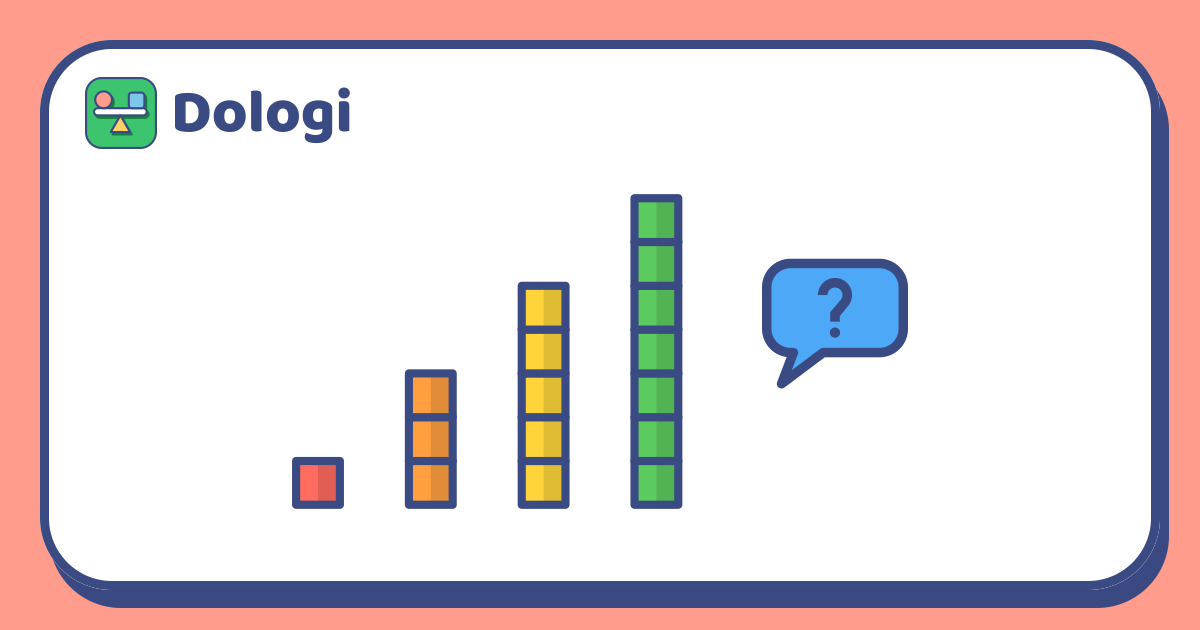
Red, blue, red, blue is a repeating pattern: the same unit comes back again and again. A growing pattern is different. Each step changes in the same way: one block, then three, then five, then seven. What comes next? And what would the tenth step look like?
Growing patterns are where patterns start to turn into early algebra, but you don't need any of that language. Blocks, beans, coins and a sheet of paper are enough.
Repeating or growing?
- Repeating patterns have a unit that repeats: circle, square, circle, square.
- Growing patterns change by a rule at each step: one more each time, two more each time, twice as many each time.
- Shrinking patterns are growing patterns backwards: two fewer each time, half as many each time.
Many children find growing patterns harder at first, because they have to compare steps rather than just copy them.
Build them with things you have
- Block towers. Build towers of one, two, three blocks. Ask: "How tall is the next one?" Then try one, three, five.
- A bean staircase. Lay beans in steps: one bean, two beans, three beans, side by side so they look like stairs.
- Coin triangles. One coin, then a row of two under it, then a row of three. How many coins in each triangle?
- Squares of buttons. One button, then a two-by-two square, then three-by-three. This one grows faster.
Let your child build the next step and explain how they knew.
Put the rule into words
The big step is moving from "it gets bigger" to a precise rule:
| Step | Blocks | What changed? |
|---|---|---|
| First | 1 | |
| Second | 3 | Two more |
| Third | 5 | Two more |
| Fourth | 7 | Two more |
Ask: "What happens each time?" and help your child say it fully: "Each tower has two more blocks than the one before."
Then ask a question they can't answer by building alone: "How many blocks would the tenth tower have?" Some children count on by twos; older ones may notice a shortcut. Both are great thinking.
Doubling: growing faster and faster
Doubling is a different kind of growth, and it surprises children.
- Fold a sheet of paper in half, open it and count the parts: two. Fold it in half twice: four. Three times: eight. Can you fold it a fourth time? How many parts would there be?
- Double the beans. One bean, two beans, four, eight, sixteen. Compare with "add two": which line of beans grows faster?
- Talk about why. When you add two, you always add the same amount. When you double, you add more each time, because there is more to double.
Patterns that shrink
Turn the patterns around: start with seven blocks and take away two each time. Or start with sixteen beans and halve them until only one is left. Shrinking patterns help children see that the rule works in both directions.
Ideas by age
Ages are rough guides; every child is different.
- Around 4–5: towers and staircases that grow by one, "which tower comes next?", building the next step.
- Around 6–7: patterns that grow by two or three, saying the rule in words, shrinking patterns.
- Around 8 and up: predicting the tenth step, doubling and halving, patterns like square numbers, making up patterns for others to solve.
In Dologi, the Patterns topic has "More and fewer" puzzles: children count the items in each picture, work out how many are added or taken away each time, and choose what comes next.
In short
- In a growing pattern, each step changes by the same rule.
- Build them with blocks, beans, coins and buttons, and let your child build the next step.
- Put the rule into words, then predict a step far ahead without building it.
- Explore doubling, halving and shrinking patterns to see different kinds of growth.
Read more: Patterns in numbers: odd and even, counting in twos and skip counting