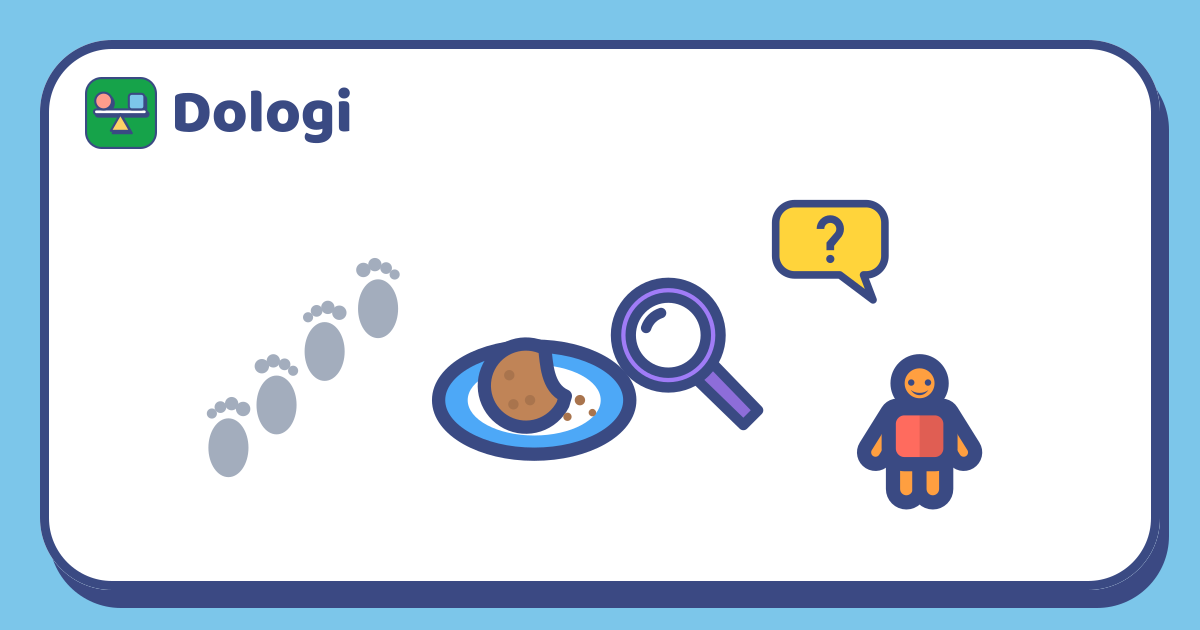
There are crumbs on the plate, a chair has been moved, and the cookie jar lid is crooked. "Who ate the cookie?" Most children light up at a mystery like this. Without realising it, they start doing what detectives do: looking closely, collecting clues and working out the most likely explanation.
Detective games are a playful way to practise reasoning from evidence, a skill children will use at school, in friendships and, later, when they need to judge what they read and hear. This article suggests easy mysteries to set up at home and ways to help your child explain their thinking.
What do detectives actually do?
Detective work can be broken into a few simple steps:
- Observe carefully. What do you see, hear or notice that's unusual?
- Collect clues. Which details might be important?
- Think of explanations. What could have happened? Try to find more than one possibility.
- Choose the best one. Which explanation fits all the clues?
- Stay open. If a new clue appears, be ready to change your mind.
You don't need to teach these steps formally. Just ask questions that follow them, and your child will start to use them naturally.
The cookie mystery
Here's a simple mystery for children from around 4 or 5.
- Set the scene while your child is in another room: a plate with crumbs, a teddy bear with a crumb on its paw, and a trail of paper footprints from the plate to the teddy's chair.
- Present the mystery: "Oh no! Someone ate the last cookie. Can you find out who?"
- Give your child a "magnifying glass" (a real one, or a rolled-up piece of paper) and let them investigate.
- Ask questions, not answers: "What did you find? Where do the footprints go? What's on teddy's paw?"
- Ask for an explanation: "Who do you think it was, and why?"
Older children can handle more suspects and trickier clues: a crumb on two toys, footprints that stop halfway, a clock showing when it happened.
Clue words that turn guesses into reasoning
A guess becomes reasoning when there's a "because". Encourage your child to use linking words:
- "I think… because…" "I think it was teddy because there's a crumb on his paw."
- "That means…" "The footprints go to the chair. That means someone walked there."
- "It can't be… because…" "It can't be the car, because cars don't eat cookies!"
| Clue | What it might tell us |
|---|---|
| Crumbs on the plate | Someone ate here |
| Footprints to the chair | They walked to the chair afterwards |
| A crumb on teddy's paw | Teddy touched the cookie |
| The lid is on the jar | Maybe they put it back, or maybe the jar wasn't opened |
Notice that clues can have more than one meaning. Talking about that is part of the fun.
More mysteries to play at home
- What's missing? Put five objects on a tray, let your child look, then remove one while they close their eyes. "Which one disappeared? How do you know?"
- The mystery bag. Put an object in a cloth bag. Your child feels it without looking and describes the clues: "It's round, smooth and heavy…"
- Whose shoe is it? Lay out shoes from the family and ask your child to match them to people using clues like size and style.
- The hidden object. Hide a small toy and give clue cards: "It's somewhere soft." "It's higher than the table." "It's not in the bedroom."
- Mystery footprints. Make prints with damp feet or toy wheels on paper and guess who or what made them.
Good detective habits
Real detective thinking is less about being clever and more about being careful.
- Look for more than one explanation. "Could anyone else have done it?"
- Separate clues from guesses. "Did you see it, or do you think it?"
- Check every clue. A good explanation fits all the clues, not just one.
- Be willing to change your mind. Praise your child when they say, "I thought it was teddy, but this new clue changes things."
- Be kind to suspects. In real life, it's good to ask before blaming, especially with brothers, sisters and friends.
In Dologi, "Who lives where?" puzzles give a few clue cards, and children use them to work out which house belongs to each robot: detective work with neat, checkable clues.
In short
- Detective games practise reasoning from evidence: observe, collect clues, think of explanations and choose the best one.
- Set up simple home mysteries, like the cookie mystery, and ask questions rather than giving answers.
- Encourage linking words such as "because", "that means" and "it can't be… because…".
- Build good habits: look for more than one explanation, check every clue and be ready to change your mind.
Read more: The process of elimination: the "if it's not this one, which one is it?" game