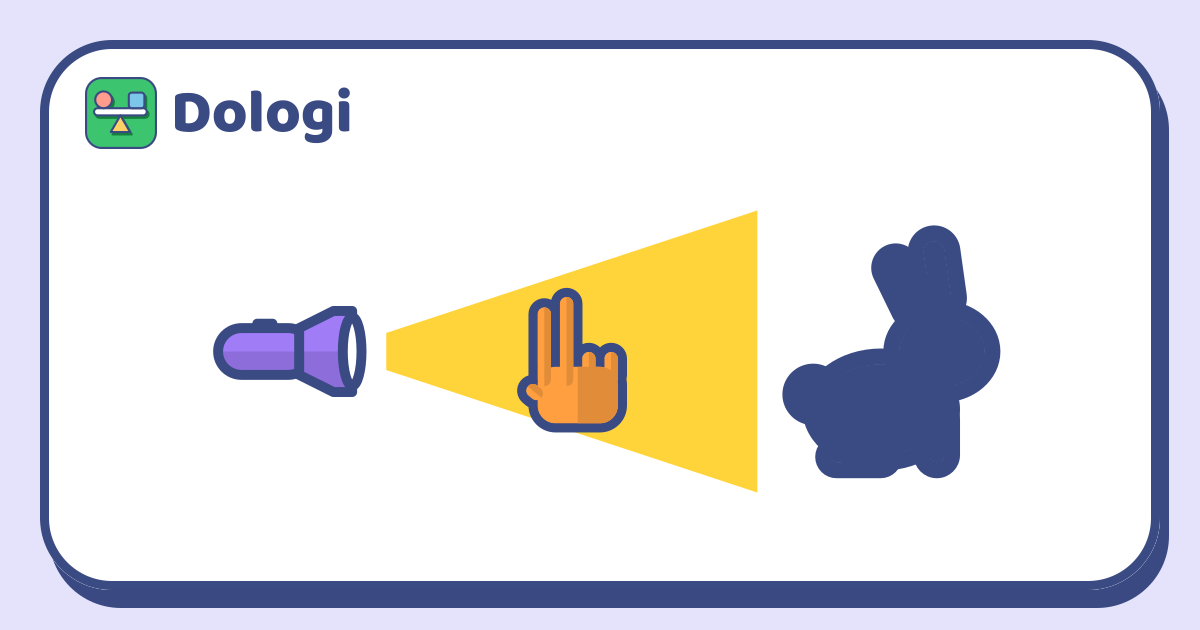
The light goes off, a torch goes on, and a hand on the wall turns into a rabbit. Then the rabbit wiggles its ears, and nobody wants to go to bed.
Hand shadows are an old game that asks for real thinking. The shadow doesn't look like the hand that makes it, so your child has to work out how a solid hand becomes a flat outline, and what happens to that outline when the hand turns or moves.
Setting up
- A dim room and a bare, light wall. It doesn't have to be completely dark.
- A torch lying on a table or a pile of books, pointing at the wall from about two big steps away. That leaves both hands free. A phone light works too.
- Sit beside the beam, with your hands between the torch and the wall.
One rule from the start: the torch never points at anyone's eyes.
Five animals to start with
| Animal | How to make it |
|---|---|
| Rabbit | Make a fist and raise two fingers as ears. Wiggle them |
| Bird | Hook your thumbs together, palms towards you, and flap the fingers of both hands |
| Dog | Hold one hand side-on, fingers straight and together, thumb up as an ear. Drop the little finger to open the mouth |
| Snail | One hand lies flat with two fingers raised as horns. The other hand sits on top as a fist: the shell |
| Crocodile | Press the heels of both hands together and open and close them like jaws, fingers bent as teeth |
Show each animal once, then let your child find it with their own hands. The search is the valuable part, so don't rush to correct the fingers.
What the shadow teaches
Turning. Make the rabbit, then slowly turn your wrist. The ears merge, the head gets thin, and the rabbit is gone. Ask your child: "The hand is the same. Why did the shadow change?" A shadow keeps only the outline, and the outline depends on which side faces the light.
Near and far. Move the hand towards the torch and the rabbit grows. Move it towards the wall and it shrinks and gets sharper. Ask for a prediction before each move. Then set a challenge: stick a piece of tape on the wall and make the rabbit's ears reach exactly that high.
Hidden parts. Fingers tucked behind the fist don't show at all. Hold up three fingers behind your other hand and ask how many the wall can see.
Guess by looking only at the wall
- One player makes a shape. The others look at the wall, not at the hands, and guess.
- What changed? Make an animal, let everyone look, then change one finger. Who spots the difference?
- Copy my shadow. Make a shape while your child looks only at the wall. They try to make the same shadow with their own hands.
The last version is the hardest, because it runs backwards: from the flat outline to the hand that could have made it.
A story on the wall
Two animals are enough for a story. Agree on three sentences: who is there, what happens, and how it ends. Your child directs and you play the second animal.
Size can be part of the story. A rabbit that walks towards the torch becomes a giant, and one that hops to the wall becomes tiny again.
| Rough age | What to try |
|---|---|
| 4–5 | The rabbit and the bird; making a shadow grow and shrink |
| 6–7 | All five animals; guessing by looking only at the wall |
| 8–9 | Copying a shadow from the wall; inventing a new animal |
| 10 and up | Two-hand figures; a story with two characters; drawing instructions for an invented shadow |
Ages are only a rough guide, and every child is different.
In Dologi, "Find the shadow" puzzles in the Focus topic show an object and several shadows, and children pick the shadow that really belongs to it. It is the same matching of a shape to its outline.
In short
- A torch on a table, a bare wall and two hands are all you need.
- Start with five animals and let your child search for the shapes themselves.
- Turn the hand and the outline changes; move it towards the torch and the shadow grows.
- Guessing and copying by looking only at the wall trains thinking from outline back to shape.
Read more: Whose shadow is that? Reasoning from shadows with a torch and everyday objects