Your child adds and subtracts without trouble, then meets a short story with numbers in it and freezes. Or they grab the two numbers they can see, add them, and write an answer that makes no sense. This is very common. A word problem asks children to read, understand a small situation and choose a calculation, all at once, and the calculation is often the easiest part.
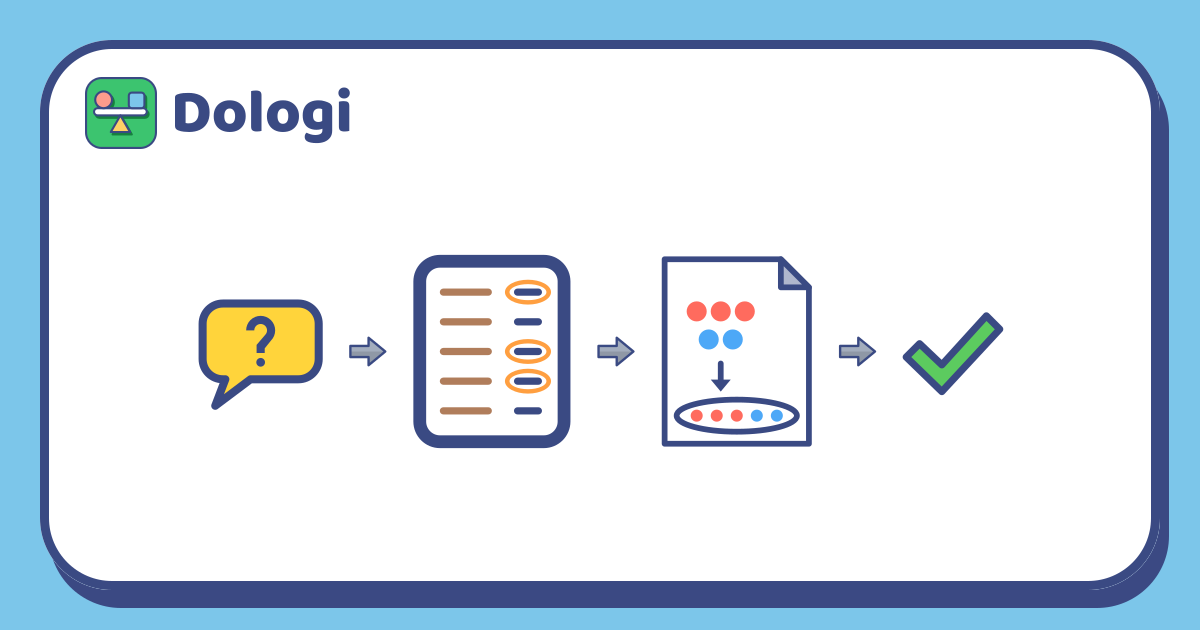
This article gives you a simple routine to use at home with children from about 6 to 10: read the story, find the question and the facts, picture it, then check the answer. It works with any school's way of teaching.
Why word problems trip children up
- The numbers jump out. Children see 12 and 4 and start calculating before they know what is happening.
- Key words can mislead. Some children learn that "more" means add and "left" means take away. That works sometimes, and fails on a problem like: "Tom has 9 marbles. That is 3 more than Ben. How many does Ben have?" The word "more" is there, but the answer comes from taking away: 9 − 3 = 6.
- Reading takes up their attention. For a child who still reads slowly, decoding the words uses most of their energy, and the meaning slips away.
- The question is at the end. By the time they reach it, they have forgotten the beginning.
None of this means your child is "bad at maths". It means they need a way in.
Step 1: read it as a story
Read the problem twice. The first time, no pencil: just listen to the story. If your child is a slow reader, read it aloud for them; the goal here is understanding, not reading practice.
Then ask your child to tell it back in their own words, without numbers:
- "Who is in the story?"
- "What happens?"
- "What do we want to find out?"
Take this example: "Sam has 12 stickers. He gives 4 to his sister, then buys 5 more. How many stickers does Sam have now?" A good retelling sounds like: "Sam has some stickers, gives some away, then gets some more. We want to know how many he has at the end." If your child can say that, the hardest part is done.
Step 2: find the question and the facts
Now go back with a pencil.
- Underline the question. It is usually the last sentence. Reading it first on the second pass tells your child what to look for.
- Circle each number and say what it counts. Not just "12" but "12 stickers at the start". Not "4" but "4 stickers given away".
- Cross out what is not needed. Some problems add extra details, like the colour of the stickers or the day of the week. Spotting them is a skill in itself.
| Number | What it means | Does the total go up or down? |
|---|---|---|
| 12 | stickers at the start | start |
| 4 | given to his sister | down |
| 5 | bought later | up |
A small table like this is enough. Your child can now see that there are two steps: 12 − 4 = 8, then 8 + 5 = 13.
Step 3: picture it, then check it
Before calculating, help your child see the situation. With younger children, act it out: 12 buttons on the table, move 4 away, add 5. With older children, a quick sketch is enough: dots or boxes, not a pretty drawing.
Before working it out, ask for a rough guess: "Will Sam end up with more or fewer than 12?" (Only a little more, because he gives away 4 and gets 5.) A guess gives your child something to compare the answer with.
After calculating, check the answer against the story:
- Answer in a full sentence with the unit: "Sam has 13 stickers now." Writing just "13" hides mistakes.
- Does it make sense? If the answer is 21, ask: "Sam gave some away. Can he really have that many?"
- Read the question once more. Did we answer what was asked, or something else?
Practising at home without worksheets
Short, spoken problems in everyday life build the habit better than pages of exercises.
- Problems from your day. "We have 6 eggs and the recipe needs 2 for each cake. How many cakes can we make?" Let your child explain how they worked it out.
- Stories with no numbers. "Some children were on the bus. At the next stop, a few more got on." Then ask: "What could we ask about this story?" Without numbers to grab, children focus on the situation. Add the numbers afterwards.
- Your child writes the problem. Give a calculation, such as 10 − 3, and ask your child to invent a story for it. Then swap: you write one, they solve it, and they check yours.
- Same words, different meaning. Now and then, give two problems that look alike but need different calculations, like the marble problem above. It teaches your child to read carefully instead of hunting for key words.
In Dologi, the "Count and answer" puzzles keep the words short, but the question still matters: "How many robots have 2 eyes and 2 legs?" is not the same as "How many robots?". These puzzles are a small, friendly way to practise reading the whole question before answering.
If reading itself seems very hard for your child, or the difficulty lasts a long time, talk to their teacher. They can tell you whether the problem is reading, maths, or simply practice.
In short
- Word problems mix reading, understanding and calculating; the calculation is often the easy part.
- Read the story first without a pencil, and ask your child to retell it without numbers.
- Underline the question, say what each number counts, and cross out what is not needed.
- Picture it, guess roughly, answer in a full sentence, and check that the answer fits the story.
Read more: Draw it to understand it: visual thinking for word problems.