Your child talks all day about dinosaurs, diggers or the neighbor's cat. A crossword you draw yourself, filled with words about exactly that, is often more tempting than any worksheet. Children want to solve it because it is "their" crossword.
This guide goes step by step: from a five-word crossword you can make in ten minutes for a child of about 6 or 7, to a full-page grid for 10- to 12-year-olds. At the end, you swap roles and your child makes a crossword for you to solve.
Getting ready: squared paper and a favorite topic
- Squared or graph paper. A crossword needs equal boxes, and printed squares save you the ruling.
- A pencil and an eraser. You will rub things out a lot while fitting words together, so skip the pen.
- A topic your child loves: animals, things in the kitchen, toys, vehicles, characters from a book you have just read together. Brainstorm eight to ten words on that topic and write them in a list.
Pick words your child already knows and can read. The crossword is for recalling and writing familiar words, not for learning new ones. One or two slightly harder words are fine, as long as they share a letter with an easy word that helps your child work them out.
A few conventions: write in capital letters, one letter per box, and leave out spaces and hyphens in longer answers (SEA HORSE becomes SEAHORSE). Agree on this at the start so nobody gets stuck on a missing box.
A five-word example: linking words through shared letters
Topic: animals. The easiest method is to lay one long word across as a "backbone" and hang shorter words down through it.
- Write CROCODILE across, one letter per box.
- Find another word that shares a letter, and write it downwards so the shared letter sits in that same box.
- Leave at least one empty column between two down words, so their letters never sit side by side.
| Down word | Crosses CROCODILE at | How it sits |
|---|---|---|
| CAT | the 1st letter, C | C is on the backbone, A and T go down |
| FOX | the 3rd letter, O | F above, O on the backbone, X below |
| DOG | the 5th letter, O | D above, O on the backbone, G below |
| PIG | the 7th letter, I | P above, I on the backbone, G below |
The down words sit in columns 1, 3, 5 and 7, so there is always an empty column between them. Once it all fits, rub out the letters and keep only the boxes. Write a small number in the first box of each word: 1 for the word across, 2 to 5 for the words down.
Writing clues: pictures or riddles
The clues decide how easy or hard the crossword is, more than the number of words.
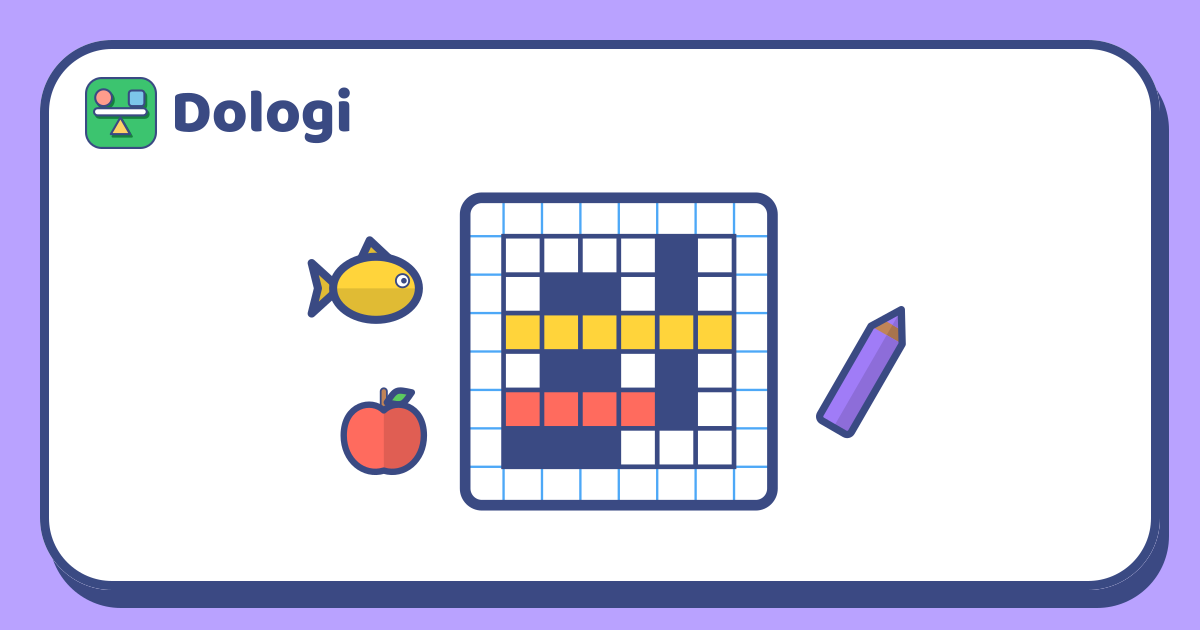
- New readers (about 6–7): draw a picture instead of writing a clue. A fish next to number 1, an apple next to number 2. Fill in the first letter of each word, or tell your child how many letters it has. They look at the picture, say the name, then sound it out letter by letter.
- Confident readers (about 8–9): use a short riddle. "Red-brown, with a bushy tail" is FOX. "Says oink and loves mud" is PIG.
- Older children (about 10–12): try fill-in-the-blank sentences, opposites or clues with two meanings. "The tortoise and the ___" makes them recall the animal from a familiar story.
If your child gets stuck, do not give the answer straight away. Add help in small steps: the number of letters, then the first letter, then a letter they already have from a crossing word. Those crossing boxes are the clever part of a crossword: finish one word and you get a free letter in another.
From five words to a full page
Once five words feel easy, grow the crossword a few words at a time:
| Age (roughly) | Words | Clues | Extra help |
|---|---|---|---|
| 6–7 | 4–5 short words | Pictures | First letter filled in |
| 8–9 | 6–10 words | Short riddles | Number of letters given |
| 10–12 | 12–20 words, a full page | Fill-in sentences, wordplay | None needed |
How to build a bigger crossword:
- Draft on a separate sheet. Cross the two longest words in the middle of the page, then add words that share letters with the ones already placed. If a word will not fit yet, save it for later; there is usually room by the end.
- Keep the touching rule. Two words should only meet at a shared box. Letters from different words sitting side by side make nonsense "words". For a children's crossword, leaving one empty box between parallel words is enough.
- Copy onto a clean sheet. Draw a frame around the grid and shade in every unused box inside it. Number the words from top to bottom, left to right.
- Write the clues in two columns, "Across" and "Down", using the same numbers.
- Keep an answer sheet on separate paper, so your child can check their work at the end.
The topic can also follow what your child is learning: parts of a plant, animals from a reading book, things in a school bag. They revise words while thinking it is just a game.
Swap roles: your child makes a crossword for you
After solving a few, invite your child to be the puzzle maker. They choose a topic, list the words, find shared letters to fit them together and write the clues for you. Younger children can make a three-word crossword with picture clues. Older ones often want to make it really hard to "catch out" a parent.
The hardest part for most children is writing the clues. Too easy, and you solve it instantly; too vague, and nobody can guess. When you guess wrong, your child has to look again: what is my clue missing? That is practice in seeing things from the solver's side.
Solve it for real, and do not pretend to be stuck for too long. When you finish, let your child mark it with their own answer sheet. If a box went wrong, for example two crossing words that do not share the same letter, fix it together as part of the game, with no scores.
In short
- Pick a topic your child loves and eight to ten words they already know; agree on capital letters, one letter per box and no spaces.
- Start with one long word across and a few down words crossing it, with an empty column between parallel words.
- Use picture clues for new readers, short riddles for confident readers, and fill-in sentences and wordplay for older children.
- Swap roles so your child makes a crossword for you: they fit the words, write the clues and do the marking.
Read more: Word puzzles for children who can read: anagrams, two-part words and words hidden in sentences