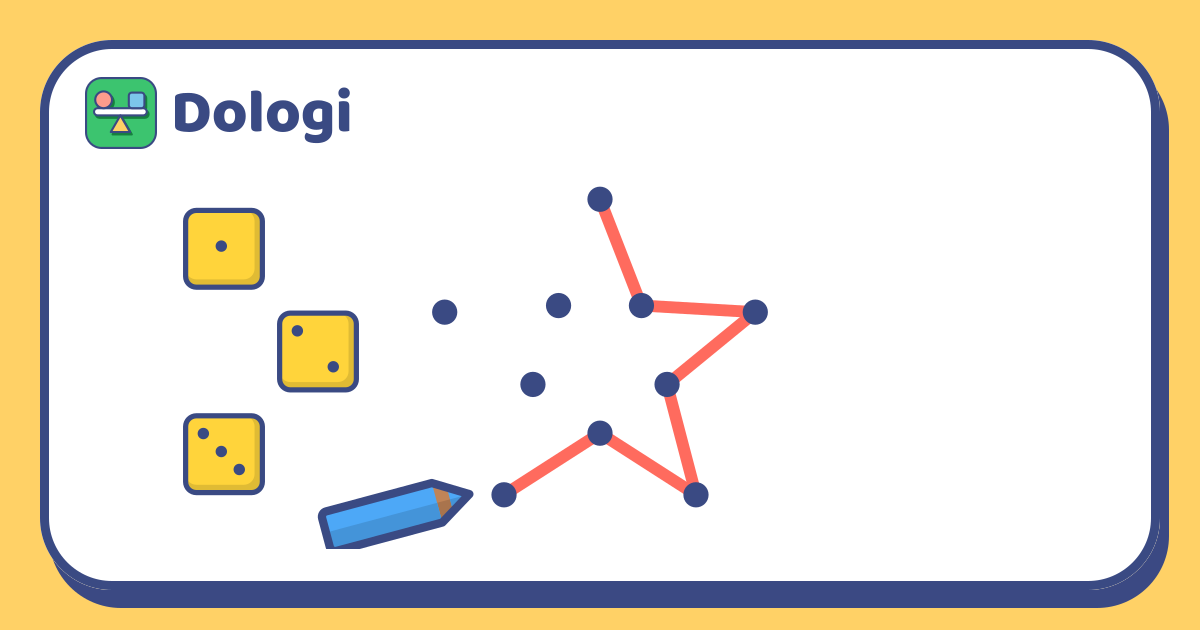
A page of dots, each with a number. A line from 1 to 2, from 2 to 3, and with every line a little more of a picture appears.
Dot-to-dot puzzles are counting in order with a reward at the end. The ones you draw yourself have one big advantage: they fit your child exactly. If ten is the limit today, the picture has ten dots. If counting in twos is the new skill, the dots say 2, 4, 6.
Drawing one in three minutes
- Sketch a simple outline lightly in pencil: a star, a fish, a house, a boat. The line shouldn't cross itself.
- Put a clear dot at every corner, and a few along each curve.
- Number the dots in order, all the way round. Circle the first one so your child knows where to start.
- Rub out the pencil line, leaving only dots and numbers.
Eight to twelve dots are plenty for a first picture. Keep dots with neighbouring numbers reasonably close, so that the next one can be found.
Six levels
| Level | What is written at the dots | What it practises |
|---|---|---|
| 1 | Dice patterns from one to six | Counting small amounts |
| 2 | 1 to 10 | The order of the numbers |
| 3 | 1 to 20 or 30 | The teens and crossing the tens |
| 4 | 2, 4, 6, 8 and so on | Counting in twos |
| 5 | Counting in fives or tens, or backwards from 20 | Other number sequences |
| 6 | Small sums such as "3 + 1", joined in the order of their answers | Calculating before each line |
One picture can be used twice. Draw the same star with the numbers 1 to 10 for a younger child and 10, 20, 30 up to 100 for an older one.
Helping without taking over
- Finger first. Let your child trace the whole route with a finger, saying the numbers aloud, before the pencil touches the paper.
- Guess halfway. When half the dots are joined, ask: "What do you think it is going to be?" Predicting a whole shape from part of its outline is good practice in seeing shapes.
- When stuck, count. If your child can't find the next number, don't point. Count aloud together from 1 up to where they are, and the next number usually comes by itself.
- A ruler for older children. Joining two dots with a ruler is harder than it looks and is good preparation for geometry.
Your child draws one for you
Swap roles. Your child sketches a shape, sets the dots, numbers them and rubs the outline out. Then you solve it, slowly and exactly as numbered.
Any mistake shows up at once. A skipped number or two dots with the same number gives a strange line across the picture. Don't fix it for your child. Ask "What happened here?" and let them find the slip in their own numbering.
You can also plant a mistake in a puzzle of your own, such as two dots marked 7, and see whether your child notices before drawing.
| Rough age | What to try |
|---|---|
| 4–5 | Six to ten dots with dice patterns or the numbers to 10; tracing with a finger first |
| 6–7 | Up to 30 dots; guessing the picture halfway; counting backwards |
| 8–9 | Counting in twos, fives and tens; sums at the dots; drawing a puzzle for a younger child |
| 10 and up | Pictures with fifty dots or more; multiples of three or four; joining with a ruler |
Ages are only a rough guide, and every child is different.
In Dologi, "Connect the dots" puzzles in the Math topic ask children to join numbers from the smallest to the largest. A homemade puzzle is the same idea on paper, with exactly the numbers your child is working on.
In short
- A sketched outline, dots at the corners and numbers in order make a dot-to-dot in three minutes.
- The numbers can grow from dice patterns to 30, to counting in twos and tens, to small sums.
- Tracing with a finger, guessing the picture halfway and counting when stuck help without giving answers.
- When your child designs the puzzle, every numbering mistake shows up as a wrong line.
Read more: Patterns in numbers: odd and even, counting in twos and skip counting