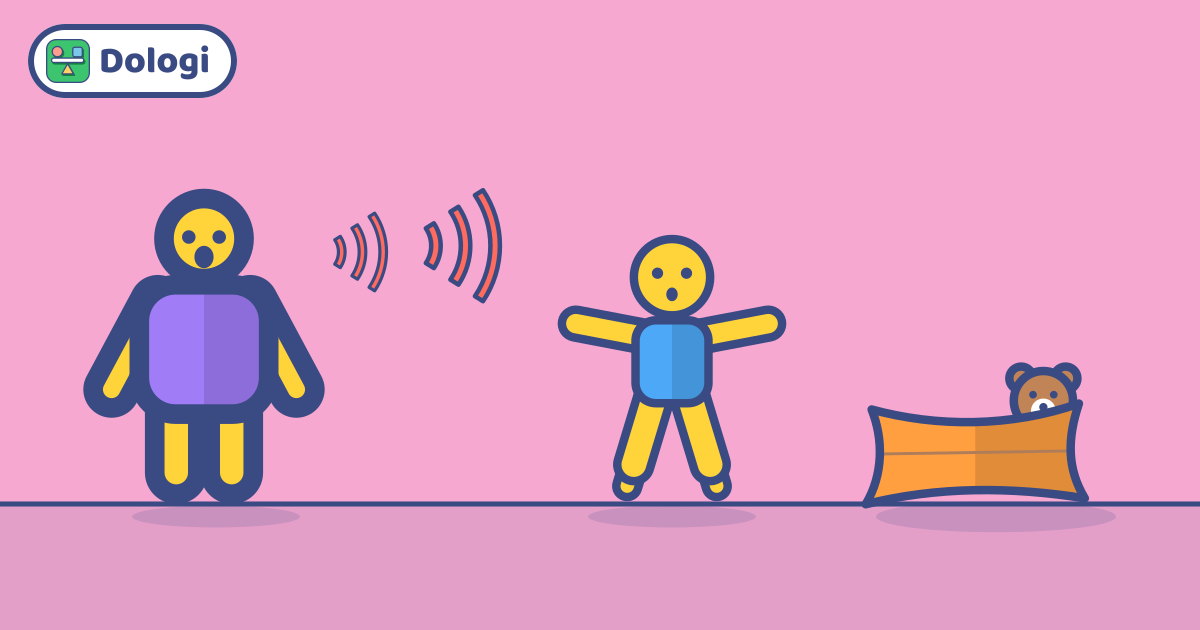
"Hot or cold" is the classic hide-and-find game: the searcher wanders the room, and the hider only says whether they're getting closer or farther away. It sounds simple, but to succeed your child has to keep comparing: is the clue now "hotter" or "colder" than a moment ago? Swap the words for singing that gets louder or tapping that speeds up, and it becomes a real listening workout. Suits ages 4 to 9.
The basic rules
- Pick a small, unbreakable object: a little teddy bear, a ball, a wooden spoon.
- The searcher leaves the room or closes their eyes and counts to twenty. The hider hides the object.
- The searcher moves around the room. The hider may only say:
- "Cold" when the searcher is far away,
- "Warmer" when they're getting closer,
- "Hot" and "Boiling hot" when they're very close,
- "Colder" when they turn away.
- Once it's found, swap roles.
For 4-year-olds: limit the hiding area (only on the sofa, only in the living room), let the object peek out a little, and use just two words, "hot" and "cold."
Level 2: no words, sing louder
The hider says nothing and just hums a familiar song. Closer means singing louder, farther means singing softer. The searcher has to notice whether the singing just got louder or quieter compared with a few steps ago, and change direction.
This is much harder: there's no word that says "right way," so your child has to compare loudness on their own.
Level 3: tap faster
The hider taps a spoon gently on a pot or claps steadily. Closer means faster tapping, farther means slower. The volume stays the same. Your child has to listen to the speed rather than the loudness, so this works well after talking about how high, loud and long sounds differ.
Level 4: your child hides and picks the clue style
When roles swap, the hard part belongs to your child: they have to keep track of where you are compared with the hiding spot and change the clue at the right moment. Let them choose the clue style: words, singing, tapping, or something new (whistling higher and higher, counting faster).
Now and then, walk deliberately the wrong way to see whether your child switches straight to "colder." They'll discover that giving accurate clues is as tricky as searching.
The four levels at a glance
| Level | Clues given by | Ages | What your child has to notice |
|---|---|---|---|
| 1 | Words: cold, warmer, hot | 4–6 | What the words mean |
| 2 | Singing louder or softer | 5–8 | Loudness compared with a moment ago |
| 3 | Tapping faster or slower | 6–9 | Whether the beat speeds up or slows down |
| 4 | Your child hides and chooses clues | 6–9 | Where the searcher is; changing the clue in time |
Tips for parents
- Safe hiding places: not behind power outlets, in the medicine cabinet, or anywhere that needs climbing. Agree on "no moving big furniture."
- Really stuck? Give one location clue: "It's lower than your knees," "It's somewhere soft."
- Set a time limit of two or three minutes per round so whoever is waiting doesn't get restless.
- Several kids: the whole group searches, each heading a different way; the hider gives clues to whoever is closest. The kids have to listen for whose clue it is.
The Listening topic in Dologi has a puzzle called Odd note out: "Which card sounds different from the others?" Just like searching by the singing, your child has to listen to each sound and compare them with one another.
In short
- The searcher moves around the room and the hider says whether they're near or far; when it's found, swap roles.
- Level up by dropping the words: louder singing, then faster tapping, so your child has to compare on their own.
- Let your child hide and choose the clues; keeping clues accurate is practice too.
- Safe hiding places, a time limit, and a location clue when someone is stuck.
Read more: High is not the same as loud: pitch, volume and length, Blind man's buff: the old blindfold listening game