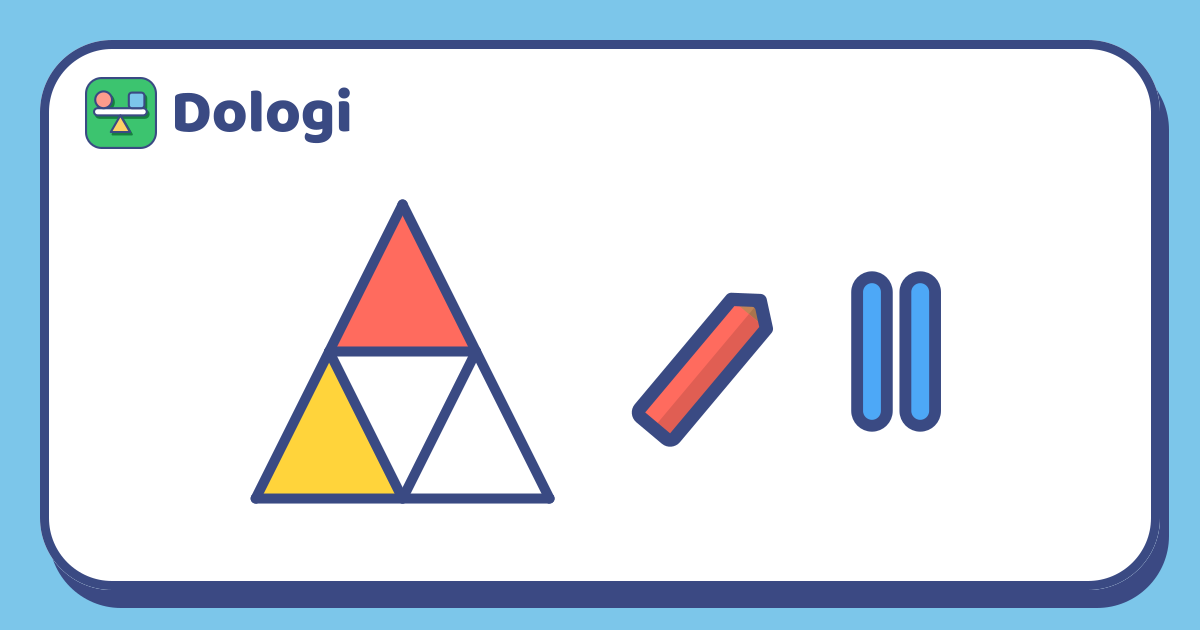
Draw a large triangle. Join the middle points of its three sides. Now ask: "How many triangles can you see?"
Most children say four, and so do most adults. Look again: the big triangle around the outside is a triangle too. The answer is five. Shape-counting puzzles look easy and trip up nearly everyone, which is exactly why children enjoy them. They also teach two useful ideas: a shape can be made of smaller shapes, and counting well needs a system.
Why the first answer is too small
Our eyes go straight to the smallest pieces. The larger shapes, made of several pieces joined together, are hidden in plain sight.
So the first question to teach is: "Is there a shape here made of more than one piece?" Once a child has found the big triangle hiding around the four small ones, they start looking for hidden shapes everywhere.
A method: count by size
- Count the shapes made of one piece.
- Count the shapes made of two pieces joined together.
- Go on with three pieces, four pieces, up to the whole figure.
- Add the numbers up.
Take three boxes drawn side by side in a row. How many rectangles?
| Made of | How many |
|---|---|
| 1 box | 3 |
| 2 boxes side by side | 2 |
| 3 boxes | 1 |
| Altogether | 6 |
A few tools make it easier:
- Colour each small shape as it is counted, like the two coloured triangles on the cover.
- Trace bigger shapes with a finger before counting them.
- Make a tally mark for each shape found, so nobody has to hold the number in their head.
Five puzzles to draw
All you need is paper and a pencil. The answers are further down.
- Two boxes side by side. How many rectangles?
- A triangle with the middles of its sides joined (the picture on the cover). How many triangles?
- A square cut into four small squares by one line across and one line down. How many squares?
- A triangle with two lines drawn from the top corner down to the bottom side, making three slices. How many triangles?
- A square with both diagonals drawn. How many triangles?
A bonus for older children: a square cut into nine small squares, three by three. How many squares?
Answers
- Puzzle 1: 3. Two small boxes and the whole shape.
- Puzzle 2: 5. Four small triangles and the big one.
- Puzzle 3: 5. Four small squares and the big one.
- Puzzle 4: 6. Three single slices, two shapes made of two slices next to each other, and the whole triangle.
- Puzzle 5: 8. Four small triangles, and four larger ones each made of two small neighbours.
- Bonus: 14. Nine small squares, four squares made of four pieces, and the whole square.
If your child's answer is different, don't give the number straight away. Ask: "Show me the ones you counted." Usually they find the missing shape themselves.
Let your child set the puzzles
Swap roles: your child draws a figure, counts it carefully in secret, then challenges you. Setting a puzzle is harder than solving one, because you have to be sure of your own answer.
A nice way in: take a finished figure, add one more line, and ask, "How many more are there now?"
| Rough age | What to try |
|---|---|
| 5–6 | Two or three boxes in a row; colour each shape as it's counted |
| 7–8 | The split triangle and the square of four; counting by size |
| 9–10 | Diagonals; the three-by-three square; tally marks for each size |
| 11 and up | Inventing puzzles; spotting the pattern in rows of boxes (1 box gives 1, 2 give 3, 3 give 6, 4 give 10) |
Ages are only a rough guide, and every child is different.
In Dologi, "Shapes inside a figure" puzzles in the Space topic ask children to count all the squares or triangles in a figure made of lines, including the ones made of several smaller pieces.
In short
- In a shape-counting puzzle, bigger shapes hide among the small ones.
- Count by size: one piece, two pieces, three pieces, then add up.
- Colour, trace and tally so that nothing is missed or counted twice.
- Let your child draw puzzles for you: setting one is the best practice of all.
Read more: Counting paths on a grid: a challenge for children who love maths