It is raining, and your child has more energy than the flat has room. Put three cushions on the floor, pull out a chair, stick a line of tape on the carpet, and the living room becomes an obstacle course.
It is a game for the body, but there is a lot of thinking inside it: words such as over, under, around and between, remembering a sequence of steps, and reading or drawing a simple plan. This article shows how to build a course, and how to get more out of it than a few minutes of jumping.
Build the course
Four to six stations are plenty. Use what you have.
| Station | Made from | What to do |
|---|---|---|
| Stepping stones | Cushions in a line | Step from one to the next without touching the floor |
| Tunnel | A sturdy chair, or a blanket over two chairs | Crawl under |
| Slalom | Plastic bottles or shoes in a row | Weave around them |
| Balance line | A strip of tape or a skipping rope on the floor | Walk along it, heel to toe |
| Target | A laundry basket and rolled-up socks | Throw three sock balls in |
| Finish | A scarf tied to a door handle | Touch it |
A few safety points before starting:
- Clear the space, and keep away from stairs, glass and sharp corners.
- Use only furniture that can't tip over. No climbing on shelves or stools.
- Bare feet or non-slip socks, and cushions only on a floor where they don't slide.
- Stay nearby while your child is on the course.
Say the route in words
Before the first run, walk the course together and say what happens at each station: "Over the cushions, under the chair, around the bottles, along the line."
Then your child says it alone. Then they run it.
This small step matters. Position words are the vocabulary of space, and children learn them best while their body is doing what the word says.
A memory version: describe the whole route once, and your child does it without reminders. Three steps are enough for a four-year-old. Older children can manage five or six, or a route where one station is visited twice.
Draw the plan
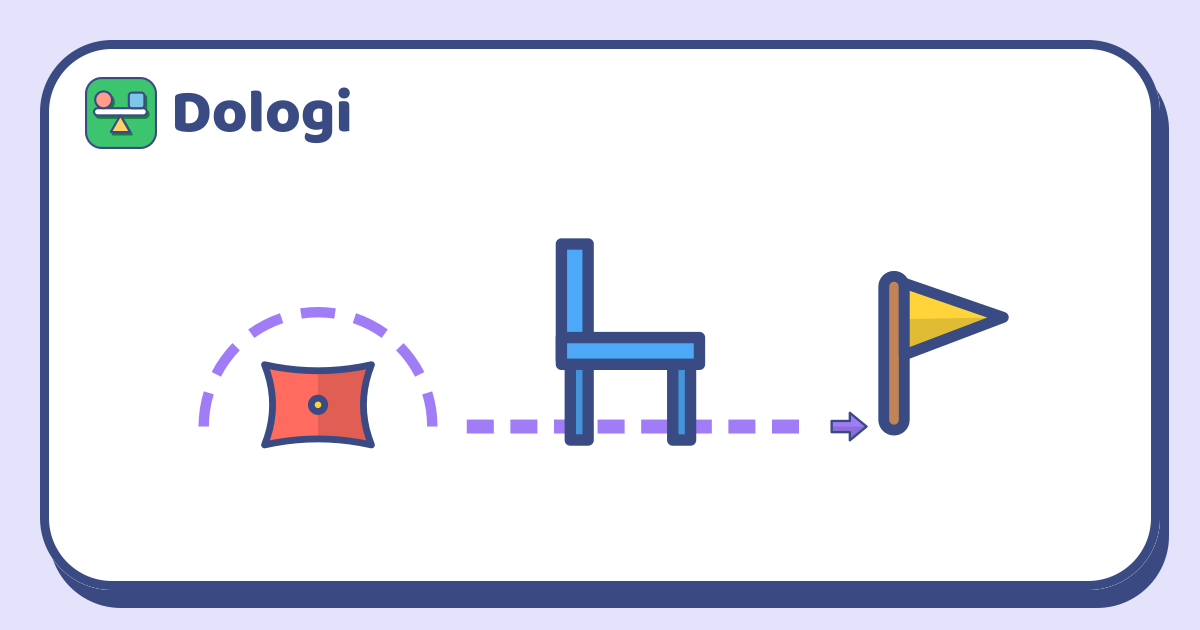
After a few runs, sit down with paper and draw the course as if you were looking down from the ceiling. A square for each cushion, a box for the chair, a dotted line for the route and an arrow at the end, as on the cover.
Now the plan can be used in three ways:
- Read it. You draw a new route on the same plan, in a different order. Your child reads it and runs it.
- Change it. Your child moves one station, then corrects the drawing to match.
- Design first. Your child draws a new course on paper before touching a single cushion, then builds it and checks whether it works.
The third is real planning: imagining a space that doesn't exist yet. Give a small brief to make it interesting: "Your course must have one over, one under and one around, and it must end at the door."
Harder, but not faster
Racing against a stopwatch is the quickest way to bumps and tears. There are better ways to raise the challenge.
- Carry something. A rolled sock on the head, or a ball on a spoon.
- Change the movement. Sideways along the balance line, or backwards through the slalom.
- Add a rule. "Today the floor between the cushions is water."
- Estimate. "How many steps will the stepping stones take?" Guess, then count.
- Beat your own number. Count aloud together instead of using a timer, and try to be one count quicker next time.
| Rough age | What to try |
|---|---|
| 4–5 | Three or four stations; saying the route together |
| 6–7 | Five or six stations; remembering the route; reading a simple plan |
| 8–9 | Designing and drawing their own course to a brief |
| 10 and up | Designing a course for a younger child; writing instruction cards for each station |
Ages are only a rough guide, and every child is different.
The last station is tidying up
Make putting things back part of the game. "Every cushion back on the sofa before I count to thirty" works surprisingly often.
In Dologi, "Maze" puzzles in the Space topic ask children to find a way through a maze. It is the same habit as on the course: look at the whole route before setting off.
In short
- Cushions, a sturdy chair and tape are enough for four to six stations.
- Say the route in position words before running it: over, under, around, along.
- Draw the course from above, then read, change and design plans.
- Raise the challenge with carrying, new movements and rules rather than speed.
Read more: Draw a map of your child's room: seeing things from above