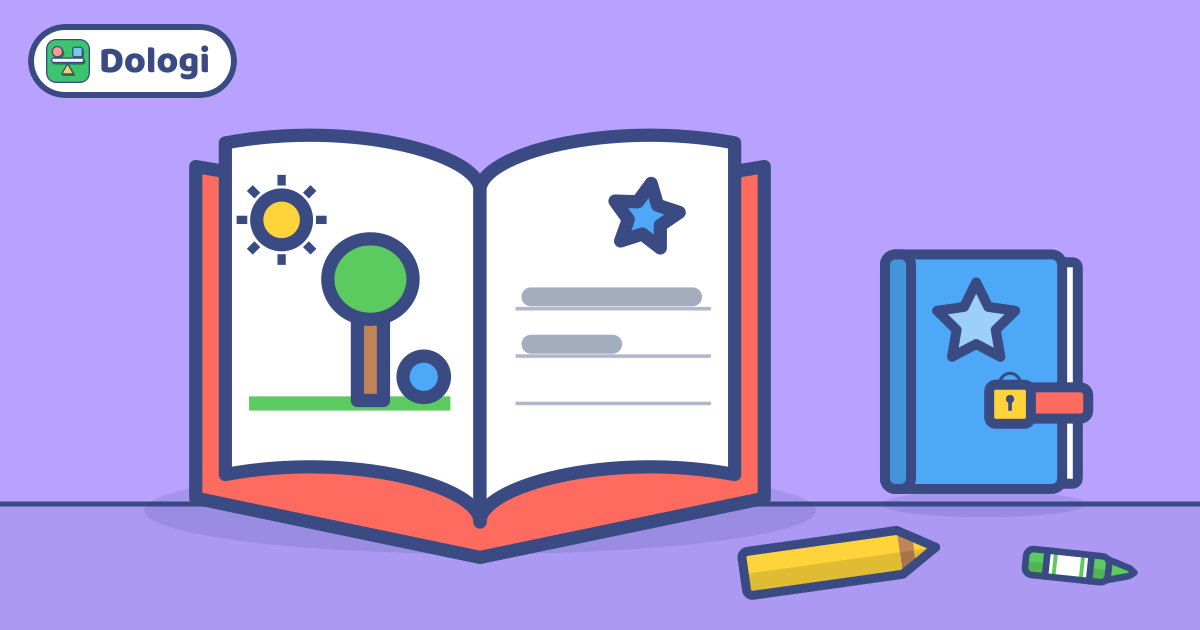
When parents hear "journal," many picture pages of neat handwriting and decide their kindergartner or first grader is nowhere near ready. But a child's journal can start much smaller: one picture and one sentence about something that happened today. If your child can't write yet, they draw and tell, and you write it down.
A notebook like this gives children a daily chance to look back on their day, pick one thing to tell and put a name to how they felt. Here's how to get started, and how to keep it going without turning it into a second helping of homework.
A notebook that belongs to your child
You don't need anything special. Any notebook will do, but let your child choose it: the color, whether to decorate the cover with stickers. A notebook that's theirs is a notebook they'll want to open.
- The notebook: for younger children, look for "primary journals" with a blank space at the top for drawing and lines at the bottom for writing. Or just draw a line across the middle of each page.
- Something to write with: a pencil and a few crayons or markers. Skip the eraser: in a journal, crossing out is fine.
- A regular time: pick a calm moment, like after dinner or right before the bedtime story. Five to ten minutes is plenty.
Draw first, write second
For a child who is just learning to write, a whole sentence takes a lot of effort. Drawing helps them remember what happened and decide what to say, and the words come after. A rough guide by age (every child is different):
| Age | Your child | You |
|---|---|---|
| 4–5 | Draws something from the day and tells you about it | Write their exact words under the picture and read them back |
| 6–7 | Draws, then writes one short sentence | Help with sounding out when asked; don't write it for them |
| 8–10 | Writes a few sentences about one event, adds a drawing if they like | Suggest a topic when they're stuck |
| 11–12 | Writes on their own and chooses the topic | Let the journal be private; read only when invited |
Writing down a 4- or 5-year-old's words is more useful than it looks. Your child sees their own speech turn into print, and next time they may point to each word as you read it back.
When your child says "I don't know what to write"
"How was your day?" usually gets "Fine." Ask something more specific, or offer a sentence starter to pick from:
- "Today I laughed really hard when…"
- "On the way to school I saw…"
- "The best thing I ate today was…"
- "Something I want to tell Grandma is…"
- "Tomorrow I want to…"
If they're still stuck, walk back through the day together in order: what happened in the morning, at school, after school. Then choose just one moment. Questions about the senses make drawings and sentences more vivid: "What could you hear? What did the pancake taste like?"
Don't correct spelling in the journal
A first grader might write "I wnt to the prk with Dad" instead of "I went to the park with Dad." Teachers call this invented spelling, and it's a normal stage: your child is writing the sounds they hear. A journal isn't a spelling test. If every page comes back covered in corrections, children start writing only the words they're sure of, or stop wanting to write at all.
Respond to what they wrote instead: "You went to the park? What did you play on?" Some families write a short reply right under their child's entry, like a letter back and forth. If you use the correct spelling in your reply ("I love the park too!"), your child sees it without feeling corrected.
Spelling still matters. It just gets practiced somewhere else: at school, in word games, while reading together.
Keeping the habit without making it homework
- Skipping a day is fine. A journal doesn't count pages. Three entries a week that your child enjoys beat seven they dread.
- Ask before you read. It's their notebook. Older kids may want privacy, and a notebook with a strap or a tiny lock tells them you respect that.
- Read old pages together. At the end of the month, flip back to the beginning. Kids are often amazed at what they'd forgotten, and at how much their handwriting has changed.
- Keep your own journal. If you write in a notebook at the same time, journaling becomes something the family does, not a chore handed to the kid.
Looking back on the day to write about it means noticing and holding on to details. In Dologi, the Memory topic has a puzzle called "What disappeared?": your child studies a group of objects and tries to remember everything they see, then one thing vanishes and they say which one it was. That habit of looking closely in order to remember is the same one that fills a journal page.
In short
- A child's journal can start with one picture and one sentence a day; if they can't write yet, they draw and tell and you write it down.
- Offer sentence starters, or walk through the day together and pick one moment.
- Don't correct spelling in the journal; respond to the content and model the right spelling in your reply.
- Skip days without guilt, ask before reading and look back at old pages together now and then.
Read more: Retelling the day in order: helping children practice sequence and expression, A nature journal for children: watching birds and insects around your home