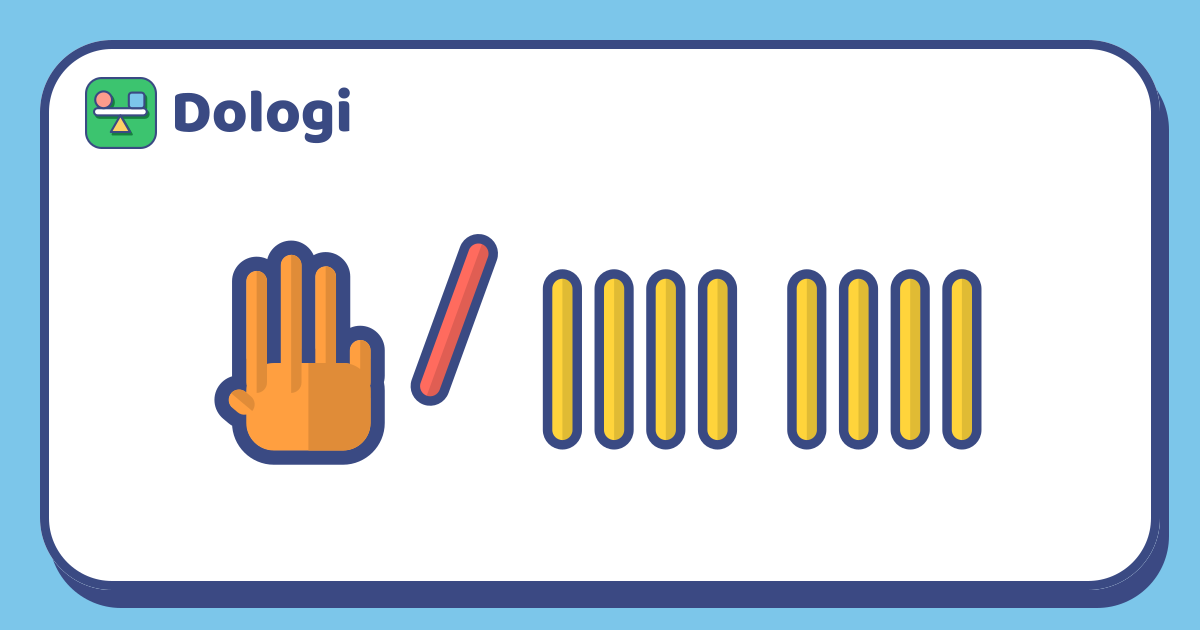
"There are five left. If I take one… you'll have four. Then whatever you take, I can take the rest!"
The last stick game needs nothing but a handful of sticks and two players. The rules take ten seconds to explain. And yet there's a secret hidden in it, and children who find it have learned one of the most useful ideas in problem solving: start from the end and work backwards.
How to play
- Lay out about 10 to 15 sticks in a row. Ice lolly sticks, pencils, spoons, buttons or coins all work.
- Players take turns. On your turn, take one, two or three sticks. You must take at least one.
- Whoever takes the last stick wins.
That's all. A game lasts a minute or two, so you can play many in a row, and that matters, because the secret only shows itself after several games.
Start with very few sticks
With 15 sticks, nobody can think through every possibility. With very few, a child can. So play some tiny games first:
- Three sticks, your child's turn. They take all three and win. "So if you see one, two or three sticks, you've won."
- Four sticks, your child's turn. Ask them to try every option. Take one, and you take the last three. Take two, and you take the last two. Take three, and you take the last one. Four is a bad number to have in front of you.
This is the turning point. Let your child say it in their own words: "If I leave you four, I win." You don't need to explain more than that.
Working backwards to the secret
Now ask: "What if there are five sticks?" Your child can reason from what they already know: "Take one and leave four." With six, take two. With seven, take three. Each time, the aim is to leave four.
And eight? Whatever you take, the other player can leave you four. So eight is bad too. Children around eight and older often spot the pattern by themselves:
| Sticks in front of you | What happens |
|---|---|
| 1, 2 or 3 | Take them all and win |
| 4 | Bad: whatever you take, the other player can take the rest |
| 5, 6 or 7 | Take enough to leave 4 |
| 8 | Bad again |
| 9, 10 or 11 | Take enough to leave 8 |
The safe numbers to leave are 4, 8, 12… This is working backwards: instead of asking "what should I do now?", you start from the winning position and ask "what comes just before it?" The same idea helps with mazes, puzzles and even planning the morning ("we leave at 8, so when do we need to get up?").
Some younger children won't find the whole pattern, and that's fine. Knowing "leave four" is already a real strategy.
Keeping it fun once someone knows the secret
Once one player knows the secret, the game can feel one-sided. Some ways to keep it interesting:
- Take turns starting. With a number of sticks like 12, the starting player is in trouble.
- Change how many you can take. If each turn is one or two sticks, the bad numbers become 3, 6, 9… Children can work out the new secret from small games, just like before.
- Make the last stick a loser. Whoever takes the last stick loses. Now you want to leave the other player one stick, then 5, then 9.
- Don't always play perfectly. With younger children, make a few honest mistakes so they can catch you. "Oh no, I left you four!"
| Rough age | What to try |
|---|---|
| 5–6 | 5 to 7 sticks; taking one or two; counting what's left after each turn |
| 6–7 | Finding out why four left in front of you is bad; "leave four" as a first strategy |
| 8–9 | 10 to 15 sticks; finding the pattern 4, 8, 12; explaining it to someone else |
| 10 and up | Changing the rules and finding the new secret; the last-stick-loses version |
Ages are only a rough guide, and every child is different.
In Dologi, the Space topic has "Move the tower" puzzles: moving a stack of discs one at a time, never a bigger one on a smaller one. To move the biggest disc, the smaller ones have to be out of the way first, so children learn to think from the goal back to the next step.
In short
- A row of sticks, one to three per turn, and whoever takes the last stick wins.
- Start with three or four sticks so your child can try every option.
- "Leave four" is the first secret; working backwards gives 4, 8, 12.
- Change the rules (one or two per turn, last stick loses) and look for the new secret together.
Read more: Working backwards: start from the goal to find the way