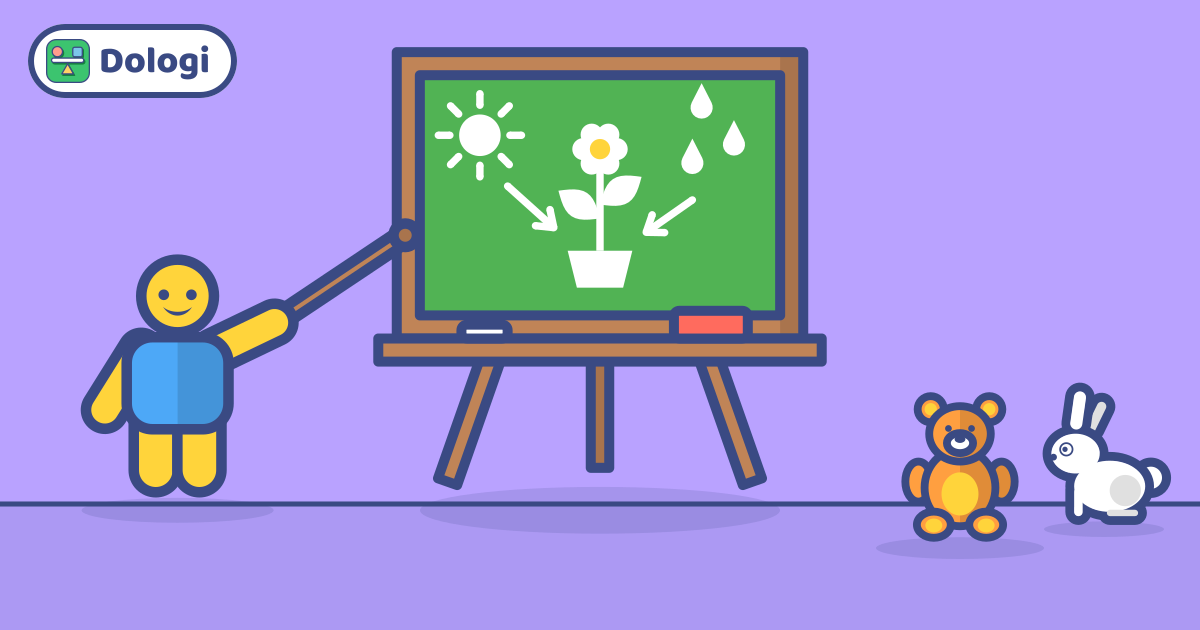
"What did you learn in school today?" "Nothing." Many parents know this conversation. Now try something different: "Can you teach me what you did in science? I never really understood how plants grow." Suddenly your child has a job, an audience, and a reason to remember.
Teaching something back is one of the easiest learning habits to start at home. It needs no materials, it works for almost any subject, and it shows both of you right away what your child really understands. Here's how to set it up for children from about 5 to 12, and how to be a good "student."
Why teaching helps the teacher
- Your child has to remember without looking. Explaining from memory is much better practice than rereading.
- The ideas need an order. To teach, your child has to decide what comes first, what comes next, and how the parts connect.
- Your child has to find their own words. Repeating the book's sentences is easy; saying it in your own words takes understanding.
- Gaps show up quickly. "Wait, I don't know why that happens" is a useful moment: now you both know what to look at again.
- It feels good. Being the expert, even for five minutes, gives a child confidence.
Set up a small class
Keep it short and simple: five to ten minutes, a few times a week, after homework or after dinner.
- A board or a sheet of paper. A small chalkboard or whiteboard is fun, but a big piece of paper works just as well.
- Students: you, a sibling, a grandparent on a video call, or a row of stuffed animals. Stuffed animals are patient students, and some shy children find them easier to start with.
- Your child chooses the topic. Let them look at the book or notes first, then put them away and teach.
| Age (roughly) | What to teach |
|---|---|
| 5 to 6 | How to play a game, the steps of brushing teeth, what happened in a picture book |
| 7 to 9 | Today's lesson, how to solve a math problem with objects, a fact about an animal |
| 10 to 12 | A chapter with a drawing on the board, a science experiment, a historical event in order |
Be a curious student
Your role is to listen and ask a little, like a student who is interested but doesn't know much yet.
- "What does that word mean?"
- "Can you show me an example?"
- "Why does that happen?"
- "How do you know?"
- "What would happen if...?"
- "Can you draw it for me?"
One or two questions per lesson are enough; it should feel like a conversation, not a quiz. Let your child finish before you ask anything.
Now and then, get something a little wrong on purpose: "So plants eat soil?" Correcting the "student" makes your child explain the idea more clearly. The article on helping your child explain their thinking shows how to do this with math problems.
When the teacher gets stuck
Getting stuck isn't a failure. It's what makes teaching useful: it shows exactly what to check.
- Name it kindly. "Good, we found the part to look at again."
- Look it up together. Go back to the book or notes, then let your child teach that part a second time. If your child takes notes, the article on taking notes with bullet points, sketches, and summaries explains how to make notes that are easy to teach from.
- Don't correct every slip. If a fact is wrong, come back to it at the end: "I read something different. Shall we check together?"
- Don't grade the lesson. The goal is for your child to want to teach again tomorrow.
Ideas for different subjects
- Stories: your child tells the stuffed animals what happened in a book: who was in it, where it took place, what the problem was, and how it ended. The article on retelling the day in order has more ideas for putting events in order.
- Math: show how to solve a problem with objects or a drawing, and explain why it works, not just the steps.
- Science: draw it on the board, for example what a plant needs to grow, with arrows.
- New words: teach the toy class the new words from spelling or a foreign language.
- Before a test: your child teaches you one section a day instead of rereading everything. The article on reviewing for tests without the stress shows how to spread review out over several days.
- Everyday skills: an older child teaches a younger one to play a card game or set the table. It takes patience, and that's part of the learning, too.
Keep it fun
- Switch roles sometimes. You teach your child something from your work or hobby, and your child asks the questions.
- Praise clear explaining. "I understood that because you showed me an example" tells your child what made the lesson good.
- Don't turn every evening into school. A short lesson now and then works better than a fixed daily routine your child dreads.
In Dologi, the Memory topic has a puzzle called What’s in the sack?: fruits fly into a sack one by one, some fly out again, and at the end your child answers questions about the fruits still inside. After a round, ask your child to teach you how they kept track, then take a turn yourself while they coach you.
In short
- Teaching something back makes your child remember without looking, put ideas in order, and use their own words.
- A five-minute class with you or stuffed animals as students is enough; your child chooses the topic.
- Be a curious student: ask one or two simple questions, and sometimes get something wrong on purpose.
- When your child gets stuck, look it up together and teach that part again, without grading.
Read more: Right answer, but can't explain it: helping your child learn to show their thinking, Retelling the day in order: helping children practice sequence and expression, My child copies the whole page: teaching older kids to take notes with bullet points, sketches, and summaries