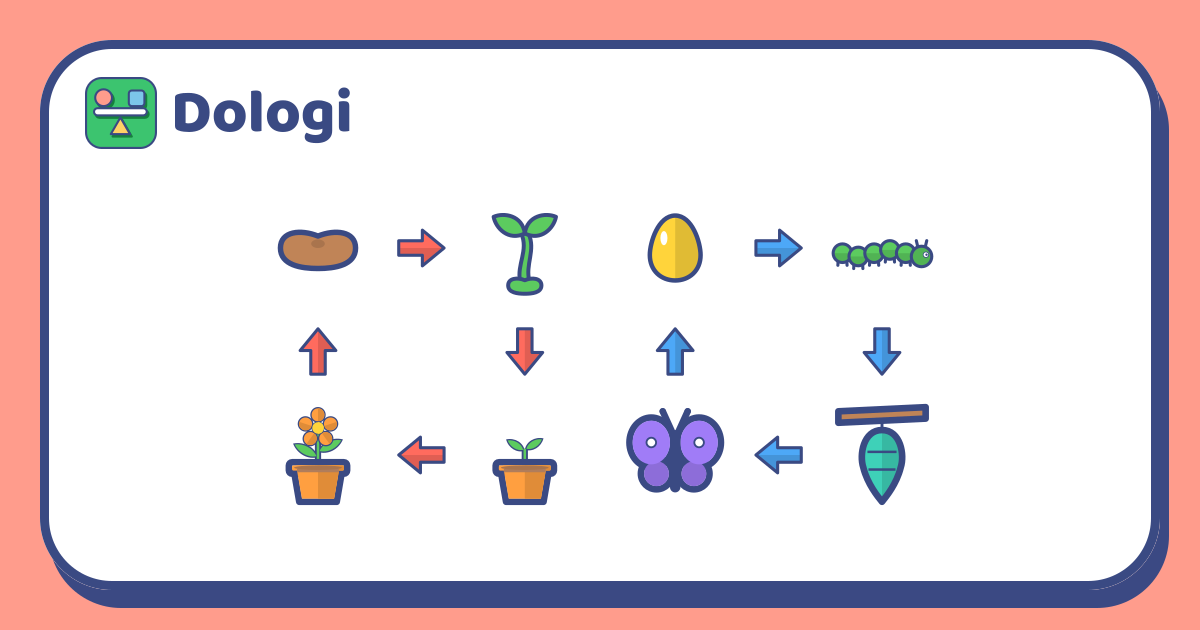
Children love to watch things change: a bean splits and sends out a root, a caterpillar on a leaf gets fatter every day, a tadpole grows legs. Behind all of these is one big idea that young scientists can grasp from around 4 or 5: living things go through stages, and the last stage starts the circle again. That circle is called a life cycle.
This post explains life cycles in simple words, then gives you four things to do at home: grow a plant from seed to new seeds, find the cycle in your kitchen, watch animals where they live, and turn what your child sees into a life cycle wheel and a card game.
What a life cycle is, in simple words
A life cycle is the set of stages a living thing goes through: it starts small, grows, becomes an adult, and makes new seeds, eggs or babies. Those start the same stages again. That is why we draw it as a circle and not as a line.
| Living thing | Stages |
|---|---|
| Bean plant | seed → sprout → young plant → flowers → pods with new seeds |
| Butterfly | egg → caterpillar → chrysalis → butterfly |
| Frog | egg → tadpole → tadpole with legs → frog |
| Chicken | egg → chick → hen or rooster |
| People | baby → child → teenager → adult |
Older children can spot a difference: a butterfly and a frog change shape completely between stages, while a chick and a baby mostly get bigger. Ask: "Which ones look like their parents when they are born? Which ones don't?"
Grow a whole cycle on the windowsill
A bean is a good choice because it grows fast and you can see every stage. Growing a seed in a jar to watch the root and shoot is a project in itself (see the link at the end); here, the aim is to go all the way round the circle.
- Plant. Soak a few dried beans overnight, then plant them in a pot of soil, about a finger deep. Keep the soil damp and the pot in a bright spot.
- Watch. Once a week, your child draws the plant or you take a photo from the same place. Stick the pictures in a row.
- Flowers. After some weeks, small flowers appear. Ask what they might be for.
- Pods. Each flower can turn into a pod. Leave a few pods on the plant until they dry and turn brown.
- Close the circle. Open a dry pod together: inside are new beans, just like the one you started with. Plant one, and the cycle starts again.
How long this takes depends on the plant, the light and the season, so treat it as a project for a few months, not a few days. If the plant doesn't make pods, the photos still show most of the circle.
Find the cycle in your kitchen
You don't have to wait months to see the "new seeds" stage. Many foods are the part of the plant that holds seeds:
- Cut a tomato, a pepper, a cucumber or an apple in half and look for the seeds.
- Open a pea pod or a green bean and count the seeds in a row.
- Compare: which fruit has one big seed, which has many small ones?
Then ask the question that closes the circle: "If we planted this seed, what would grow?" Your child can try with an apple seed or a few dried lentils on damp cotton, and see which ones sprout.
Watch animal life cycles where they live
For animals, the best way to learn is usually to watch, not to collect. Wild eggs, tadpoles and caterpillars belong where they are, and their stages need the right plants, water and temperature.
- In the garden or park: look under leaves for caterpillars and eggs, check a pond in spring for tadpoles, and come back to the same spot every week or two.
- Birds in spring: if a bird builds a nest nearby, watch from far away for eggs, chicks and young birds learning to fly, without going close.
- On a farm visit: see eggs, chicks and grown hens in one place.
- In books and nature films: good for stages you can't see at home, like a chrysalis opening.
After touching soil, plants or animals, everyone washes their hands. A small notebook with a date and a drawing for each visit turns a walk into a real observation.
Draw a life cycle wheel and play the card game
The wheel. Divide a paper plate into four parts. In each part your child draws one stage, going clockwise, with an arrow from each stage to the next and from the last back to the first. Pin a paper arrow in the middle with a split pin so it can turn. Ask: "Where does it start?" On a circle, any stage can be the start; many children are surprised by that.
The card game. Draw each stage on a small card and shuffle them.
| Age (roughly) | Game |
|---|---|
| 4–5 | Three cards of one living thing: put them in order, then say what happened |
| 6–7 | Four or five cards; then mix two cycles and sort them into two circles |
| 8–10 | Add what each stage needs (water, light, leaves to eat) and compare which cycles change shape completely |
You can also take one card out and ask which stage is missing, or lay out three cards and ask what comes next.
In Dologi, the "What happened first?" puzzles in the Logic topic show a plant in a pot at different stages and ask which picture comes next: the same thinking as putting life cycle cards in order.
In short
- A life cycle is a set of stages that ends where it began: new seeds, eggs or babies start the circle again.
- Growing beans from seed to dry pods lets your child see the whole circle on the windowsill; kitchen fruits show the seed stage in minutes.
- Watch animals where they live and come back to the same place; leave eggs, tadpoles and caterpillars where you found them.
- A paper-plate wheel and a few picture cards turn what your child saw into ordering and reasoning practice.
Read more: Growing a bean: observing and recording like a scientist