Children notice shadows long before they can explain them. A shadow follows them down the street, gets longer in the evening, and disappears under a cloud. "Why?" is a very good question to answer with experiments rather than words.
This article gives you a set of light and shadow experiments for children aged about 4 to 11. You only need a torch, a few things from around the house, and later a stick and some sunshine. The habit throughout is the same as in any good experiment: predict first, then try, then explain what happened.
What you need
- A torch, or a phone light. A small desk lamp works too.
- A dim room with a table or a clear patch of floor. Total darkness isn't needed.
- A few objects: a wooden or plastic block, a toy figure, a glass of water, a clear plastic bottle, a sheet of baking paper, a piece of cardboard, a spoon.
- Tape or a pencil and paper to mark where shadows end.
One rule before the light goes on: the torch points at the objects, never at anyone's eyes.
Long shadow, short shadow
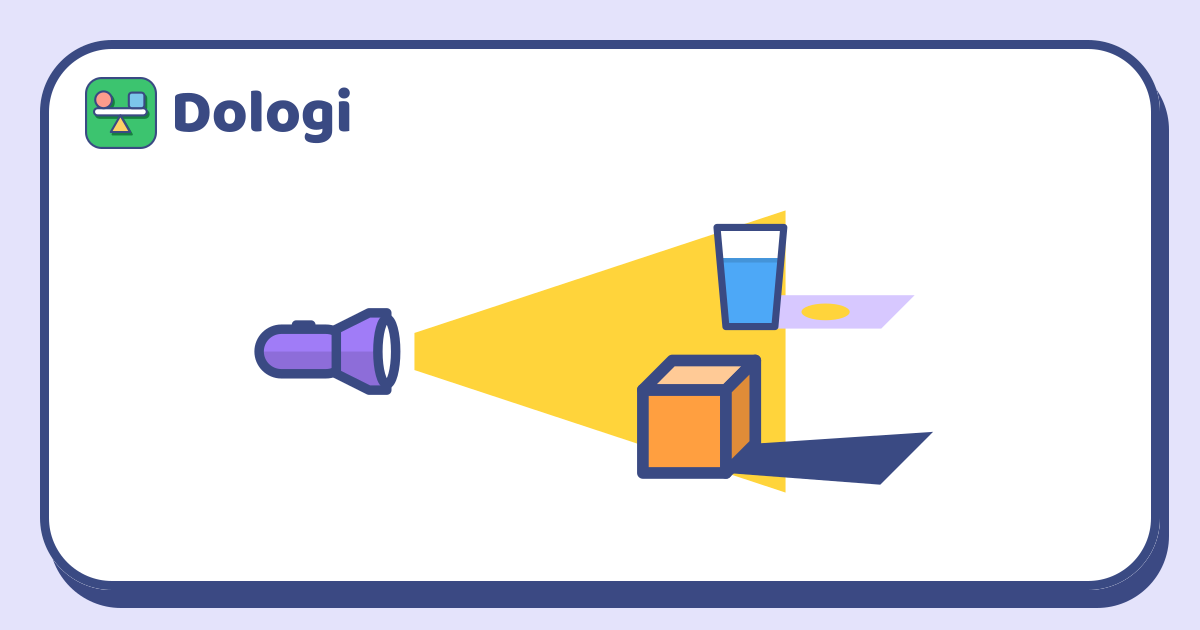
Stand a block on the floor and lay the torch on the floor a little way off, pointing at it. Look at the shadow behind the block. Now ask your child to predict: "If I lift the torch up high, will the shadow get longer or shorter?"
Then move the light slowly and watch together.
| Where the torch is | What the shadow does |
|---|---|
| Low, almost on the floor | Long, stretching far behind the block |
| Halfway up | Shorter |
| High, almost above the block | Very short, gathered around the bottom of the block |
| Moved to the left | The shadow swings to the right |
Two ideas come out of this. The shadow is always on the side away from the light. And the lower the light, the longer the shadow. Mark the end of each shadow with a piece of tape, then ask your child to put the torch where the shadow will reach a mark you choose. Working backwards like this is harder, and it shows whether the idea has really clicked.
A shadow is simply the place the light cannot reach because something is in the way. Ask: "Where would you hide from the torch so it can't see you?" Children often find this explanation themselves.
Which things let light through?
Gather six to eight objects and make three piles together before testing anything:
- Light goes through: you can see clearly through it. A glass of water, a clear bottle, a plastic bag.
- Some light goes through: light passes, but things look blurry. Baking paper, tissue paper, a thin sheet of fabric.
- No light goes through: a block, cardboard, a book, a spoon.
Then shine the torch on each object in turn and look at its shadow. Dark shadow, pale shadow or almost none? Move an object to another pile if the shadow surprises you.
The glass of water is often the favourite. Its shadow is pale, and inside it there is usually a bright spot or line, because the water gathers some of the light together. Ask your child why the glass leaves any shadow at all if you can see through it. The answer is that even clear things stop a little of the light.
A good follow-up question: "Which would you use for a curtain that lets the room stay bright but stops people seeing in?" The middle pile suddenly has a job.
A shadow show on the wall
Once your child knows how shadows behave, let them put on a show. Cut simple shapes from cardboard, tape them to sticks, and play them in the torch light against a bare wall or a sheet.
Challenges that use what they just learned:
- Make a giant: move the figure towards the torch and the shadow grows. Move it to the wall and it shrinks.
- Add colour: tape a piece of coloured see-through plastic or tissue paper over a hole cut in a figure. The light that comes through is coloured.
- Hands as puppets: a rabbit with two fingers for ears is always a hit.
A sundial in the garden
On a sunny day, the experiment moves outside, and the sun becomes the torch.
- Push a straight stick into the ground, or stand a pencil upright in a lump of clay on a sheet of paper on a sunny windowsill.
- In the morning, mark the end of the shadow with a pebble or a chalk line.
- Come back every hour or so and add a mark. Write the time on the paper, or say it aloud and let your child remember where each pebble goes.
- Before each visit, ask: "Where will the shadow be this time? Longer or shorter?"
By the afternoon you will have a fan of marks. The shadow moves as the sun moves across the sky, and it is shortest around the middle of the day, when the sun is highest. That is the same idea as the torch held high above the block. The next day, at a time you marked, check whether the shadow lands on the same pebble. If it does, your child has built a clock out of a stick.
Remind everyone to look at the shadow, not at the sun. Never look straight at the sun.
Dologi's Space topic has Light beam and Turn the mirrors puzzles: children follow the light from a torch, see where mirrors send it and which things block it. It is the same reasoning about where light can and can't go, practised in small steps.
In short
- A torch, a block and a dim room are enough to discover that shadows fall away from the light and grow longer when the light is low.
- Sort objects by how much light passes through them, then test each pile with the torch.
- A shadow show on the wall turns the rules into a game: move closer to make a giant.
- A stick in the sun becomes a sundial: mark the shadow every hour, predict the next mark, and never look at the sun itself.
Read more: Hand shadow puppets with a torch: make an animal, guess it, tell a story