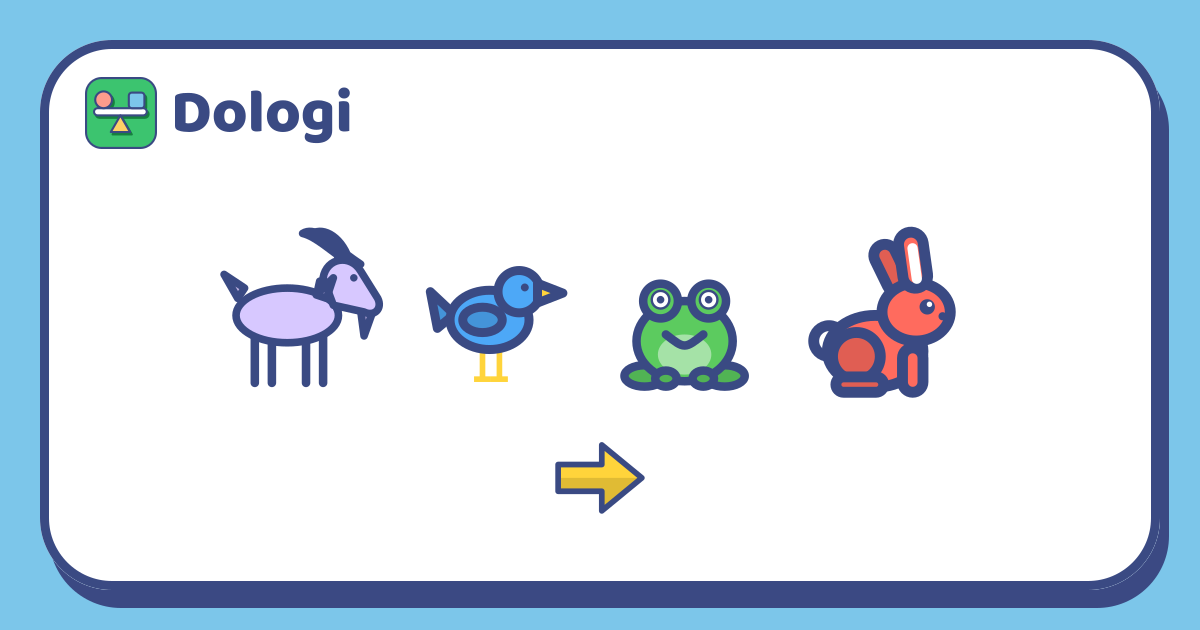
"The frog is at the front. The rabbit is at the back. The bird is right behind the frog. Where does the cat go?" Line-up puzzles give children a few clues about who stands where, and ask them to work out the whole line.
They need no special materials, they can be made easy or hard in seconds, and they practise some of the most useful reasoning skills: understanding position words, combining several pieces of information and checking an answer against every clue.
Play with toys first
Line up three or four soft toys or figures in a row on the table. Decide which end is the front of the line, and put something there, like a book as a "door" the line is walking towards.
Then give your child the clues one at a time and let them arrange the toys:
- "The frog is at the front."
- "The rabbit is at the back."
- "The bird is right behind the frog."
Ask: "So where does the cat go?" Once the toys are in place, read each clue again and let your child point to show that it's true.
Moving real toys is important. Children can try an arrangement, see that it breaks a clue, and fix it, without having to hold everything in their head.
Position words to practise
Many difficulties in line-up puzzles are really about words. Check that your child understands these before making the puzzles harder:
| Word | What it means in the line |
|---|---|
| at the front / first | The one nearest the door |
| at the back / last | The one furthest from the door |
| in front of | Somewhere closer to the door, not necessarily right next to |
| right in front of / just in front of | Next to, on the door side |
| behind | Somewhere further from the door |
| between | With one on each side |
| next to | Right beside, on either side |
The difference between "in front of" and "right in front of" is a common stumbling block. Act it out with the toys: "The bird is in front of the rabbit. Could there be someone between them?"
Which clue to start with?
When there are several clues, children often take them in the order they're given. A smarter strategy is to start with the clue that fixes a position for sure:
- "First" and "last" clues place a toy exactly. Start with those.
- "Right behind" or "right in front of" clues link two toys together like a pair. Place the pair next.
- "Somewhere in front of" clues are the loosest. Use them last, to choose between the spaces left.
Ask your child after a puzzle: "Which clue helped you most? Which one did you use first?" Over time they'll start choosing the strongest clue on their own.
Check every clue at the end
A common mistake is to finish the line and stop. Make checking a habit:
- Read each clue aloud and point to the toys.
- Tick the clue on paper if it's true.
- If one clue is false, ask: "Which toy do we need to move? Does moving it break another clue?"
This "check every clue" step is exactly what good problem solvers do. It also catches misunderstandings about words like "between".
One answer, or more than one?
Sometimes the clues aren't enough. Try this with four toys:
- "The cat is at the front."
- "The rabbit is behind the frog."
Your child might find cat, frog, rabbit, bird, and then cat, bird, frog, rabbit, and more. Both follow the clues. Ask: "Is there only one way? What extra clue would make there be just one answer?"
Thinking about whether a puzzle has one answer, several answers or none at all is a big step in logical thinking, often suitable from around age 8, though every child is different.
Make it harder or easier
- Ages 4–5: three toys, one or two clues, using only "first", "last" and "next to".
- Ages 6–7: four toys, three or four clues, adding "in front of", "behind" and "between".
- Ages 8 and up: five toys, clues with "not" ("The bird is not at the back"), and puzzles where your child invents the clues for you.
When your child writes a puzzle, they have to make sure it has exactly one answer. That's surprisingly hard, and excellent practice.
In Dologi, "Who lives here?" puzzles use the same kind of thinking with a row of houses: a few clue cards say who lives where, and children work out who lives in the house marked with a question mark.
In short
- Use toys in a row and a clear "front" so children can try arrangements and fix them.
- Practise position words, especially "in front of" versus "right in front of".
- Start with the clues that fix a position, then pairs, then the loosest clues.
- Check every clue at the end, and ask whether there's only one possible answer.